The National Archives goes to the movies

The National Archives

The National Archives is the UK government’s official archive – not to be confused with the National Archives and Records Administration in the USA. In 2003 the UK’s Public Record Office merged with the Historic Manuscripts Commission to become The National Archives (known to its friends as TNA), which pointed to a broader, more inclusive remit, but some still hanker for the reassuring days of the PRO. The location has remained the same – an imposing modernist building in Kew, to the west of London, with ponds and swans in its grounds, and hordes of historians and amateur genealogists within. It holds government and public records from the Domesday Book onwards, which are released to the public generally after thirty years have elapsed from their original production.

All of which is preamble to the news that TNA has produced a podcast entitled The National Archives Goes to the Movies, and it’s rather good. Written and presented by Joseph Pugh, the podcast is a knowledgeable guide to the history of British cinema through the records of The National Archives. Recorded before an audience, around half of the hour-long talk is about the silent period. Among the subjects he covers are Will Barker’s 1911 film of Shakespeare’s Henry VIII, all copies of which were burned in a publicity stunt; the efforts of the Colonial Office to ban The Birth of a Nation; concern within the Home Office at how Cecil B. De Mille’s The Cheat could offend the Japanese; the production of Maurice Elvey’s ill-fated epic The Life Story of David Lloyd George (1918); the British government-sponsored dramas Hearts of the World (1918) and The Invasion of Britain (1918); Home Office efforts to ban Graham Cutts’ sensationalist Cocaine (1922); and Marie Stopes’ correspondence with the Home Office over her birth control film Married Love (aka Maisie’s Marriage) (1923).

The point of the talk is not only to entertain but to encourage research. Consequently most of the films that Pugh refers to are also listed on Your Archives, TNA’s wiki where researchers can post information on files that they have found. I’m not sure how much the wiki gets used, because researchers tend to be a little wary of giving away all their sources, but the principle is noble.
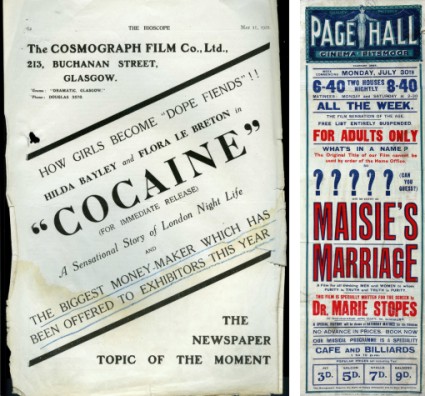
A trade paper advertisement for Cocaine and a poster for Maisie’s Marriage, taken from The National Archives’ Flickr site, original file references HO 45/11599 and HO 45/11382

The sort of records one find in The National Archives are those which document the day-to-day processes of government departments. There are memos, memos responding to memos, and memos responding to memos responding to memos. There are letters, minutes, briefing papers, personal papers, official papers, diaries, reports, lists, registers, passenger lists, medal rolls, photographs, maps and posters. The contents are generally arranged chronologically, identified by government department and then gathered together by theme into individual numbered folders.

The National Archives can be a daunting place for any newbie researcher. There is no single index, and although they produce an amazing rich online catalogue (helpfully named the Catalogue) they also have to produce a multitude of specialist guides that explain how to pursue particular topics. One of these research guides covers The Arts, Broadcasting and Film, and it’s a very good starting point. As said, The National Archives arranges its records by department, so it is important to know that responsibility for film was held by the Board of Trade’s Industries and Manufactures Department (formed 1918), but information on film is spread widely across particularly all departments. To produce a complete guide to TNA records to silent film would require a blog (or a wiki) all of its own, but here’s an outline guide to some of the key departments to explore. Please note that catalogue references will simply take you to the barest of descriptions online, and to view the documents themselves you will have to visit Kew.

  • AIR (Air Ministry, Royal Air Force etc)
    Records of aerial photography and cinematography during World War One are held in AIR 2 (search under ‘cinematography’).
  • BT (Board of Trade)
    Records of registered companies (since dissolved), including hundreds of film businesses (producers, distributors, cinemas etc), with information on capital and shareholders, are in BT 31; records of liquidated companies 1890-1932 are in BT 34; trade marks (BT 42-53) includes film company trademarks, though there is no overall index so you need to search on-site by date (see the TNA guide on registered designs and trade marks); BT 226 has bankruptcy records for companies and individuals. BT 26 and BT 27 contains lists of ship passengers who arrived in (1878-1960) or left (1890-1960) the UK. The incoming lists themselves can be viewed online (payment required) at Ancestry, and the outgoing list (again payment required) at Ancestors on Board.
  • CAB (Cabinet)
    Papers from the very heart of government. Nicholas Reeves’ Official British Film Propaganda During the First World War has a handy guide to PRO/TNA papers relating to official film, including Cabinet papers in CAB 21, 23-25, 27, 37 and 41.
  • CO (Colonial Office etc)
    Many records relating to the production, distribution and exhibition of films in British colonies and countries of the empire, including records of the Empire Marketing Board (for which John Grierson worked) in CO 758 (correspondence), CO 759 (index cards), CO 760 (minutes, papers) and CO 956 (posters).
  • COPY (Copyright Office, Stationers’ Company)
    Before the 1911 Copyright Act if a UK film producer wanted to copyright a film (usually they did so only if there had been a case of their work being copied) then they had to do so as it if was a photograph; consequently there are numerous records of films 1897-1912 registered under COPY 1. The registration forms were accompanied by single frames, bromide prints, or in a few cases a few frames of film (the originals are now held by the BFI). For a guide to this collection, which comprises a few hundred titles among the many thousands of photographs, see Richard Brown’s essay in Simon Popple and Colin Harding’s In the Kingdom of Shadows. There are also registers and indexes under COPY 3. Some film posters and other promotional material can also be found in the COPY records.
  • ED (Department of Education and Science)
    Disparate documents on film and education, a theme of growing interest throughout the 1920s, including assorted commissions of enquiry.
  • FO (Foreign Office)
    The Foreign Office was concerned with promoting British foreign policy. There are extensive records relating to British propaganda films being shown overseas during World War One, in particular FO 115 on propaganda in the USA and Canada, FO 371 covering general correspondence, and FO 395 which covers war films and American propaganda 1916-17. There is a card index to the FO papers in TNA’s search rooms, making this a particularly fruitful area to explore.
  • HO (Home Office)
    The Home Office oversaw domestic policy. There are extensive records on actual legislation (starting with the 1909 Cinematograph Act) and proposed regulation affecting the British film business, including such issues as censorship, local authority control, unlicensed film exhibitions and the filming of contentious events (political marches etc) are in HO 45. See also HO 158 for relevant general papers and correspondence.
  • INF (Ministry of Information etc)
    A particularly valuable source, with records of the War Propaganda Bureau, the War Office Cinematograph Committee, the Department of Information and the Ministry of Information, all of which were concerned with film production during the First World War (further official papers on war film production are held by the Imperial War Museum). The main section to follow is INF 4. Of particular interest is one chapter from the unpublished memoir by J. Brooke Wilkinson, leading film industry representative and first head of the British Board of Film Censors, at INF 4/2
  • J (Supreme Court of Judicature)
    Covers records of court cases (Chancery), often a rich source of information on how a film company operated. See in particular the winding up orders under J 13.
  • LAB (departments responsible for labour and employment matters and related bodies)
    Includes documents on film industry employees and industrial relations (though relatively little here for the silent era).
  • MEPO (Metropolitan Police)
    The Metropolitan Police conducted surveys of early London cinemas around 1908-09 after they were causing some social concern. The result is a rich record of the early cinema business and audiences, to be found in MEPO 2. They are described in detail in Jon Burrows’ two essays ‘Penny Pleasures: Film exhibition in London during the Nickelodeon era, 1906-1914,’ Film History vol. 16 no. 1 (2004) and ‘Penny Pleasures II: Indecency, anarchy and junk film in London’s “Nickelodeons”, 1906-1914,’ Film History vol. 16 no. 2 (2004), while the London Project database lists the venues covered by files MEPO 2/9172 file 590446/7 and MEPO 2/9172, file 590446 (see also HO 45/10376/16142). There are later surveys of cinemas and screenings of indecent films in the 1920s.
  • RG (General Register Office)
    Has census returns from 1861 onwards (1841-1851 are under HO 107). These can all be found online through various commercial services (see details here), but all are available for free at Kew – see the helpful TNA guide to researching census records.
  • WO (War Office)
    There is relatively little that specifically relates to film here, as most papers relating to the War Office Cinematographic Committee will be found at the Imperial War Museum and the House of Lords Record Office (Beaverbrook Papers). But surviving records of film personnel who served during the War (including Official cameramen) can be found at WO 338 (officers’ service records), WO 363 (service records), WO 364 (pension records) and WO 372 (medal cards). Digitised copies of the actual documents in all four categories can be found online through TNA’s Documents Online or Ancestry (in both cases payment is required for downloads).
  • Other records where information on silent era films can be found include ADM (Admiralty), CUST (Customs and Excise), IR (Inland Revenue), and T (Treasury).

This is a very simplistic overview, and it must be stressed that information on films will be found all over the place. For example, type in the term ‘cinematograph’ in the catalogue and you will get 1,108 records from forty-four separate departments (448 records from twenty-five departments if you narrow the date search to 1896-1930). It is a good idea to look at the bibliographies of books and the end notes of journal articles which have benefited from research at TNA (or PRO before it) to pick up specific references and useful indications of where it would be profitable to search.

The National Archives has produced some substantial publications which explore a subject in depth with copious file references. However, there is no such guide for film (one has been talked about for years but has never been forthcoming). However, there is a classic article by Nicholas Pronay, ‘The “Moving Picture” and Historical Research’, Journal of Contemporary History vol. 18 (1983) (available to higher education users on JSTOR) which describes in details the several kinds of government records which can be used for the study of film, describing why they were created, and giving specific file names. Note also that the above file information relates only to silent films – there is a huge amount of information at The National Archives relating to film (and television) from later periods, particularly govering the GPO Film Unit, film during World War II, the COI Film Unit, the Colonial Film Unit, broadcasting policy, British Council records, and much more besides.

The National Archives is still an underused resource for film history, though we have got beyond the days when Rachael Low could write a multi-volume history of British film apparently without any reference to the Public Record Office. If you’ve not been, and you can get there, then you really should – it’s the most engrossing and rewarding research experience imaginable. Go explore.

By the way, films can be public records too, but the productions of the Ministry of Information, the COI Film Unit and others are preserved on TNA’s behalf by the BFI National Archive and the Imperial War Museum.

My thanks to Brad Scott for alerting me to the podcast.

Defining Muybridge

http://www.eadweardmuybridge.co.uk

As was pointed out here recently, this is turning out to be the year of Eadweard Muybridge. The sequence photographer whose work laid paths both technological and intellectual towards motion pictures isn’t enjoying a centenary of any sort, but nevertheless we have a major exhibition now running Washington until July, moving to Tate Britain in London in September, and San Francisco in February 2011; a new critical biography by Marta Braun to be published in September; other events, exhibitions and symposia (there was a one-day event at the BFI South Bankon May 21st); and now a new website: Eadweard Muybridge: Defining Modernities.

The website has been produced in collaboration by Kingston University and Kingston Museum in the UK, Kingston being Muybridge’s home town. It sets out “to provide a definitive research resource surrounding the work of 19th Century photographer Eadweard Muybridge”, and it has gone about its task in a particularly handsome way. The site is divided into four main sections: Collection Map & Database; Muybridge: Image & Context; Comparative Timelines; and Bibliography.

The Collections Map & Database lists “all known physical collections of Muybridge’s work housed in cultural organisations around the world; as well as selected collections of rare books published by Muybridge during his lifetime”. The search form on the front page suggests that the research will be able to locate individual items in these collections through a single database, but in fact you are pointed to a more basic collection guide with indication of number of Muybridge-related items held. You can refine your research by country and category, and see the collections arranged on a world map.

‘Boy. Child without legs. Getting off chair’, from http://www.eadweardmuybridge.co.uk

Muybridge: Image & Context is a set of useful short essays on key aspects of Muybridge’s work, beautifully illustrated with slide shows (Muybridge remains an absolute gift to any designer). Themes include The Modern City, Landscape, Foreign Bodies, and The Human Figure in Motion.

Comparative Timelines is a browsable timeline of the Muybridge era, 1800-1907 (he lived 1830-1904). It allows you to trace events in his personal life, film history, invention, photography, US history and world history side-by-side. Finally there is a bibliography, with a surprisingly brief supplementary list of web links.

Eadweard Muybridge: Defining Modernities is a pleasure to look at and easy to navigate. It has ambitions to become the definitive resource for Muybridge online, and hopefully it will indeed build on these good foundations, though it has a little way to go before it can match Stephen Herbert’s solo production The Compleat Muybridge (oddly not included among the site’s links) for its range and comprehensiveness.

And there’s more. Also just launched is Muybridge in Kingston, a site which usefully brings together Muybridge collections, events and projects located in Kingston, which certainly is doing its native son proud. Next, the always excellent Luminous Lint photography website has an online exhibition entitled Scientific Movement. Created by Alan Griffiths, the exhibition traces the history of the efforts by scientists to capture movement through photography, covering Muybridge, his great French contemporary E.J. Marey, and others whose less familiar work continued well into the twentieth-century: Ottomar Anschütz (1846-1907), Arthur Clive Banfield (1875-1965), Prof. A.M. Worthington, Ernst Mach, the Bragaglia brothers in Italy, Frank B. and Lillian Gilbreth and Harold E. Edgerton (1903-1990).

Finally, as a taster for what we in the UK can expect in September, here’s short promo for the Washington exhibition, Helios: Eadweard Muybridge in a Time of Change:

Researching Ireland

Irish Film & TV Research Online is a monument to the passion for national film history. It is a website that serves as a focal point for Irish and Irish-themed film and television of all kinds. It is hosted by Trinity College Dublin, and it is mainly comprised of three searchable databases, each of which has extensive content relevant to the study of silent film (and beyond, of course).

Irish Film & Television Index
The Index documents “all Irish-made cinema and major television productions as well as Irish-themed audio-visual representations produced outside of Ireland.” It’s a bold claim, but it would be a challenge to prove them wrong, as its coverage is extensive – nearly 40,000 titles – and it includes important areas that other national filmographies often ignore, such as newsreels, interest films (and indeed silents). It based on the book publication by Kevin Rockett, The Irish Filmography: Fiction Films 1896-1996 (1996), with additional material chiefly researched by Eugene Finn. The database includes films of uncertainty identity which exist in film archives, as well as films which are now lost. As noted it includes bot Irish production and Irish-themed productions – so the researcher will find plenty of American films included because of their Irish themes and characters. However it doesn’t document the films of Irish filmmakers who operated out of Ireland if their films did not have Irish themes (so Rex Ingram is represented in the Biographies section but not in the Film Index).

There are simple and advance search options, the latter enabling you to refine searches by country, genre, reference, location, years, songs, or date – including date range, so it is possible to isolate films from the silent period (just under 1,000 titles, fiction and non-fiction), though seemingly no way of arranging by date order, which prevents the researcher from getting an idea of chronology and change (unless you seach year-by-year, which is laborious). The records themselves are often extensive, as this record for Kalem’s The Lad from Old Ireland demonstrates:

Title LAD FROM OLD IRELAND, THE
Production company Kalem Co
Country of origin USA
Producer OLCOTT, Sidney
Director OLCOTT, Sidney
Script/Adaptation GAUNTIER, Gene
Photography HOLLISTER, George
Cast Sidney Olcott (Terry O’Connor), Gene Gauntier (Aileen), Arthur Donaldson (priest), J P McGowan, Robert Vignola (men in campaign office on election night), Thomas O’Connor (Murphy, a landlord), Jane Wolfe (Elsie Myron, an American heiress), Laurene Santley, Agnes Mapes.
Colour b&w
Sound sil
Footage 8241009 [it’s not explained what this means]
Release date 1910
Copy IFA, NFTVA, IFA (VHS)
Summary In the rural Ireland location of Rathpacon, County Cork, Terry is working in the fields. Determined to improve his poverty-stricken existence, he decides to emigrate to America. He bids a sad farewell to Aileen, his sweetheart, who is left in the care of her mother, but he promises to return to her. Arriving in New York, Terry works on a building site and eventually rises to become the Tammany Hall mayor of the city. Forgetting about Aileen, he is seen in the company of an American heiress on the night of his electoral victory. However, he finds a letter from Aileen informing him of her family’s desperate economic plight and declaring that they are in danger of being evicted from their home. Returning home, Terry is seen on a ship in mid-ocean conjuring up an image of Aileen. When he arrives at Aileen’s cottage the eviction is in progress. He enters the cottage and confronts the landlord. He thrusts the rent arrears into his hand and sends him out of the house. The following Sunday the banns are read by the priest announcing the forthcoming marriage of Terry and Aileen. (V).
Note USA Rel 23/11/1910; re-issued 1/8/1914. GB distr: Markt & Co. Filmed in Ireland and USA. Farnham, whose names are sometimes given as ‘Al(l)an’ or ‘Farnum’, did not participate in the production of scenes taken in Ireland, as Herbert Reynolds points out, but would likely have been responsible for the New York studio interiors. Unpublished cast members Donaldson, McGowan and Vignola have been identified by Reynolds in the extant film. THE LAD FROM OLD IRELAND is regarded by some as the first American-produced fiction film made outside the USA (Sight and Sound, Oct-Nov 1953:96), though this may have been confused with what is contemporaneously described as ‘the first production ever made on two Continents’ (Bio 12/1/1911:47). It may also be the first fiction film made in Ireland, but see note with A DAUGHTER OF ERIN (USA 1908). The available print, with intertitles in German, ends with the penultimate scene, at the cottage.
Reference Bio 12/1/1911:47; Bio 6/4/1912:v; Bio 21/8/1913:21; Kalem Kalender 1/8/1914:2 (reissue); MPN 10/12/1910:9; MPN 17/12/1910:19; MPN 21/10/1916, Sec 2:109-10; MPW 26/11/1910:1246, 1249; MPW 3/12/1910:1296,1343; MPW 17/12/1910:1405; MPW 1/8/1914:732; NYDM 2/11/1910:29; Var 3/12/1910. AFI Cat 1893-1910:574; Bowser, 1990:153-5; Rockett et al, 1987:7-8.

All reference materials cited below are held at the Tiernan McBride Library of the Irish Film Institute.

Old file record giving film stock details, plot summary, review and subjects references for film (D.C. Swift)

The Bioscope, 12/1/1911:2, plot-synopsis of the film.

Sight and Sound, Dec. 1953:96-8, ‘Ireland’s first films’, article on Sidney Olcott’s contribution to early Irish films (Proionsias O Conluain).

‘Kalem’s Great Trans-Atlantic drama…’, copy of advertisement for the film.
Format 35mm
Distributor Markt & Co
Language English
Production credits p.c/distr: Kalem Co, p/d: Sidney Olcott, c: George Hollister, sc: Gene Gauntier, scenic dsgn: Henry Alien Farnham.
Location Cork, USA
Genre/Category Short Film Drama, Historical Drama
Keywords Migration, Labourers, Politics, Rural Ireland, Evictions, Landlords, Tenants, Priests

However there is no hyperlinking for these results e.g. you can’t click on ‘Kalem’ in this record and go to other films produced by the American company, which is a shame. This is a fine resource for the extensive information it contains, but it is fundamentally a book catalogue with some search functions rather than something fully re-imagined as an electronic database.

Irish Film & Television Biographies
Described as a work in progress, the Biographies database documents conributors to the history of both cinema and television in Ireland and those who have worked on Irish-theme films made outside the country. It is a work in progress, and unfortunately it doesn’t seem to cover anyone from the silent period of film production (e.g. Sidney Olcott, Norman Whitten, John McDonagh).

Irish Film & Television Bibliography
Another work in progress, ths Bibliography lists books, articles in journals, chapters in collections, and selections from specialist magazines. As well as being able to search across the whole database, you can browse by title or author.

The site also contains details of an annual Irish Postgraduate Film Research Seminar and a links page. Irish Film & TV Research Online has been overseen by Professor Kevin Rockett, a noted historian of Irish cinema. He describes the website as a living archive, and additional information and amendments are welcomed. No database should ever be static, but the price of relevance is eternal vigilance, as records have to be maintained and resources hosted. Hopefully Trinity College will continue to support it and researchers as dedicated as Rockett and Finn will always recognise the importance of sustaining it.

Giornate database

Pordenone catalogues

In 2002 the Giornate del Cinema Muto (aka Pordenone Silent Film Festival) produced a CD-ROM that listed and described every film shown at the festival 1982-2001. The CD-ROM is now out of print, but what was really wanted was an online version which could be updated year by year. And now we have it.

The Giornate database lists every one of the 6,330 films featured at the festival 1982-2008. You can search by year, title, director, year of release, production company, country and archive. It is a little disappointing that no searching is offered by cast member or other credits, still more that there is no searching of descriptions or a free-text search generally. Hopefully such functionality can be introduced later (such search options are available on the CD-ROM version), but as it is the database is still a very useful and welcome resource.

The database lists every film shown at the festival since 1982, with additional entries for films which have been shown more then once (i.e. in later years). The information available varies, with no synopses for earlier years, though that’s because such data was not included in the festival catalogue/booklet. More recent records are richer in detail as the catalogue has become an ever more handsome production, with background information in both English and Italian. What every record does provide is title, any alternative titles, year of production, year in which it was shown at the festival, the production company, director (where known), format (i.e. 35m, 16mm etc), the film speed at which it was shown, its duration, and the archive which supplied the copy. You even get the name of the musician who played to the film.

Such core data yields all sorts of information. For instance, the festival has shown 473 films directed by D.W. Griffith, 104 films made in 1905, 71 films made by the Cines company, 374 films made in Germany, and 505 films from the Nederlands Filmmuseum. One can find out so much – not just about the contents of films shown at the festival, but their provenance and location. Moreover, it is information that was rigorously researched in the first place for the Pordenone catalogue, and which can be relied upon. Also, there are records here for films from across the world of silent cinema which the researcher will simply not be able to find anywhere else. It is a treasure trove.

That said, it could be even better. The potential for searching by credits or across synopses has been mentioned. However, it might be that the festival could open up this resource still further to our research community, with a bit of Web 2.0 functionality. For instance, where there are gaps in the data for earlier years (if this is the case – it’s not clear is the database represents all the published information in the festival catalogues from 1982), volunteers might be willing to type in the missing text or credits. Contributing archives could add updated information on prints that they provide, likewise the scholars who contributed information to the catalogue could add updated information – in both cases not altering the original catalogue record, but putting data into a separate notes field. Anyone might contribute comments on films that they have seen – obviously with some form of moderation. Databases are such powerful tools – we mustn’t just see them as searchale lists, but instead must make full use of them as structured and updatable data.

But even as it is the Giornate database is a fabulous resource, and one that hopefully will be updated year-on-year from now on. Grateful thanks and congratulations are due to the Giornate del Cinema Muto for making the database available to all. Go explore.

Scotland’s cinemas

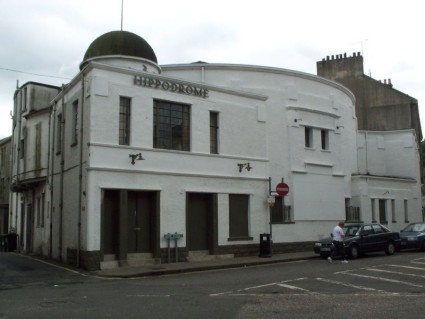
The Hippodrome, Hope Street, Bo’ness, Scotland, which opened in 1912, is now a listed building, and re-opened as a cinema in 2009, from http://www.scottishcinemas.org.uk

The Scottish Cinemas and Theatres Project is a website dedicated to recording and archiving the historic cinema architectural heritage of Scotland. It also acts as a information resource on Scottish cinemas as a subject for social history. Supported by a network of volunteers, the website aims to provide a photographic and historical record of all surviving cinema buildings in Scotland, including those whose purpose and appearance have changed from when they were first cinemas.

This is a fine resource which shows the power of networking in building up a valuable resource collectively. It has a great deal to interest the silent film researcher, as many of the cinemas and former cinemas that it documents have histories that stretch back to our era. Unfortunately there’s no searching by year or time period, so you’ll just have to browse.

At the heart of the website is the Scottish Cinema Database. This contains details of over 1,130 cinemas from over 240 different places, well over half of which are illustrated by photographs (often of the building as it is now rather than in its heyday). As indicated, the database option itself is a little limited in that there is no browse option – one simply enters a keyword for searching across name, address, town, architect etc., with results refinable by all cinemas, surviving cinemas, demolished cinemas or open cinemas. This is fine if you know what you are looking for, but for most the A-Z option will be more helpful, while the website puts a special focus on the cinemas of Glasgow, Edinburgh, Aberdeen and Dundee. The information supplied varies widely, from a one-line description, to detailed, authoritative and well-illustrated accounts, including many historical images from the collection of the Scottish Screen Archive. Collectively the accounts document not only the rise and fall and sometimes rise again of the cinema as a place of entertainment, but the mutability of such urban spaces, as they move in social purpose from places of screen entertainment to become restaurants, garages, hotels, shops and banks. The unevenness of the data makes it of limited use for the systematic study of Scottish cinemas, since one would want consistency of dates, ownership, capacity etc., but as a general finding guide and social record it serves its purpose admirably.

The website also provides a selection of articles on cinema history, a section on listed cinemas and another on cinemas at risk (taken from Scotland’s Buildings at Risk register). There is a somewhat selective links page, and a section showing images of unidentified cinemas. There’s even a section which casts its eye further afield to include some cinemas elsewhere in the UK and worldwide.

All of which is a prompt for the Bioscope to produce a post which surveys cinema databases around the world. The team at Bioscope Towers is already working on it.

Lobster catalogue online

lobster

http://www.lobsterfilms.com

For some while now we have all admired hugely the work of Lobster Films of Paris in discovering and restoring early films, many of them fascinatingly obscure and bizarre. But what exactly have they got? There have festival screenings, some DVD releases, and selected examples available on the Europa Film Treasures site, but in the absence of an available catalogue all we could do was speculate, and dream.

Well, we dream no more, because Lobster has published its full catalogue online. The catalogue covers over sixty years of cinema, from the 1890s to the 1960s, with its great speciality being early cinema. The main page describes those areas where the collection is strongest – early film, slapstick, jazz, cartoons, features, documentaries, erotic films, and detective stories. Click on ‘search’, and that takes you to a simple search page, where you can search from terms across either title or within a summary.

To the top right of the page, however, are two further search options, alphabetical or multicriteria. This is where the real discovery can take place. The alphabetical search is the browse option, so you may find the full range of titles per letter of the alphabet – 132 results under A, 180 results under B, 196 results under C, and so on. Clicking on any record gives you full descriptive details (variable across the collection, and a number have no plot description, so searches across summary are therefore going to produce erratic results). Several have a frame still illustration.

The multicriteria search option enables to specify search by title, director, actor, music, year, summary, category, keyword, sound, country, colour, version and format. So, very quickly, you may discover that Lobster has 173 films made by Georges Méliès, 16 titles featuring Douglas Fairbanks, and 20 titles from the year 1909. However, beware of uneven categorisation – I put in ‘France’ as country and ‘silent’ as sound type, and came up with only 138 titles, which is clearly wrong. Other instances of incomplete or inconsistent categorisation mean that the better option is to use the simple or alphabetical search options. Minor quibbles aside, this is a privileged glimpse into Aladdin’s cave. Go explore.

An excellent dumb discourse

ruggero

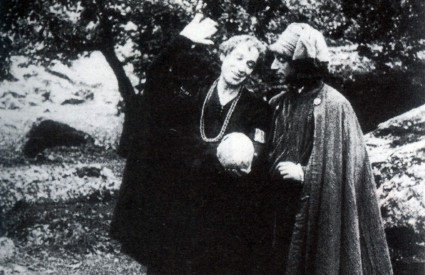
Ruggero Ruggeri as Hamlet in Amleto (1917)

It was the fervent belief of many in the early years of cinema that justification for the medium lay in how it interpeted stage drama. At a time when censorious authorities looked down upon the dubious cinema (with its low class audiences) and cinema was reaching out for respectability (and properties that were out of copyright), Pathé with its Film d’Art and Film d’Arte Italiana companies, and Adolph Zukor’s policy of ‘Famous Players in Famous Plays’ showed that there was financial good sense in bringing high-class drama to the cinema screen, however mutely.

The pinnacle of stage drama was, of course, William Shakespeare, and film companies in the silent film era took on the Bard with enthusiasm. The numbers are extraordinary. Some two hundred films, most of them one-reelers of the pre-war period, were produced that closely or loosely owed something to one or other of Shakespeare’s plays. Some film companies showed a particular interest: Vitagraph filmed Antony and Cleopatra, Julius Caesar, Macbeth, Othello, Richard III, Romeo and Juliet (all 1908), King Lear, A Midsummer Night’s Dream (1909), Twelfth Night (1910) and As You Like It (1912). Thanhouser made A Winter’s Tale (1910), The Tempest (1911), The Merchant of Venice (1912), Cymbeline (1913) and King Lear (1916). Cines, Kalem, Biograph, Ambrosio, Gaumont, Eclair, Nordisk, Milano and several others filmed the plays.

This was more than enthusiasm for high culture; it was good business. Shakespeare films appealed to an audience which found costume dramas in general to be a treat, and which was accustomed to boiled-down Bard from school texts and stage productions which concentrated on the highlights from the plays (such as the Crummles’ hectic production of Romeo and Juliet portrayed in Charles Dickens’ Nicholas Nickelby). Of course, not everyone wanted to see high culture quite as much as the cinema sometimes wanted to be associated with such culture (see the cartoon at the end of this post), but more than enough were impressed, and entranced.

Once films became longer – ironically as the cinema became closer in form to the theatre – the number of Shakespeare films fell, because longer productions were more of a challenge to audiences. But even then there was a burst of activity in 1916 (the tercentenary of Shakespeare’s death), with half-a-dozen or more productions in that year alone, and versions of the plays continued in silent form throughout the 1920s, with four key titles coming from Germany – Hamlet (1920, with Asta Nielsen as the Dane), Othello (1922, with Emil Jannings and Werner Krauss), Der Kaufman von Venedig (The Merchant of Venice) (1923, with Henny Porten) and Ein Sommernachtstraum (A Midsummer Night’s Dream) (1925, Werner Krauss again).

thetempest

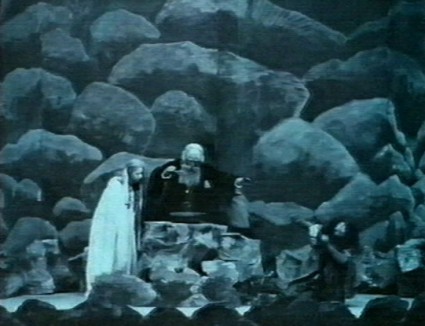
Prospero in his cave, from The Tempest (Clarendon 1908)

So where is the literature to back up this self-evidently significant corner of silent film history? Sadly, until recently, there has been very little. The silent film enthusiasts and film scholars have shied away from Shakespeare as being falsely worthy and far too uncinematic, while the Shakespeareans looked down on cinema per se, while finding the very notion of silent Shakespeare an absurdity. Jack J. Jorgens, a noted scholar, went so far as to write these dreadful words in his Shakespeare on Film (1977):

First came scores of silent Shakespeare films,one- and two-reelers struggling to render great poetic drama in dumb-show. Mercifully, most of them are lost.

Oh dear, oh dear. However, there was one work which almost eccentrically fought against the tide. Robert Hamilton Ball’s Shakespeare on Silent Film: A Strange Eventual History (1968) is one of the most remarkable books ever produced on silent cinema. It is a passionately-pursued archaeological investigation into every kind of Shakespeare film made during the silent era, encomapssing parodies, allusions, plot borrowing as well as ‘conventional’ adaptations, with Ball diggedly tracking down every obscure reference, every hidden print, every list of intertitles, with abundant fervour and an infectious interest in the people involved. This magnum opus has been cherished by the dedicated few for four decades, and for most of that time its discoveries and assertions have been taken as gospel. Yet even Ball ended his investigations with these disappointing words:

Silent Shakespeare film could not be art, a new art. The aesthetic problem is how to make good film which is good Shakespeare. It could not be good Shakespeare because too much was missing.

It is has been the task of a few of us (and I’ve been involved) to prove those words wrong. Silent Shakespeare was good Shakespeare, not because of what was missing, but because of what was there to be seen – a new medium expressing itself imaginatively while asserting its social worthiness and cultural relevance. To study silent Shakespeare films is to see films discovering what they could do. Yes there are histrionics at times, and yes there is some aburdity involved when complex plots are crammed into a ten-minute reel, but equally there is artistry, feeling and subtlety of interpretation. Have you ever seen a ballet of Romeo and Juliet and complained that the words were missing? Of course not. Shakespeare without the words is not a lesser form, but simply a form that requires its own special understanding. It expresses the significance of its subject within its specific constraints – which is precisely what art is.

The tide started to turn with the release of the British Film Institute’s video compilation Silent Shakespeare (1999), a work that was a revelation to many. Even hardened theatricals could see the special virtues in the Clarendon Film Company’s delightful reworking of The Tempest (1908) or the elemental passion evident in Ermete Novelli’s stunning performance in Re Lear (1910). The DVD has found its way onto many a university library shelf, while a number of scholars have begun to take on the silent Shakespeare film with fresh eyes – among them Jon Burrows, Roberta Pearson, Anthony Guneratne and Kenneth Rothwell.

buchanan

The leading champion, however, has been Judith Buchanan, whose quite marvellous Shakespeare on Silent Film: An Excellent Dumb Discourse is published this month by Cambridge University Press. This is the sympathetic, understanding account of a phenomenon that we have been waiting for. It is not a comprehensive history of the silent Shakespeare film – Buchanan defers to Ball in that respect – instead it concentrates on exemplary films and on uncovering the social, cultural and economic contexts. So it is that an opening chapter details a nineteenth-century legacy of performance, with particular attention to Shakespeare and the magic lantern, showing that the silent Shakespeare film was part of an established tradition. Chapters then follow on the first Shakespeare film, King John (1899), featuring Herbert Beerbohm Tree (also on the BFI DVD); Shakespeare films of the ‘transitional era’ between the early and late 1900s, with close, engrossing readings of Clarendon’s The Tempest and Film d’Arte Italiana’s Othello (1909); the ‘corporate authorship’ of Vitagraph’s productions; the contrasting interpretations of Hamlet by Hepworth (a renowned British 1913 production with theatrical great Sir Johnston Forbes Robertson) and Amleto, a 1917 Italian film starring Ruggero Ruggeri, little-known but perhaps the most accomplished extant realisation on Shakespeare on silent film (it’s crying out for the two Hamlets to be released jointly on DVD); the several films of the tercentary year, including the rival Romeo and Juliets starring Francis X. Bushman/Beverley Bayne and Theda Bara/Harry Hilliard, both films alas lost; the German productions of the 1920s; and wordless Shakespeare today (there are some stage productions experimenting with silence, notably Paata Tsikurishvili’s Synetic Theatre).

It’s written for a literary studies audience, but it is grounded in exemplary original research (Buchanan has toured the world to track down the relevant prints) and it is a pleasure to read. There is much here to detain anyone keen to extend their knowledge of film history. She knows her films as well as her plays – a rare and most welcome combination. Above all, Buchanan opens up the subject in all its richness of theme, inviting others to explore further, illuminating the films that we are so fortunate have survived. We will still turn to Robert Hamilton Ball for his extensive documentary evidence, but to Buchanan for her sophisticated understanding.


romeocartoon

A 1913 cartoon from London Opinion, speaking for anyone resistant to the cinema’s occasional urge to impress Shakespeare upon us. Taken from Stephen Bottomore, I Want to See this Annie Mattygraph: A Cartoon History of the Coming of the Movies

If you are keen to seek out silent Shakespeare films for yourself (and you should, you really should) this is what’s currently available on DVD:

  • Silent Shakespeare: includes King John (Biograph 1899), The Tempest (Clarendon 1908), A Midsummer Night’s Dream (Vitagraph 1909), Re Lear (Film d’Arte Italiana 1910), Twelfth Night (Vitagraph 1910), Il Mercante di Venezia (Film d’Arte Italiana 1910), Richard III (Co-operative 1911) [BFI] [Milestone]
  • Thanhouser Presents Shakespeare [Thanhouser series vol.7]: includes The Winter’s Tale (1910), Cymbeline (1913), King Lear (1916) [Thanhouser]
  • Richard III (Shakespeare Film Company 1912) [Kino]
  • Othello (Wörner-Filmgesellschaft 1922): also includes Duel Scene from Macbeth (Biograph 1905), The Taming of the Shrew (Biograph 1908), Roméo se fait bandit (Pathé 1910), Desdemona (Nordisk 1911) [Kino]

The International Database of Shakespeare on Film, Radio and Television, an online filmographic database not yet officially released but available in a test version, hopes to be comprehensive for the silent Shakespeare film. Buchanan herself provides a filmography (restricted to films mentioned in her text), including the location of archive prints. Around forty silent Shakespeare films survive today, mercifully.