How to Run a Picture Theatre – part 8

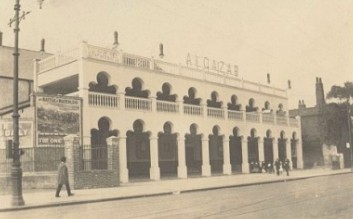
Alacazar, Edmonton

We come to the eighth and last instalment of the series of extracts taken from the c.1912 guide How to Run a Picture Theatre. We have covered selecting and fitting out the building, taking on staff, and putting together an effective programme. The last thing to consider is the licence.

In January 1910 the Cinematograph Act was introduced, the first piece of government legislation directed at the new film and cinema industry. Previously, cinema had had to be licensed under schemes designed for music or theatre performance, though the majority of them chose to avoid such bureaucratic necessities (there are even some examples of cinemas that put on purely silent shows, to avoid the demands for a music licence). The unregulated nature of the industry, and in particular the threat that such venues posed as a risk risk, led to the drafting of the Cinematograph Act. Despite its ‘compulsory’ nature, there were many cinemas which chose to ignore the new scheme and pay the fines, as Jon Burrows’ recent research into cinemas in London pre-1914 has shown. But the coming of the Cinematograph Act ultimately encouraged the huge boom in cinema construction that swiftly followed its publication. There were 4,000 cinemas in Britain and Ireland by the end of 1914.

Obtaining a License. The Cinematograph Act 1909. Under the Cinematograph Act, 1909, it is compulsory that every place to which the public is admitted, where exhibition in which inflammable films are used, shall be licensed …

It is not, however, necessary to obtain a license for premises used not more than six days in a year for a kinematograph exhibition provided that notice of such shows are given to the County Council or the Chief Police Officer, but these occasional exhibitions must confirm to the regulations …

The penalty for using an unlicensed building for an entertainment which comes within the meaning of the Cinematograph Act is a fine not exceeding £20, with a penalty of £5 per day as long as the offence continues, and power is given to the authority to revoke the license.

Music and Dancing License. Every kinematograph theatre in which music is employed – except such music be provided by automatic means – must possess a music and dancing licence.

In the case of premises situated in the Administrative County of London these are granted in November of each year …

All eight parts of How to Run a Picture Theatre can be accessed here.

(The photograph shows the Alcazar in Edmonton, one of the new breed of super-cinemas, which seated 2,000. It opened in 1913, and the poster outside advertises the British & Colonial epic The Battle of Waterloo, released in that year.)

Moving Pictures in Westminster

The Moving Pictures exhibition on the film and cinema business is London before the First World War will be on show at the City of Westminster Archives Centre 5-30 June. The exhibition, which was previously shown at Hornsey Library and Hampstead Museum, focusses on the highly active film industry and cinema business in London before 1914, with an emphasis on the relationship with local communities. The exhibition is based on The London Project, a research project hosted by Birkbeck College, London, which resulted in The London Project database of film businesses and cinemas in London before the First World War.

There are associated talks taking place at the Centre on 19 and 26 June, at 6.00 pm (admission free). The Archives Centre is located here.

For the weekend of 23-24 June the exhibition will move temporily from the Archives Centre to feature as part of West End Live, in Leicester Square.

Terra Media

chronomedia.jpg

A key aspect of The Bioscope’s mission is to highlight resources for the study of silent film, particularly those not well known or obvious.

A model example is Terra Media. This is a one-man marvel of information on the history of media, beautifully arranged, and filled with riches. Its centrepiece is Chronomedia, a detailed chonology of media history year-by-year. As the site says, “Chronomedia is designed to become the most comprehensive and accurate timeline of developments in communications media ever compiled. By integrating references to all audio-visual media—film and cinema, radio and television, cable and satellite, interactive (multi)media, photography, telegraphy, telephony and even printing and publishing—it becomes easier to see the parallel developments and interactions that have formed the media scene we know today.” The year-search option alone is a joy to see, individual entries are to the point, and it is all very satisfactorily cross-indexed, linked and illustrated.

There are other sections on quotations, the history of television as public performance, the quest for home video, a reference section, and a fascinating section on British media legislation. There are further sections on statistics (including early British cinema circuits) and contemporary documents (none covering the silent era). The site continues to grow, and is just such a pleasure to use. Its editor is David Fisher, whose day job is editor of the media news and market research journal Screen Digest. Take a look.

Cinema Context 2

Special issue Tijdschrift voor Mediageschiedenis (TMG):

Cinema in Context

Last year, Dutch film historian Karel Dibbets launched the website Cinema Context (see post on February 10th), an on-line database of Dutch cinema culture. Cinema Context aspires to become a new standard among the digital reference sources, comparable to the Internet Movie Database which was put on-line in 1996 by film buff and computer freak Col Needham and which since then has become an indispensable source for millions of film lovers and scholars worldwide. Whereas IMDb mainly offers film production data, Cinema Context is a research tool for the study of film programming and distribution.

Dibbets launched his website during the Cinema in Context conference (Amsterdam, 20-21 April 2006), where several projects of the international research group Homer (History of Moviegoing, Exhibition and Reception) were presented. The conference addressed the urgent question of the future of film studies, in general, and film history, in particular. Anno 2006, film history proved to be in a dynamic but problematic phase. Which direction will we take in the coming years? Can we collaborate more and in which ways? How do we deal with the growing but very diversified digital sources? What will be their role in our future research? Which questions are pertinent and which technologies do we need? Lastly, have we reached the limits of our territory?

This special issue of Tijdschrift voor Mediageschiedenis (2006/2), edited by Ivo Blom and Wanda Strauven, documents the important debate of the Cinema in Context conference. It deals with burning questions such as local vs. national identity, film history vs. cultural geography, ‘factual’ history writing, consumerism, and the state and availability of film historical research. The issue contains the four keynote papers (in English) of the conference, and two Dutch contributions. All articles have English written summaries. The issue also contains a list of relevant websites.

Contents:

‘Cinema in context: het einde van filmstudies?’, by Ivo Blom & Wanda Strauven

‘The place of space in film historiography’, by Robert C. Allen

Cinema Context en onderzoek naar sociale netwerken binnen de filmgeschiedschrijving: een aanzet tot discussie’, by André van der Velden, Thunnis van Oort, Fransje de Jong and Clara Pafort Overduin

‘Het taboe van de Nederlandse filmcultuur. Neutraal in een verzuild land’, by Karel Dibbets

‘Just the Facts, M’am?’ A Short History of Ambivalence Towards Empiricism in Cinema Studies’, by Ian Christie

‘On the Prospect of Writing Cinema History from Below’, by Richard Maltby

‘Local cinema histories in France: An Overview’, by Jean-Jacques Meusy

You can order the Cinema in Context issue (€ 25 excl.) at Boom Publishers.

E-mail: m.siemons@boomonderwijs.nl

Address: Boom Publishers, Martine Siemons, Prinsengracht 747, 1017 JX, Amsterdam, The Netherlands.

Cinema Context

What is the finest film reference source on the Web, for all film let alone silent film? With all due respect to the Internet Movie Database, I think it is Cinema Context, a Dutch site created by Karel Dibbets and the University of Amsterdam. Describing itself as “an encylopedia of film culture”, the site documents film distribution and exhibition in the Netherlands in 1896. It does so through four data collections, on films, cinemas, people and companies, derived from painstakingly researched data on nearly all films exhibited in Dutch cinemas before 1960. The research team located film programmes from 1896 onwards in each of the major Dutch cities, entering all film titles, names, dates, cinemas etc, and then ingeniously matched this data to the records of these films on the IMDb.

The result is an incomparably rich resource for tracing films, the performers and the producers across time and territories, opening up whole new areas of analysis. Cinema Context also contains comprehensive data from the files of the Netherlands Board of Film Censors 1928-1960. As the site states: “Cinema Context is both an online encyclopaedia and a research tool for the history of Dutch film culture. Not only can you find information here about who, what, where and when: you can also analyse this information and study patterns and networks. Thanks to Cinema Context, we are now able to expose the DNA of Dutch film culture.” Naturally, it is available in both Dutch and English.

This is the new film research. Every nation should have the same.

The London Project

The London Project is a major study of the film business in London, 1894-1914, organised by the AHRB Centre for British Film and Television Studies. The project ran 2004-05, but written outputs are in preparation and will be seen later this year; and there the main project output, a searchable database, which is available online. This documents nearly 1,000 cinemas and other film venues, and just as many film businesses located in London before the First World War. The researchers on the project were Simon Brown and Luke McKernan, with Professor Ian Christie of Birkbeck, University of London, overseeing the work.

The database is designed to attract not only early film specialists, but a general audience interested in London history. To this end there is a map of the boroughs of London, from which users can call up database results for the part of the city they are interested in. Because the database entries can be found through Google searches, it has generated quite a public response. The current web address is http://londonfilm.bbk.ac.uk, though there is talk of this changing soon. As the person responsible for the cinema records, I have to say that Simon’s film business records are better.