Prakash Travelling Cinema

Part one

Prakash Travelling Cinema is a delightful short film, posted on YouTube by the filmmaker, Megha B. Lakhani. She made the 14-minute film while at the National Institute of Design, India, and it has gone on to win festival awards.

The film documents two friends who maintain a travelling bioscope show on the streets of Ahmedabad. The ramshackle outfit, which they take around on a hand-cart, comprises a genuine c.1910 Pathé projector, adapted for sound, with peep-holes all around the mobile ‘cinema’ itself (which they call their ‘lorry’), through which children watch snippets plucked from popular Bollywood titles. One of the amazing sights of the film is either of the two men hand-cranking their sound projector at exhausting speed.

Part two

Although they are not showing silent films, the whole enterprise is imbued with the spirit of the original travelling bioscope operators of India, and of course the technology hails from the silent period. The word ‘bioscope’ still persists in places in India for cinema, as it does in South Africa. However, the film wants to do more than show a quaint operation, and it is very much about friendship, conviction, Indian society, and the persistence of a human way of doing things in the face of modern media technologies.

There are an estimated 2,000 mobile cinema shows in India today, and the travelling bioscope has been made the subject of other recent films. There is Andrej Fidyk’s 1998 documentary film Battu’s Bioscope, on a modern travelling show in rural India; Vrinda Kapoor and Nitesh Bhatia’s short film Baarah Mann Ki Dhoban (2007), on modern bioscope workers whch also touches on the history of India film exhibition; and Tim Sternberg’s film Salim Baba (2007), again about a modern travelling bioscope show, this time with an adapted 1897 Bioscope. Plus there’s Tabish Khair’s acclaimed novel Filming, published this year, which moves from a travelling bioscope show in 1929 to the Bombay cinema of the 1940s as a means to examine the rise of modern India. Clearly there’s a metaphor in the air.

Prakash Travelling Cinema was made in 2006, and there’s a full set of credits here. The film is in Hindi, with English subtitles, and on YouTube, owing to its length, it comes in two parts.

Le Bioscope

Le Bioscope

From time to time I pursue the etymology and the many uses of the word ‘bioscope’. So, let us journey to Ungersheim, Alsace, France, where you will find Le Bioscope. This is an environmental ‘leisure and discovery’ park, the intention of which is ‘to educate people to take responsibility for their own actions with respect to equilibrium with the environment’. As can be seen from the picture, it is organised in concentric circles, evoking the shockwaves caused by a meteorite which fell nearby in 1492. It is very much a ‘view of life’ (to cite the original meaning of bioscope), with the bio emphasising the biosphere, human biology, and the general interaction between Man and the world around him. It does have a cinema – Le Biorama. And for children there are lots of dinosaurs. It opened in June 2006.

No sale for Chaplin

The much-trailed auction at Christies of a Bell & Howell 2709 camera used by Charlie Chaplin resulted in no sale. The price had been put at £70,000-£90,000. The camera was one of four 2709 models used at the Chaplin studios. It was purchased in 1918 and used by Chaplin throughout the 1920s.

Despite the no sale, The Bioscope had one of its reporters on the spot, who returned with some fine pictures. Here’s a close view of the camera mechanism:

Chaplin camera

And here’s a marvellous Chaplin’s-point-of-view shot of the eyepiece:

Chaplin camera

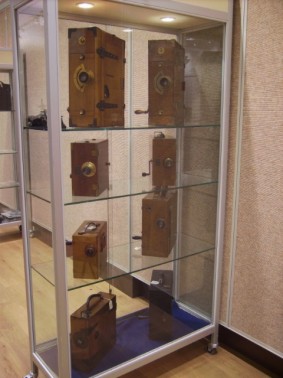
As already reported, the camera sale of which the Chaplin camera was a part is rumoured to have been Christie’s last, the collector’s market not being what it once was. Which is sad, if it means that their glamour is fading. Not that I can usually tell one box from another – I can just about manage to spot a Bell & Howell, given the ‘Mickey Mouse ears’ look of the twin magazines, but thereafter I tend to get a bit stumped. So, don’t ask me which is which among this selection of boxes, which is one for the cognoscenti:

Cinematographs

And, finally, something I can recognise, even without its box, though only because the name is somewhat prominently displayed – an Urban Bioscope, such as graces the header of this blog:

Urban Bioscope

With many thanks to Christian Hayes for the photographs.

Motion picture cameras

Chaplin's camera

You may remember the news a while ago about Charlie Chaplin’s camera coming up for auction. This will be at Christie’s in London on 25 July, which is part of a large sale of vintage motion picture camera equipment. Some enjoy this sort of stuff more than others, but the online catalogue is displaying some remakable rarities, including an Urban Bioscope from 1903 (estimate £300-500), a Kinemacolor camera (£1,000-1,500), and a 60mm Demeny-Gaumont camera (£10,000-15,000), while the Chaplin Bell & Howell will set you back £70,000-90,000. There are viewings from 21 July up to the day of the auction.

Rumour has it this will be the last Christie’s camera sale. There don’t seem to be the collectors around for cameras and projectors like these as there used to be, and Christie’s (so I am told) will be using space and resources for other, presumably more profitable things. What’ll happen to the market for vintage cinema technology, I don’t know, but Christie’s scholarly and reliable descriptions of some often extremely rare objects are going to be lost – if the rumours are true.

Any questions?

detective1.jpg

I’ve added a new section to The Bioscope, and taken one away. The deleted section is Publications, which was done in a hurry and never updated. One day it will return, in a hopefully far better form.

The new section is Questions. If you have any questions on early and silent cinema, particularly if you have a research interest in some aspect of silent film, and it isn’t being covered by regular posts, do use the comment box on the Questions page (unfortunately it isn’t possible to set up a proper enquiries form within a WordPress blog). I’ll answer what I can, or find someone who can (such as one my co-contributors), and post the results where appropriate. If you’d rather contact me privately, then of course you can (contact details on the About page).

10,000

Thanks to the fine people at WordPress, all sorts of statistical stuff comes with this blog’s content management system, and so I am pleased to report that The Bioscope has just passed the 10,000-visitor mark since it began in February of this year. 211 is the record number of visits for any one day (all those people looking for information on Albert Kahn), with somewhere between 80 and 100 as the daily average. There have been 201 posts (most from me – a handful from my co-contributors), 113 comments (could do better) and Akismet has cleared up 1,194 unwanted spam comments.

Thanks for reading The Bioscope, whose archives ought to build up into a useful reference source in time (that’s the plan). If there is information or features on silent film that you’d like to see here (particularly if it’s the sort of thing that can’t be found elsewhere on the Web), let me know.

A Continuous Now

The Bioscope

Every now and again I pursue the etymology of the word Bioscope. It’s a word which has enjoyed multiple applications over the years, and which has been applied to cinemas, cameras, projectors, fairground shows, a film journal, microscopes, a theme park in France, and of course a blog.

As has already been reported, it was first used by a religious writer, Granville Penn, whose The Bioscope; or Dial of Life (1812) you can download from the Internet Archive. The reason for returning to this is that I have now a copy of the image of the bioscope which accompanies Penn’s text. And, indeed, the bioscope was originally a dial, which came with the book, but on a separate card. The dial was marked from nought to seventy, representing the various stages of life, with eternity waiting before and after. The card came with a movable pointer (which seems remarkably modern as a sort of publishing gimmick). The idea was that the reader would place the pointer as whatever his or her age might be, and contemplate what was to come. Penn wanted his readers to avoid being lulled into the beief ‘that life is a continuous now’. Which is, if you think of it, a prescient description of the illusion that motion pictures create. Penn would have hated them.

London was dangerous

It’s been a while since I posted any memoir evidence of going to the cinema in the silent era, a particular research topic of mine. This quotation from V.S. Pritchett’s memoir A Cab at the Door: An Autobiography: Early Years (London: Chatto & Windus, 1968) also serves as further evidence of the term Bioscope, and of the early cinema practice of spraying the surprisingly compliant audiences of the time with disinfectant:

London was dangerous. We had a girl to help my mother for a few weeks and her mind, like the mind of the one at Ealing, was brimming with crime. She took me to the Camberwell Bioscope to see a film of murder and explosions called The Anarchist’s Son, in which men with rifles in their hands crawled up a hill and shot at each other. When the shed in which one of them was living, blew up, the film turned silent, soft blood red and the lady pianist in front of the screen struck up a dramatic chord. In the Bioscope men walked about squirting the audience with a delicious scent like hair lotion that prickled our heads.

The Pritchett family lived in a street off Coldharbour Lane in London. The cinema he is referring to is possibly Burgoyne’s American Bioscope, at 213 Rye Lane, Peckham. The date is around 1910, when he would have been ten years old. Pritchett of course went on to become a renowned short story writer and essayist.