Ein Sommernachtstraum

Bioscope Festival of Lost Films

Germany 1925

Director: Hans Neumann
Production Company: Neumann-Film-Produktion GmbH (Berlin)
Producer: Hans Neumann
Screenplay: Hand Behrendt, Hans Neumann
Titles: Alfred Henschke
Cinematographer: Guido Seeber
Camera assistant: Reimar Kuntze
Costumes and sets: Ernö Metzner
Original music: Hans May

Cast: Theodor Becker (Theseus), Paul Günther (Egeus), Charlotte Ander (Hermia), André Mattoni (Lysander), Barbara von Annenkoff (Helena), Hans Albers (Demetrius), Bruno Ziener (Milon), Ernst Gronau (Squenz), Werner Krass (Zettel), Wilhelm Bendow (Flaut), Fritz Rasp (Schnauz), Walter Brandt (Schnock), Armand Guerra (Wenzel), Martin Jacob (Schlucker), Tamara (Oberon), Lori Leux (Titania), Valeska Gert (Puck), Alexander Granach (Waldschraff), Rose Veldtkirch, Adolf Klein, Hans Behrendt, Paul Biensfeldt

2,529 metres

Ein Sommernachtstraum

The tragedy of Pyramus and Thisbe, from Ein Sommernachtstraum

Welcome to day two of the Bioscope Festival of Lost Films, and to our special venue this evening, the Court Electric Theatre in London’s Tottenham Court Road. Opened in 1911, this select venue seats 420, and normally its patrons are entertained by an Italian orchestra. For this evening, however, to play the special music composed by Hans May for our lost film, we have Eric Borchard’s American jazz band, brought over at great expense following their acclaimed performances accompanying the film in Berlin.

And what a treat we have for you. Ein Sommernachstraum is a fascinating film, strangely and undeservedly forgotten by the posterity that is to come. It is, of course, based on William Shakespeare’s comedy, A Midsummer Night’s Dream, which is the title it has been given in America, though in Britain it has been rather curiously renamed Wood Love. It is the last silent film to be made of a Shakespeare play, and one of the oddest of that distinctly odd genre.

The plot, as you will know, revolves around two pairs of Athenian lovers, whose fortunes are mixed up with the fairy band of the forest and a group of comic workmen rehearsing a play, whose performance forms the uproarious conclusion to both film and play. However, the film takes numerous liberties with Shakespeare, as you will see. The character Shakespeare calls Bottom is here called Zettel, and is played by the great Werner Krauss (who you will recall played Iago in the 1922 German version of Othello and Shylock in the 1926 Der Kaufmann von Venedig). Oberon is played by a woman, the Russian ballet dancer Tamara. A battle between Greek warriors and the female Amazon army is shown, such as Shakespeare never thought to stage. Theseus is seen using a telephone.

Indeed this is not a conventional, nor respectful interpretation. It satirises the performance of Shakespeare, and the rather confused critics have variously described it as being ribald, charming, stagey, sincere, magical, dull, and grotesque. The Berlin censors pronounced it as being forbidden to juveniles. That this is intentionally a radical production can be seen from the presence of contributors such as the well-known poet and critic Alfred Henschke, writing the titles which slyly parody Shakespeare, while director Hans Neumann has been previously distinguished as a producer of titles such as Robert ‘Caligari’ Weine’s strikingly expressionist Raskolnikov. Yet some critics see it only as being conventionally charming, with such magical features as double exposures for appearing and disappearing fairy folk.

The British critic Oswald Blakeston has had some curious things to say about the film in the journal Close-up:

We all know the respectable whose lives are led in a patch of arid ground shut in by a complicated geometrical pattern of lines. Valeska Gert [playing Puck] steps beyond the lines as a hierophant to show what fun one can get from being released; Krauss steps beyond the lines to show what a great actor he is. The Gert puts out her tongue at the audience in devilment; the Krauss puts out his tongue for the audience to see how well he can act the part of a devil … There are more things in this picture more ineluctably Rabelasian that I have ever discovered in the most boisterous Rabelasian comedy … The heartiness in this picture is not biased, it spreads to the simple pleasure of hacking a man in two with a battle-axe.

We are not entirely sure what Mr Blakeston is on about (and we will leave you the pleasure of seeking out a dictionary to find out what ‘hierophant’ means), but clearly the film is a challenge to the senses.

And let us not forget the music. Hans May’s music, performed by jazz band with strings, has divided opinion, but Variety calls it “a real advance in scores for accompanying comedy pictures”. May playfully combines Wagner with Tin Pan Alley, closely scoring for such comic scenes as the battle with the Amazons, and frequently in performance the audience has burst into applause at the musical flourishes alone. As with the intertitles, the music forms an ironic commentary on Shakespeare’s play.

The film has enjoyed a long run at Berlin’s Nollendorf Platz theatre, where it has appeal for a discerning audience, but doubts must be expressed whether it can enjoy a similar kind of success in America or Britain. We are very pleased to be screening it here this evening, but feel that no film burdened with the title Wood Love will last long in the British cinemas.

Hamlet (1907)

Georges Méliès contemplates Yorick’s skull

The lost short that accompanies Ein Sommernachtstraum is an appropriate one: Hamlet (France 1907). How wonderful to see the great Georges Méliès play the Dane! How wonderful too to have Shakespeare’s greatest, but undoubtedly lengthy play, brought to a far more manageable and agreeable length of ten minutes. All the essential details are there: Hamlet at the graveside, his madness aggravated by the sight of visions, Hamlet meeting his father’s ghost, Hamlet meeting the ghost of his love Ophelia, the duel before King Claudius, and the death of Hamlet. Clearly the film displays a bold use of flashbacks and much of M. Méliès’ favoured use of camera trickery. One great artist putting his distinctive stamp upon the work of another.

So ends our screening for this evening. Be sure to return tomorrow, when we shall be at the Casino de Paris to see a truly sensational American production.

A Study in Scarlet

Bioscope Festival of Lost Films

UK 1914

Director: George Pearson
Production Company: Samuelson Film Company
Producer: G.B. Samuelson
Cinematographer: Walter Buckstone
Assistant to the director: Jack Clair
Script: Harry Engholm
Based on the novel by Arthur Conan Doyle

Cast: James Braginton (Sherlock Holmes), Fred Paul (Jefferson Hope), Agnes Glynne (Lucy Ferrier), Harry Paulo (John Ferrier), James Le Fre (Father), Winifred Pearson (Lucy as a child)

Distributed by Moss
5,749 feet

A Study in Scarlet

James Braginton as Sherlock Holmes

Welcome to the opening screening of the inaugural Bioscope Festival of Lost Films! Over the next five days we will be bringing you five feature films (with accompanying shorts), each of them notable film productions, and each (so far as can be ascertained) a lost film, untraceable in any of the world’s film archives or private collections.

Today we are showing A Study in Scarlet, George Pearson’s lost classic from 1914. The screening is taking place at the magnificent West End Cinema Theatre in London’s Coventry Street, later known as the Rialto. This magnificent venue, built by Hippolyte Blanc at a cost of £31,00 with gorgeously ornamental interior design by Horace Gilbert, opened in March 1913. It seats nearly 700, and boasts the first use of a neon sign in central London. It has been long disused but is still open for dreams. Musical accompaniment comes from that incomparable organist and doyenne of the National Film Theatre, Florence de Jong. Please settle down now. Ask your children to behave, and if possible please avoid reading out the titles on the film to your neighbour. And please avoid throwing orange peel and nutshells at Miss De Jong. This is a high-class venue, and in any case she is only doing her best. So lights down, and we can begin…

A Study in Scarlet is the second feature-length film with the character of Sherlock Holmes. It is not the first film to have been made of Conan Doyle’s detective – that was the American Biograph film of 1903, Sherlock Holmes Baffled (a film which survives) – and it was preceded by several Holmesian films including earlier in 1914 the French four-reeler, Le Chien de Baskerville (also lost), which seems to have been the first Holmes feature film.

This six-reel British production is based on the first Sherlock Holmes story that Conan Doyle wrote, and it has been authorised by the author (unlike an American two-reeler based on the same book made later in the year). This exciting story of murder, love, revenge and detection takes place among the Mormon pioneers of Utah in 1850. Years later, in London, the great detective Sherlock Holmes is called upon to solve a murder, the roots of which lie in a man’s sworn revenge against the Mormons.

The Bioscope spoke to the director Geoge Pearson and asked him about the making of the film:

TB: Mr Pearson, can you tell us how you managed to recreate the Salt Lake plains and the Rockies in England?

GP: The film called for ambitious locations, but much can be suggested camera-angles to hide geographical inaccuracies. We discovered what we needed in the Cheddar Gorge and the Southport sands.

TB: How did you find your Sherlock Holmes, Mr James Braginton?

GP: Sherlock Holmes was a problem; much depended upon his physical appearance, build, height, and mannerisms had to be correct. By a remarkable stroke of fortune Samuelson had an employee in his Birmingham office who absolutely fitted these requirements.

TB: But surely he could not act?

GP: A tactful producer can control every action of an inexperienced actor. I decided to risk his engagement as the shrewd detective. With his long and lean figure, his deer-stalker hat, cape-coat and curved pipe, he looked the part, and played the part excellently.

TB: The scenes of the wagon train are very impressive. What planning was involved?

GP: As Buckstone and I were finishing our last scenes in the gorge on June 25th, we received an urgent message that all was ready at Southport; everything possible had been done to meet the problem of a suitable date for all concerned, and that date was Friday, June 26th, and furthermore, only the morning of the day! There was a little moonlight when we arrived, and since Buckstone and I had not yet seen the actual sport in the sands where it might be possible to stage that long procession of waggons, we spent the anxious hours before dawn in search of a suitably lengthy gully, and with a compass to guide us stuck sticks in the sand to mark the camera position and the line route for the waggons. The long snakelike winding caravan had to appear round a far distant bend in the sand-dunes, and move slowly towards the camera position. We had to get that important scene right first time, for a retake could only result in utter chaos. How we got that long line of wagons with their characteristic hoods, the cattle, the women, children and bearded drivers past the camera without mishap is beyond belief, but get it we did.

A Study in Scarlet

The Mormon trek, recreated on Southport sands

The producer of this great work is the ebullient G.B. ‘Bertie’ Samuelson, who created such a sensation in 1913 with his bold epic of the life of Queen Victoria, Sixty Years a Queen (of which just a one minute fragment survives). Bertie was born in Southport, Lancashire, so this is very much a personal film for him, with many local people turning out to play the Mormon pioneers. It is also the first film to be made at Mr Samuelson’s impressive new studios at Worton Hall, Isleworth, on the outskirts of London. The spectacular production has been acclaimed already by the critics, who have been impressed by its economy of style, its scenic settings, and the intense performance of Mr Fred Paul as the vengeful Jefferson Hope. Some have even gone so far to say that the work improves upon aspects of Conan Doyle’s original novel, by cutting out some of the more wearisome descriptive manner. Enthusiasts of the great Sherlock Holmes may feel that his appearance, only towards the end of the film, is a little too brief, but all are agreed that these scenes are undeniably dramatic.

Owing to the unfortunate outbreak of the Great War, the film’s release was delayed until December 1914, though we understand that Mr Samuelson managed to sell the film to the United States for a handsome four-figure sum. If anyone is going to put the British film on the map (at last!) it will be the indefatigable Samuelson.

The main feature will be preced by a short film, equally lost. The Great European War (UK 1914) is a Samuelson production which he has made in the period between the outbreak of the Great War and the release of A Study in Scarlet at the end of 1914. This startling compilation of actuality film and dramatic inserts is a typically bold, if hurried, flourish from Mr Samuelson. As George Pearson, the director, tell us, Mr Samuelson conceived of the idea of a film about the war on the evening of the day on which hostilities were announced, 4 August 1914. They wrote the script all night and began production on 7 August! Mr Pearson calls the film ‘a fictitious News-Reel brought bang up to date with material provided by the headlines of the daily Press’. Every out-of-work actor in town has been comandeered, along with every concievable kind of military costume. Filled with trenchant symbolism (‘a flag unfolding, a lion rampant, German hands tearing a parchment treaty to pieces…’) this is filmmaking forged in the heat of the historic moment. Posterity may find it all a little on the ridiculous side, but posterity was not there at the time, and in any case posterity does not – we fear – have the chance to see it.

So, a great start to our festival of lost films, we hope you will agree. Please return tomorrow, when we will be at the Court Electric Theatre, Tottenham Court Road, to see a most strange and adventurous 1925 German film…

Countdown to the festival

Bioscope Festival of Lost Films

Just eight days remain until we start The Bioscope Festival of Lost Films – a world first, I believe. The festival runs 14-18 January, and all of the films to be shown (one feature and one short per day) will be guaranteed not to exist. Once they did, and one reason why the titles are not being announced in advance, is that exhaustive researches are being undertaken in archives around the world to ensure that the selected films do not still exist somewhere.

However, we can give you some incidental details. The festival will of course be taking place in lost venues. Those selected – a different one each night, all in London – are:

The West End Cinema Theatre, Coventry Street
The Court Electric Theatre, Tottenham Court Road
The Casino de Paris, Oxford Street
The Cambridge Circus Cinematograph Theatre, Charing Cross Road
The Circle in the Square, Leicester Square

All are no longer cinemas. The West End Cinema Theatre, which opened in 1913, later became the Rialto and closed in 1982. It is a Grade II listed building but remains disused. The Court Electric Theatre, which closed in 1928, does not exist as a building, but the space it occupied is now the foyer of the Dominion Theatre. The Casino de Paris (opened 1909) is now a McDonald’s. The Cambridge Circus Cinematograph Theatre (opened 1911) is now the Montagu Pyke bar. And the Circle in the Square (originally called the Bioscopic Tea Rooms, opened 1909) is now an Angus Steak House. But we can dream.

And we have musicians. We have gone for the best, and can promise three names once renowned for their accompaniment of silents at the National Film Theatre: Arthur Dulay, Ena Baga and her sister Florence de Jong playing the organ. You will be transported. Book now!

The Bioscope Festival of Lost Films is dedicated to the anonymous person who visited this blog using the search term “lost films download”. We must all continue to live with such hope.

50,000 and counting

After eleven months of posting to the day, the Bioscope has just chalked up 50,000 views. It took five months to reach the first 10,000, so clearly we’ve been on quite an upward curve recently. According to Technorati, the Bioscope is at number 224,227 in its list of blog popularity, so the curve will have to go upwards a little more before we reach the giddy heights of Boing Boing or Engadget, but what do they tell you about early colour systems, freemasonry lodges, digitised newspaper collections, silent film pianists, British film distributors of the 1890s, where to download books that tell you how to write silent screenplays, or how to participate in lost film festivals? This is the place to be.

2008 – The Year of Colour

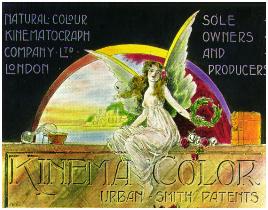
Kinemacolor poster

A happy new year to one and all!

2007 was a productive year for The Bioscope, from small beginnings, and I hope that the coming year will see the service continue to gow and for the archive of useful content to build up. In 2008 I’ll be continuing to provide news on events, festivals, conferences, screenings, DVD releases and online resources for early and silent cinema. The Library of freely-available digitised documents will continue to grow (there is quite a backlog of titles to be added in due course), and I hope to add new features and maybe indulge in a redesign somewhere along the line.

However, the major theme running through 2008 will be colour cinematography in the silent era. 2008 sees the centenary of the first public exhibition of Kinemacolor, the world’s first natural colour motion picture system. Pedants may say that the centenary of Kinemacolor might have been 1906/2006 (when it was patented), 1907/2007 (when it was exhibited in a preliminary form to an audience of film professionals) or 1909/2009 (when it was first called Kinemacolor and was first exhibited to a paying public). But 1 May 1908 was when the system was first shown to a startled general audience at Urbanora House, Wardour Street, London – and that’s good enough for me.

So throughout 2008 there will be posts on colour cinematography to 1930. Not just Kinemacolor (though there will be plenty on that), but the experimental efforts that preceded it, hand-painted and stencil colour, tinting and toning, Biocolour, Cinechrome, Chronochrome, Kodachrome, Prizmacolor, Technicolor, Polychromide, Kodacolor, and more. There will be potted histories, archive documents, illustrations and (if I can find them) film clips. It’ll all build up into a year-long series to cherish and keep.

Lastly, here’s a checklist of some of the silent film events taking place over the year (all of which and more will be recorded in the Calendar section):

14-18 January – The Bioscope Festival of Lost Films
17-20 January – Slapstick 2008 silent comedy festival, Bristol
24-27 January – StummFilmMusikTage festival, Erlangen
9 February – Border Crossings: Rethinking Early Cinema conference, Berkeley
22-23 February – Kansas Silent Film Festival
13-16 March – Cinefest, Syracuse
26-28 March – City in Film conference, Liverpool
3-6 April – British Silent Cinema Festival, Nottingham
11-13 June – The Fifth International Women and the Silent Screen conference, Stockholm
17-21 June – Domitor conference, Peripheral Early Cinemas, Perpignan and Girona
28 June-5 July – Il Cinema Ritrovato, Bologna
11-13 July – San Francisco Silent Film Festival
8-10 August – Capitolfest, New York
28 August-1 September – Cinecon festival, Hollywood
25-28 September – Cinesation festival
4-11 October – Giornate del Cinema Muto, Pordenone

Keep reading, keep commenting, and tell your friends.

The Bioscope Festival of Lost Films

Bioscope Festival of Lost Films

The days are grey, the weather foul, and we need something to lift our spirits. So how about The Bioscope’s very own film festival? We always try to point you to the various silent film festivals around the world, but for its own film festival The Bioscope wants to do something a little different.

So we’re going to have the world’s first festival of lost films. The Bioscope Festival of Lost Films will take place over five days, 14-18 January 2008. It will present five lost silent feature films, each accompanied by a short, with supporting materials, side events, and maybe a celebrity interview or two. So, just like any other festival, except of course that there will be no films to show you. Because all of the films featured will be lost films, not known to exist in any archive anywhere. So a collective act of imagination will be required, as well as a collective sigh at what has been so thoughtlessly cast aside.

What films will be showing? We cannot yet tell you. Just as some festivals have to leave it until the last moment because they cannot be sure of securing the films that they want to show, so The Bioscope Festival of Lost Films will need to be cautious in case the films it hopes to programme turn out to exist somewhere. It seems the story about F.W. Murnau’s The 4 Devils having been found is only an ingenious prank, but there could be some truth to the rumours about King Vidor’s Bardelys the Magnificent having been found. Only at the last minute will it be possible to confirm the final selection. Rest assured that only the best titles will get selected for your delectation.

Therefore, please note down 14-18 January in your diaries, and look out for further announcements about the festival as the time gets nearer.

Postscript (January 2008)

The films featured in the festival were:

Day 1: A Study in Scarlet (1914) and The Great European War (1914)
Day 2: Ein Sommernachtstraum (1925) and Hamlet (1907)
Day 3: Human Wreckage (1923) and Dorian Gray (1913)
Day 4: The Mountain Eagle (1926) and Number 13 (1922)
Day 5: Drakula halála (1921) and Life Without Soul (1915)

God’s soldiers

Joseph Perry

Joseph Perry, from http://www.salvationarmy.org.au

While at Pordenone I met with Tony Fletcher, early film researcher extraordinaire, who told me about a DVD made by the Salvation Army, William Booth – God’s Soldier. This includes a substantial amount of film of Booth, the founder of the Army, in the early years of the twentieth century. The Salvation Army site includes a clip from the film, showing Booth’s motor tour through Britain in 1904 (unfortunately with added-on crowd noises and sound effects). It just goes to show how it’s worth looking in odd places to find early film materials.

It’s also a reminder of the great importance played by the Salvation Army in early film history, and I thought I provide a quick survey with links to assorted online resources. Many social interest groups and charities took an interest in using moving pictures to support their work, almost as soon as films were first made widely available on screen in 1896. None was more active in this area than the Salvation Army, particularly in Australia.

Herbert Booth

Herbert Booth, from http://www.victorian-cinema.net

There in 1896 Herbert Booth, rebellious son of William, joined Joseph Perry, who ran the Army’s Limelight Department. Together they added film to the Limelight Department’s multi-media show of Bible stories and uplifting instruction, which combined magic lanterns, photography, choral singing and sermons to create powerful, and hugely popular, narrative spectaculars. One such show, Soldiers of the Cross, first created in 1900, is sometimes cited as being the world’s first feature film, though in fact it was not a single film but rather a combination of slides, film, scripture and song. Moreover, it was preceded by an earlier effort, the two-and-a-half-hour Social Salvation (1898).

Booth and Perry built a glass-walled film studio at 69 Bourke Street, Melbourne in 1898. The room still exists as a archive and museum maintained by the army, with exhibits on the Limelight Department’s work. Initially they filmed with a Lumière Cinématographe, but by 1901 the were using a Warwick Bioscope. Soldiers of the Cross was exhibited across Australia, but Herbert Booth clashed with Salvation Army command in London, and left the Army in 1902, moving to San Francisco and taking Soldiers of the Cross with him. Perry continued in the film industry, increasingly making secular films, and continued as a film distributor into the 1920s.

William Booth himself made good use of film to propagandise for his cause. He had a film cameraman assigned to the Army, Henry Howse, who went with him to the Holy Land in 1905, and filmed many, if not all, of the early films of Booth featured in the God’s Soldier DVD. The original films are now preserved in the BFI National Archive.

There is an excellent site, Limelight, telling the story of the Limelight Department in Australia, based on a 2001 Australian Broadcasting Commission programme and exhibition. This has extensive information on the people behind the Limelight Department, the films they made and used, their tours, and the broader context of Australian early film history.

The Salvation Army in Australia provides its own history of the Limelight Department and its filmmaking activities, plus a history of the making of Soldiers of the Cross.

The National Film and Sound Archive in Australia has a feature on Soldiers of the Cross, which includes selections of the magic lantern slides that were a part of the show (none of the original film is known to survive, but the show did include some Lumière life of Christ films, which do survive).

The Who’s Who of Victorian Cinema site has biographical entries on Herbert Booth and Joseph Perry.

Much research has been done into the Salvation Army and its use of film in these early years by the American scholar Dean Rapp. His essay, ‘The British Salvation Army, the Early Film Industry and Urban Working-Class Adolescents, 1897-1918’, in 20th Century British History 7:2 (1996), is well worth tracking down (it’s available online through some academic subscription services).

Finally, the Salvation Army continues to make use of moving images, and has an active video unit.

The Wisconsin Bioscope

Urban Bioscope

Urban Bioscope Model D, from http://www.wisconsinbioscope.com

The Wisconsin Bioscope is, as its own proud boast has it, “the leading silent film production company in the Midwestern United States, if not the world, today”. It is the brainchild of Dan Fuller, of the University of Wisconsin-Madison department of communication arts, who every year takes a group of students on a seminar, “Making the Early Silent Film”, with the result being a genuine silent film production.

The company takes its name from an Urban Bioscope Model D of 1907, with which their first two films, Plan B (1999) and Winner Takes All (2000) were filmed. Since then they have used a more accommodating Universal newsreel camera, circa 1923. The films are made in imitation of silent films of the 1907-1912 period, with loving attention paid to sets, performance, titles, developing, printing and music. The Wisconsin Bioscope website (recently revised), goes into fascinating detail about the technology employed, and the whole exercise is a delightful mixture of authentic investigation and tongue-in-cheek pastiche, as these introductory words from the website’s front page indicate:

All our productions are photographed with a hand-cranked motion picture camera on black & white 35 millimeter film, almost always at the rate of 16 frames per second. To crank faster is simply wasteful.

All our productions are developed, printed, toned, and edited by ourselves, following the motto:

If you want it done right, do it yourself.

Whenever possible, we film using daylight. Why pay for something that the sun freely provides?

We understand that other companies have experimented with motion pictures that, to some extent, duplicate color and sound.

This is a grave error.

If the public were to want color, it would visit a picture gallery or, better still, a botanical garden in the full bloom of spring!

If it were to want sound, it would attend the theatre or concert hall!

Although it may be temporarily seduced by kinemacolor, talking pictures, or even tele-vision, we know the great mass of the public has a deep desire for high-quality motion pictures produced and exhibited in the tried-and-true manner:

Pantomime accompanied by Live Music.

When false attractions grow tiresome, as they always do, the public will again demand the product pioneered by Mr. Edison and the frères Lumiére.

The Wisconsin Bioscope stands ready for that day!

Well, it’s hard to argue with any of that, but are the films any good? You bet they are – remarkably so. Technically excellent, but also wittily and sympathetically constructed. They’ve been good enough to feature regularly at the Pordenone Silent Film Festival, where three new titles will be showing next week. The revised website now has QuickTime examples of several of them: A Expedição Brasileira de 1916 (2006), Cosmo’s Magical Melt-A-Ways (2006), Rent Party (2006), A Day’s Work (2006), The Rivals (2005), Daddy Don’t (2005), The Dancer (2004), The Starving Artist (2004), The Sick Child (2004), Cadtastrophe (2003), The Magic Tree (2003) and Winner Takes All (2000). All of them are worth a peek. Or else take a look on YouTube at A Visit with Grandmother (2005), with piano by David Drazin.

The website is rich in information, including production stills. All in all, a project done in absolutely the right spirit. and named after just the right piece of equipment, of course.

20,000

The Bioscope has just received its 20,000th visit! It’s been just under eight months in existence, and took the first five to reach the 10,000 mark, so we’re on the up-and-up. Thank you to everyone who reads the outpourings, and do keep on sending me ideas, news and comments.

I thought that to mark the occasion I should point out some of the past posts which have useful reference information, and which have got buried now in the achives, as not everyone may be aware of them:

By far and away the most visited post on The Bioscope has been Searching for Albert Kahn. This is a guide to Autochromes (colour photographs) and the collection of Albert Kahn which featured in the BBC4 series The Wonderful World of Albert Kahn.

There are two posts on the digitisation of newspaper collections worldwide which have materials of value for the study of silent film, Times Past and More Times Past.

There is the eight-part series extracted from a 1912 guide, How to Run a Picture Theatre. Look out for other such series in the future.

There’s the two-part guide to the huge collection of downloadable newsreels, non-fiction and fiction films to be found on the British Pathe site, in British Pathe – part one (the fiction) and British Pathe – part two (the rest). Look out also for Movietone and Henderson, another freely-available newsreel collection – although Movietone was a sound newsreel, the site has a significant early film presence through the remarkable Henderson collection.

There’s a guide to good books on silent cinema, in A Good Read or Two; and a guide to Researching patents, demonstrating what can be found online for free.

Then there are some of my favourite posts: The Silent Worker, on silent films and the deaf; the spectacular Hollywood stage production of Julius Caesar in 1916, described in Shakespeare in the Canyon; the several posts on digitised books such as the 1917 National Council of Public Morals report The Cinema, the Paul McCartney video which uses the Pepper’s Ghost trick, explained in It’s all done with mirrors (well, glass actually); the intrepid war reporter Jessica Borthwick, in A Girl Cinematographer at the Balkan War; thoughts on Martin Scorsese’s wish to save lost films, in Nine out of Ten; discussions of optics coming out of Simon Ing’s book The Eye, in Land and Kinemacolor (the colour experimenter Edwin Land, that is) and The Persistence of Vision; the story of James Joyce’s brief career as a cinema manager, in Visiting the Volta; and the unlikely Croydon pioneer of film achiving, Louis Stanley Jast, whose work is described in Croydon and film archives and The camera as historian.

Plus there’s the Library, FAQs, the latest information on upcoming conferences and festivals, and a Calendar of events. And there are lots of new ideas lined up for the future.