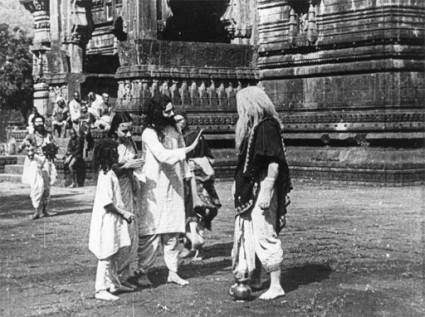
Early cinema is making a bid for world recognition with the announcement that the film Harishchandrachi Factory has just been nominated as India’s official entry to the 2010 Academy Awards. The film, written, produced and directed by Paresh Mokashi, tells the story of Dhundiraj Govind Phalke, producer of India’s first full-length feature film in 1913, Raja Harishchandra.
Harishchandrachi Factory has a lively website, where you can see clips, stills and learn about the production and D.G. Phalke himself. It tells the romanticised story of how Phalke took the medium that was the plaything of Europeans, Americans and elitist Indians, and gave it to the people, creating the Indian film industry in the process.
Phalke was the one-man pioneer of Indian dramatic cinema – director, productor, cameraman, editor, actor, and all points in between. He was born in 1870, the son of a Sanskrit scholar, and after studying art and architecture became a photographer, make-up artist and even had a magic act, before established a printing works in in 1908. It was apparently the experience of seeing a filmed life of Christ in Bombay around 1911 that inspired him to establish a native Indian cinema. He travelled to Britain in 1912, puchasing a Williamson camera and gaining instruction in film techniques from Cecil Hepworth.
He formed the Phalke Films Company that same year, and made his first film Raja Harishchandra, in 1913 (Phalke encouraged the belief that his was India’s first dramatic film, but it was preceded by two short dramatic films). The film told the story from Hindu mythology of King Harishchandra, as told in the Ramayana and the Mahabharata. The story tells how the virtuous king sacrifices his kingdom and his family in the pursuit of truth, only to be restored to power through the intervention of the grateful gods. The film was originally 3,700ft long, and around half survives of what is said to be the film at the National Film Archive of India, though some sources state that what survives comes from Phalke’s 1917 remake Satyavadi Raja Harishchandra. The Archive lists eight Phalke films in its collection: Raja Harishchandra, Lanka Dahan (1917), Shree Krishna Janma (1918), Kaliya Mardan (1919), Sinhasta Mela (1921), Tukaram (1921), Brick Laying (1922), Setu Bandhan (1932) and the undated Pithache Panje. Scenes of Phalke at work also exist from a 1917 short Chitrapat Kase Tayar Kartat (How Films are Made).
Phalke Films made four more films, then in 1914 Phalke returned to London to established business contacts and obtain fresh production equipment, later setting up Hindustan Cinema Films and going on to make over forty silent features and one talkie. He died in 1944. Harishchandrachi Factory is bound to generate renewed interest in the revered founding father of Indian cinema, whose own history is now almost as much bound up in mythology as the subjects of his pioneering films.
We have written here before on the tradition of the travelling bioscope in India, film shows put on by men journeying from town to town with projector in a hand cart, some of whom work with equipment dating back to the early cinema period.
The subject has interested a number of filmmakers. There is K.M. Madhusudhanan’s feature film Bioscope, The Bioscopewallah by Prashant Kadam, Megha B. Lakhani’s Prakash Travelling Cinema (available in two parts on YouTube), Andrej Fidyk’s Battu’s Bioscope, Vrinda Kapoor and Nitesh Bhatia’s Baarah Mann Ki Dhoban and Salim Baba by Americans Tim Sternberg and Francisco Bello, which was nominated for an Oscar in 2008.
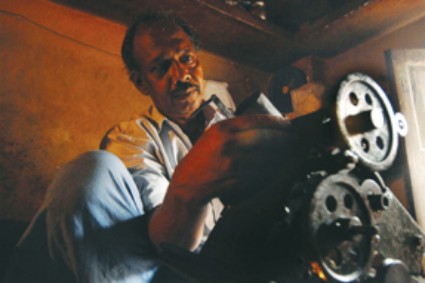
An article by Nilanjana Bhowmick on the man featured in that last film has turned up on Little India (an Indian newspaper published in the USA). Entitled ‘The last bioscopewallah’, its subject is Mohammed Salim, who tours Kolkata with his 100-year-old projector (apparently Japanese in origin) on a cart, accompanied by his reluctant son. It’s an evocative piece of writing, depicting a decades-old form of street entertainment that just about hangs on in the age of the iPod and the DVD, sustained by the belief of the bioscopewallah in the magic of literally bringing cinema to the people. These are a few choice paragraphs:
Bioscopewallah……bioscopewallah ayah….aao, dekho,nai purani filme sirf ek rupiya. (Here comes the Bioscopewallah, come and watch new and old films for just Re 1).
The throw-back cry from the 1960s and 1970s of Indian street vendors trying to lure children and adults to the magic of movies in a box still reverberates in the serpentine bylanes of Kolkata, mingled with the smell of moss and decay. The cry might not have the same verve, nor perhaps does it elicit the earlier enthusiasm. But it still attracts curious onlookers who crowd around as the last bioscopewallah of Kolkata sets up his shop near a school or a movie theater.
Children rush to his cart, clutching a rupee coin in their hands. Some older people might still remember the voyeuristic feeling of peek-a-boo cinema under the shade of the ominously grave-looking black cloth, but most have either forgotten or never experienced the charm of the movie in the wooden box.
Mohammad Salim, with his 100-year-old projector, is a relic from a forgotten era. He roams the streets of Kolkata, letting people experience in short bursts the often surreal world of the bioscope.
Salim’s voice has become weaker with age, but the enthusiasm remains undimmed. He is the thin string that binds Kolkata with its glorious past to the beginning of cinema — the Royal Bioscope Company, India’s first bioscope company. Salim is not only oblivious to the legacy he has carried on his shoulders for decades now, but he is equally nonchalant about his brush with international fame, which includes an Oscar nominated documentary on his life. He only understands his bioscope and beyond it everything else pales.
Salim’s journey on the Kolkata streets with his bioscope began more than 40 years ago. In his late fifties, he laboriously pushes along his archaic projector on a hand driven cart. These days often he is accompanied by one of his unwilling sons, for whom the bioscope holds no magic. Sometimes he is mistaken for an ice cream vendor, most times he is ignored. In this digital age, the wooden bioscope holds no attraction and Salim cuts a lone figure as he wanders from one street to another. However, as he sets shop and Bollywood music and dialogs burst forth from his bioscope, a small crowd gathers around him; a crowd that wants to lose itself in the garish, colorful, melodramatic and musical world of Bollywood movies. The glamour, thrill, drama and dreams of Bollywood are packed into three-four minutes of trailers that transport the viewer into a makeshift world of the movies — short lived, but an escape from the real world nevertheless …
… In the 1960s and 1970s the call of the bioscopewallah was eagerly awaited in the neighborhoods of Kolkata. However in this age of television and computers, the bioscope is as antiquated as the term itself. Salim recalls the golden days when his father’s bioscope ruled the roost: “When my father used to call out, people used to come rushing out of their houses, especially children and women. They used to stand in the balcony for hours in order to catch the bioscopewallah.”
Salim started with his father when aged just twelve. In those days there were many other bioscopewallahs, all of whom showed only silent films. To keep up with the times, Salim has had to adapt to sound, showing scraps of films that highlight songs, dances and fights.
Salim survives in an age dominated by iPods and DVDs by updating his equipment to keep pace with the modern age. His passion with the bioscope led him to experiment with it and add new features. The original bioscope had no provision for sound so Salim, realizing he will lose his audiences if he failed to add it to his trailers, acquired sound.
“I love my projector and the fact that this small box contains all the wonders of a cinema hall. And I told myself, there must be a way to put sound too! I went to the cinema halls and asked people about how they put the sound on the lip movements. We tried to replicate that in my projector and succeeded. It was because I went with the times that I have been able to keep this alive. If there was no sound, no one would have watched it anymore.” …
… The era of the bioscope will likely end with Salim. His sons are not interested in carrying forward the tradition of their father and grandfather. They are young men who have come of age in the digital era of mobile phones and computer games.
Salim is philosophical about his plight and the future of his craft. He insists he is not driven by money, otherwise he would have sold the projector — an antique piece — by now. “I have had offers from abroad to sell my bioscope, I have said no. It is the heritage of my country, why should I sell it to another country?”
One of the great treasures available to anyone with a serious interest in the history of silent cinema is the Talking Silents series produced by Digital Meme. This is a series of ten DVDs of Japanese silents films, with two or three titles per disc. Silent cinema continued in Japan well into the 1930s, but survival rates for Japanese silents make for sorry reading. It is estimated that between 95-99% of all Japanese silent films are lost (with almost none before 1923 owing to the destruction of the Nikkatsu film store in the Tokyo earthquake). Those that do survive are often in a poor condition. Classics such as Kinugasa Teinosuke’s A Page of Madness (1926) and Yasujiro Ozu’s I Was Born But… (1932) are well-known, but what is so interesting about the Digital Meme series is that it includes comparatively routine genre works, so that one gets a real taste of popular Japanese silent cinema.
The striking feature of the series is the use of benshi narration. In the silent era (and even for a while the sound period), Japanese films were accompanied by narrators, an inheritance from the Japanese theatrical tradition. Originally each part in a film was taken by a separate off-screen performer, until the film industry rebelled against this theatrical domination, around 1920, and the single benshi tradition began. The benshi were the stars of Japanese silent cinema: audiences revered theme, and the performers developed individual styles. The DVDs include narrations from recordings made of benshi in the 1970s and 80s, and recreations of the style by Midori Sawato. The narration is an optional feature, and the films carry both the original Japanese titles and English translated titles.
The films present fine mixture of styles, including samurai tales and contemporary dramas, with some early titles from the great master Kenji Mizoguchi. This is full list:
Talking Silents 1:
* Taki no Shiraito (The Water Magician)
Produced by Irie Production, 1933
98 minutes / 24 fps
Directed by Kenji Mizoguchi
Cast: Takako Irie, Tokihiko Okada, Ichiro Sugai
* Tokyo Koshinkyoku (Tokyo March)
Produced by Nikkatsu Uzumasa, 1929
28 minutes / 24 fps
Directed by Kenji Mizoguchi
Cast: Shizue Natsukawa, Reiji Ichiki, Isamu Kosugi
Talking Silents 2:
* Orizuru Osen (The Downfall of Osen)
Produced by Daiichi Eiga, 1935
90 minutes / 24 fps
Directed by Kenji Mizoguchi
Cast: Isuzu Yamada, Daijiro Natsukawa, Ichiro Yoshizawa
* Tojin Okichi
Produced by Nikkatsu Uzumasa, 1930
4 minutes / 24 fps
Directed by Kenji Mizoguchi
Cast: Yoko Umemura
Talking Silents 3:
* Orochi (Serpent)
Produced by Bantsuma Production, 1925
74 minutes / 24 fps
Directed by Buntaro Futagawa
Cast: Tsumasaburo Bando, Misao Seki, Utako Tamaki
* Gyakuryu (Backward Flow)
Produced by Toatojiin, 1924
28 minutes / 16 fps
Directed by Buntaro Futagawa
Cast: Tsumasaburo Bando, Benisaburo Kataoka, Teruko Makino
Talking Silents 4:
* Koina no Ginpei, Yuki no Wataridori (Koina no Ginpei, Migratory Snowbird)
Produced by Bantsuma Production, 1931
60 minutes / 24 fps
Directed by Tomikazu Miyata
Cast: Tsumasaburo Bando, Kikuya Okada, Reiko Mochizuki
* Kosuzume Toge (Kosuzume Pass)
Produced by Makino Tojiin, 1923
39 minutes / 16 fps
Directed by Koroku Numata
Cast: Banya Ichikawa, Shinpei Takagi, Tsumasaburo Bando
Talking Silents 5:
* Kurama Tengu
Produced by Arakan Production, 1928
71 minutes / 24 fps
Directed by Teppei Yamaguchi
Cast: Kanjuro Arashi, Takesaburo Nakamura,
Reizaburo Yamamoto, Kunie Gomi and Keiichi Arashi
* Kurama Tengu Kyofu Jidai (The Frightful Era of Kurama Tengu)
Produced by Arakan Production, 1928
38 minutes / 16 fps
Directed by Teppei Yamaguchi
Cast: Kanjuro Arashi, Reizaburo Yamamoto, Kunie Gomi and Keiichi Arashi
Talking Silents 6:
* Nishikie Edosugata Hatamoto to Machiyakko (The Color Print of Edo: Hatamoto to Machiyakko) (1939, Shinko Kinema, 65 min.)
Directed by Kazuo Mori
Cast: Utaemon Ichikawa, Yaeko Kumoi, Shinpachiro Asaka, Wakako Kunitomo
* Akeyuku Sora (1929, Shochiku Kamata, 71 min.)
Directed by Torajiro Saito
Cast: Yoshiko Kawada, Mitsuko Takao
Talking Silents 9:
* Roningai Dai Ichiwa (1928, Makino Production, 8 min.)
Directed by Masahiro Makino
Cast: Komei Minami, Juro Tanizaki, Toichiro Negishi
* Roningai Dai Niwa (1929, Makino Production, 72 min.)
Directed by Masahiro Makino
Cast: Komei Minami, Hiroshi Tsumura, Toichiro Negishi
* Sozenji Baba (1928, Makino Production, 32 min.)
Directed by Masahiro Makino
Cast: Komei Minami, Shinpei Takagi, Toroku Makino
Talking Silents 10:
* Jitsuroku Chushingura (Chushingura: The Truth)
Produced by Makino Production, 1928, 64 min.
Directed by Shozo Makino
Cast: Yoho Ii, Tsuzuya Moroguchi, Kobunji Ichikawa, Yotaro Katsumi
* Raiden
Produced by Makino Production, 1928, 18 min.
Directed by Shozo Makino
Cast: Toichiro Negishi, Arata Kaneko, Masahiro Makino
Talking Silents vols. 5-8
You get a little in the way of extras on each of the DVDs: a commentary from film critic Tadao Sato, an introduction by modern benshi Midori Sawato. The Digital Meme site has downloadable PDFs of introductions by Tadao Sato. The DVD booklets are thin and half in Japanese, half-English. What is noteworthy is the offer made to educational institutions. Digital Meme makes the series available under three prices: Home Use (allowing individual viewings), Rental Use (allowing institutions to give their members and affiliated persons the right to rent the collection and take it out of their libraries) and Institutional Screening Rights Agreement (for institutions that want to screen the DVDs to a public audience within their premises, or at an affiliate, on a non-commercial basis).
Digital Meme also make available a 1980 documentary on DVD on the life of film actor Tsumasaburo Bando, Bantsuma: The Life of Tsumasaburo Bando (Bantsuma: Bando Tsumasaburo no shogai), and a 4-DVD set Japanese Anime Classic Collection. This is a treasure trove of early Japanese animation, with some of the translated titles delightfully giving indication of their idiosyncratic content: The Tiny One Makes It Big, Dekobo the Big Head’s Road Trip, Why is the Sea Water Salty?, The Duckling Saves the Day. A section of the Digital Meme site gives details of each of the 55 titles on the four-disc set, with frame stills and some synopses. The set comes with English subtitles (and Chinese, and Korean), some live benshi narration, and examples of anime with synchronised audio tracks from gramophone records.
Dekobo no Jidosha Ryoko (Dekobo the Big Head’s Road Trip)
And there’s more. Digital Meme also markets Masterpieces of Japanese Silent Cinema, a DVD-Rom which includes extracts from forty-five films, a database of 12,000 film titles, almost 1,000 stills, posters, original programmes and leaflets, interviews with film veterans, and reference articles, making it an interactive encyclopedia of Japanese silent film, albeit at a price of 18,000 Yen (around $180) which means only institutions are likely to purchase it.
For more on Japanese silent cinema, here’s a few handy sources:
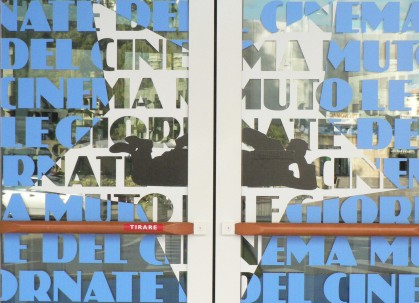
For those who may not know, the recumbent figure who supplies the Pordenone silent film festival logo is Donald O’Connor. That’s Donald O’Connor playing Buster Keaton in The Buster Keaton Story (1957). A curious choice, all things considered, but, hey, it works.
Were I a writer of any skill, I would look upon the films that we saw on Tuesday 7 October, and I would draw out unexpected themes and make thoughtful overviews. But diversity was the only theme on offer. For anyone with only general ideas of what silent films comprise, this was the day to have your eyes opened.
Ironically, if there’s one thing that the average person is able to associate with silent film, it’s slapstick, and that’s what we started with (or rather, what I started with, as I missed the Austrian film Kleider Machen Leute that began the day). Under the ‘Rediscoveries’ strand we were offered a barrage of Keystone Film Company comedies, most of them recent discoveries or restorations. For the festival, this marked the twenty-fifth anniversary of the Keystone-themed festival it ran in 1983.
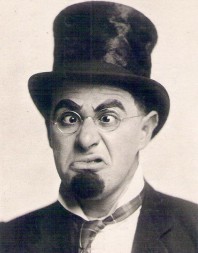
Mack Sennett, Keystone’s presiding genius, ran his studio as an assembly line, pumping out comedies by the yard, with an accomplished, hard-wearing troupe of performers able to fit themselves perfectly into the rigours of whatever routine Sennett had dreamt up for them this week. Three things were particularly noticeable about the films: the unquenchable vitality of the performers, the opportunistic taste for sketches to be devised out of some local event or eye-catching piece of scenery, and the phenomenal speed. One knows all about the knockabout thrills of American slapstick, but looking at a film like Love, Speed and Thrills (1915), the sheer number of shots, angles and different set-ups was prodigious, and seemed to run counter to the demand for getting out the films cheaply and quickly. They made such work for themselves, simply by the pursuit of comic excellence. Not that one could call all of the films strictly funny as such – not funny now, that is – and that the grotesquely gesticulating Ford Sterling (left) was ever revered as a comedian has left posterity baffled. Sterling pulled every face known to man (and a few that man has now happily forgotten) in his efforts to draw laughter out of the curious Stolen Glory (1912), where he and Fred Mace play warring Civil War veterans, filmed interrupting a genuine war veterans’ parade, apparently without any protest from the participants.
Other Keystones that caughter the eye included A Deaf Burglar (1913), which drew some easy laughs from a situation readily inferred from the title, and A Little Hero (1913), which starred a cat (named Pepper), a dog and Mabel Normand, the dog saving a caged bird from the cat’s predations in a scenario that looked for all the world as though it were borrowed from that deathless British classic, Rescued by Rover. Love, Speed and Thrills more than lived up to its title. One could only look on with astonishment at the violent indignities to which Minta Durfee was put in this frenetic chase comedy. These comedies were the inheritors of the comedy series made by European companies, but in their difference to the works of Max Linder, Cretinetti et al one sees how it was that American cinema, and the idea of America, conquered the world. Their new world dynamism is overpowering. Love, speed and thrills sold America.
And then for something completely different. There is growing interest in European women filmmakers in the silent era, and among their select number is the intriguing figure of Elvira Giallanella, director of Umanità (1919). Not much is known about Giallanella, except that she established a film company, Vera, in 1913, which made a Futurist-inspired production, Mondo baldoria (1913), then formed Liana Film, with great ambitions for extensive production, but with just the one title seeing the light of day – Umanità. This thirty-five minute work is unique. It is an anti-war allegory based on a children’s poem by Vittorio Bravetta. The child protagonists are named Tranquillino and Serenetta, which gives you a fair idea of the filmmaker’s intentions. The children wake up in the night – Tranquillino smokes a cigarette (eye-popping stuff) and has a nightmare, in which the world has been destroyed by war and he and his sister are given the task of rebuilding it. Given the nil budget, we have to rely on our imaginations quite a bit. The futility of war is revealed, for instance, by a neat line of empty boots. Peculiarly, the children are guided by a gnome (the embodiment of one of their toys), across deserted, rocky landscapes. The action wasn’t all that easy to follow, chiefly because the Italian intertitles had been bravely translated by the festival into English verse, at the expense of some logic. Intriguingly, Tranquillino, discovers the seeds of violence in him as he wishes to throw bombs, but the two children resort to prayer and are comforted by a bearded God and Jesus (one of a number of appearances during the Giornate). A film of muddled meaning and technique – who saw it at the time, and what on earth did they make of it? – but out on its own among silent film. The film it reminded me of was Richard Lester’s post-apocalyptic comedy The Bed Sitting Room, the survivors wandering about a shattered, empty world, trying to recover meaning.
Shown in the ‘Film and History’ strand, Umanità was paired with the surviving reel of the five-reeler American film If My Country Should Call (1916). This was not anti-war as such, as its avowed theme was ‘preparedness’ for an America which would shortly join the conflict, but its central, sympathetic character was a mother (played by Dorothy Phillips) whose sentiments were anti-war. It was something of a shock to read a closing intertitle which denounced her attitude as selfish. Otherwise it was a tale of enfeebled manhood (and by extension the nation), redeemed by the promise of fighting. Lon Chaney appeared as a doctor, and scenarist was Ida May Park.
Right up my street was Paul Spehr’s special presentation on the films of William Kennedy-Laurie Dickson. As Spehr’s new book says it, Dickson was The Man Who Made Movies. The Edison employee who was assigned in the early 1890s to solving the problem of creating a photographic motion picture device, Dickson not only – more than anyone else – created motion pictures (the system he devised, with 35mm perforated film, is with us still) but he was a maker of movies in the artistic sense. His films, from the earliest experiments with Edison through to his bold adventures with the British Mutoscope and Biograph Company in the late 1890s, are hauntingly beautiful. I won’t got into every film here, but just to say that Spehr presented them as part of a combined film and computer slide show, and did so with wise aplomb. It is quite something for someone who has just written a 706-page book on his subject to express its essence so simply and clearly. Of the many films he showed, I’ll note just one – Dickson’s very first, Monkeyshines no. 1, miniscule images photographed and laid around a cylinder, before they realised that copying Edison’s earlier invention, the Phonograph, wasn’t quite the way to go. From a microphoto on a cylinder to the big screen of the Verdi – and it’s on YouTube too, the human figure in motion evolving out of incoherence, the ghost in the machine:
Monkeyshines no. 1 (1889), the first American movie
My prize for the most disappointing film of the week went to A Modern Musketeer (1917). This really ought to have been a gem. A complete copy was only recently discovered, and it represents a key point in the development of Douglas Fairbanks’ persona, from his young-man-about-town persona to the swaggering figures of his 1920s historical romps. It seemed to have a cast-iron premise. Fairbanks plays a young man whose mother was addicted to the works of Alexandre Dumas just before he was born, and he is imbued with the spirit of The Three Musketeers, which he then tries to take into modern American life as a twentieth-century D’Artagnan. Fabulous concept – what could possibly go wrong? Well, after overplaying the idea wildly in an energetic opening five minutes, the film then abandons it almost entirely for a muddled, uncertainly-paced comedy-thriller set in the Grand Canyon, with an unpleasantly racist undertone in its depicition of the native American villain. Pianist Ian Mistrorigo (a Pordenone masterclass alumnus) tore along at a terrific pace, trying to make the film what it ought to have been, but the film stubbornly refused to live up to his expectations. It’s great that the film has been found and restored, but it’s unfunny, unthrilling, and frankly clueless. Oh dear.
Ed’s Co-ed, from University of Oregon
At this point I was planning to see two Sessue Hayakawa films, His Birthright (1918) and The Courageous Coward (1919), but the word had got round that Ed’s Co-ed (1929), which had been shown the day before to a minimal audience in the Ridotto, was getting a second screening because people really had to see it. Dutifully I went, and I’m very glad I did. There was a fascinating story behind it. In 1928 a University of Oregon student, Carvel Nelson, got to work on the set of F.W. Murnau’s The City Girl. Bitten with the film bug, he decided to make his own film, working with fellow students and an English professor, and raising finance locally. The Nelson and his eventual co-director James Raley made so bold as to approach Cecil B. DeMille for advice. DeMille put them in touch with his cinematographer, James McBride, who amazingly joined the production as technical director and got paid for it as well. With a 35mm Bell & Howell camera rented from Hollywood, and a cast recruited from across the university, Ed’s Co-ed went into production in February 1929 and had its premiere locally in November of that year.
Ed’s Co-ed is a strikingly accomplished film. McBride’s presence clearly aided the fluid, expressive cinematography, including a number of vivid sequences (a punt drifting on the waters through trees, a close shot of women students looking through a window enraptured by some violin playing), but he could not have claimed responsibility for the immaculately engineered script with central and sub-plots artfully interwoven, nor the highly capable performances from the entire cast. There is not a trace of amateurism about Ed’s Co-ed. The story is that of every college movie you ever saw – country boy Ed comes to college, is picked on by other students, he falls for the girl but is rejected by all after he admits to a crime to cover up for someone else who actually committed it, his talents are recognised (he plays the violin, he’s top in all his grades), he wins through at last. It’s so like ever college film made that you could be fooled by its ordinariness, but this is a college film that actually came from a college, and it is a treasure trove of period attitudes, codes, fashions and language.
The 35mm original of Ed’s Co-ed was destroyed in the 1960s when a 16mm dupe was made. We were told that the university hadn’t shown sufficient interest in the film to want to fund a restoration, which is a shame if true because though it might be a hard sell, a DVD edition could reach both silent film fans and those with an interest in American social history. However, there must be some interest from the university, because you can find the whole of Ed’s Co-ed online (87mins). It’s available in streamed and downloadable forms from the University of Oregon’s Scholar’s Bank website – no music track, but otherwise it’s a good quality encoding, and I warmly recommend it. Praise, by the way, for the accompaniment at Pordenone from Neil Brand (piano) and Günter Buchwald (violin, to match Ed’s playing), overlapping beautifully.
I missed most of the evening screenings, owing to a genial supper with a gaggle of pianists, but I returned for the last film of the day, The Man Beneath (1919). This is one of the films recently discovered and restored by the Nederlands Filmmuseum of Sessue Hayakawa, the Japanese-American star who has attracted such critical and archival interest of late. Hayakawa is fascinating not just for his star presence and position as an Asian performer in the heart of Hollywood, but for his thinking about his role and the degree to which he tried to combine positive images of himself as a representative Japanese figure with the demands of the box office, through his position as an independent producer.
The Man Beneath was made by Hayakawa’s own Haworth Pictures Corporation, and it came at a time when he felt it was right to expand his range somewhat. Hence the peculiar set-up, where we get a Japanese actor, playing a Hindu doctor, in an American film, set in Scotland. Hayakawa plays Dr Chindi Ashuter, who is in love with the Scottish Kate Erskine, and she in love with him, though she is held back by the fear of the social consequences of a mixed marriage. Her sister is married to an associate (white) of Ashuter’s, whose entrapment by a secret society and rescue by Ashuter forms the main action of the film. But it is Ashuter and Kate’s thwarted love that is the real theme. He returns to Scotland, but she sorrowfully rejects him, and he leaves sadder and wiser. Of course, a mixed marriage was never going to be shown upon the screen in 1919, so the plot had nowhere else to go, but what lingers in the mind is the intensity of the feelings, particularly as expressed in a luminous performance by Helen Jerome Eddy as Kate. Hayakawa is less of a presence, curiously enough, but one shot where he stares in anguish at his reflection in the mirror and tears at his face, drawing blood, says everything.
And so we saw farewell to Day Four, and look forward to the morrow, bringing us smouldering South American passions, Austrian troops scaling mountains, a near-lynching presented as comedy, a Mozart-free Figaro, a gold digger triumphant, and bare knuckle boxing accompanied by the harp.
Showing at the National Theatre in London 12-15 August as part of its ‘Watch this Space‘ summer festival of outdoor entertainment is Movieplex, an entertainment that tells the story of a forgotten pioneer of Indian cinema, one Shanta Rao Dutt (1881-1987). Dutt, it seems, led a remarkable life. In 1896, when aged just 15, he witnessed a Lumière brothers’ film screening at the Watson’s Hotel, Bombay. Instantly struck by the magic of cinematography, Dutt – a porter at the hotel – discovering the unattended machine spooled with film ready for a demonstration the following morning, could not resist having a go for himself, and shot a film of the baby son of his landlord (‘negotiations are currently in progress between the Lumière estate and the Dutt family to release this print from the Lumière archive for public exhibition’). The prank got him fired from the hotel, but led him to pursue the Lumières to France.
There he was briefly employed by the brothers, before being fired for taking an unauthorised time lapse film. Undaunted, he worked for a time with Georges Méliès, before acquiring his own cinematograph camera. He returned to India in 1900, making films of his trip along the ay, then made a film of his brother Jeevan’s journey to Fiji as a bonded labourer (the only copy of the film was lost in a shipwreck). Dutt next took on commission from the British Raj, filmed in Japan, then went to England where he worked as a newsreel cameraman from Pathé, before joining British intelligence during World War One. He shot a film, The Docker and the Rose, in Liverpool in 1920, marrying its heroine. A copy was rediscovered in 2006. The Dutt family travelled to the Soviet Union in 1927 and met Eisenstein, then in 1933 Shanta founded the Movieplex company. He was knighted in 1945. The family continued its entrpreneurial activities, with one family member opening a cosmetic firm, and another opening the Movieplex Emporium on London’s Tottenham Court Road in 1975, selling VHS players. Shanta died in 1987, aged 106.
OK, enough of all this. You can follow the whole convoluted story, with chronology, genealogy, filmography and business promotions on the Movieplex site. The whole thing is a fiction, but one on which an extraordinary amount of effort has been spent. Aside from the main website and exhibition, there is a blog where an academic earnestly discusses Dutt’s films, a MySpace site from a young American fan who thinks Dutt was ‘some dude’, and a WordPress blog from a woman who says she is related to Dutt’s wife and has been researching the family history. Most brazenly, there is the previously ‘lost’ film The Docker and the Rose, an extract from which has been published on YouTube by the Liverpool Echo, which would appear from this press report to have fallen entirely for the story.
A 1920s tape discovered two years ago in a Wallasey antique shop was the inspiration for a major piece of outdoor art.
Movieplex is based on the work and life of lost filmmaker Shanta Roa Dutt and a nine-minute silent film, Docker and the Rose, which he made in Liverpool.
It was specially commissioned by Liverpool Culture Company and premieres in the city as part of The Imagine Festival which takes place next week.
The film was found in 2006 in the drawer of an Edwardian display box bought from an antique shop in Wallasey.
It was bought by Ajay Chhabra, co-artistic director of arts company nutkhut, who was in Liverpool with wife Simmy for the performances of Bollywood Steps.
He said: “My wife and I found the tape when antique hunting and borrowed equipment to watch it.
“We couldn’t believe what we had found.
“We decided we wanted to make it into a piece of outdoor art. Simmy and I enjoyed our time in Liverpool with Bollywood Steps so much and had made a number of friends, so we approached the Culture Company with the idea.
“They were very keen and commissioned us to go ahead. It seemed only right that a film made and based in Liverpool should come home in the Capital of Culture year.”
The specially commissioned piece of outdoor art features two containers, one with memorabilia from the Dutt family’s many films and history and the second a miniature cinema which shows the nine minute silent comedy.
A 1920s tape? Others have bought the story seemingly hook, line and sinker – for example, the Liverpool Post, Screen India and The Hindu. Even Manchester’s the North West Film Archive, as quoted in the press reports, has been ‘closely involved in the conservation and digital conversion of the film’, though one assumes they were rather less fooled than the papers and are playing along with the game.
What is going on here? The people behind the mischief are called nutkhut, a London-based ‘creative organisation’. Nutkhut in Sanskrit means ‘mischievous’, and nutkhut have applied considerable ingenuity to spinning a tale of enterprise and adventure, with just enough attention to plausible detail (the journey to Fiji, the VHS emporium in Tottenham Court Road) to dupe the unwary. In particular, the ‘lost film’ clips shows how many cannot tell an original from pastiche. Some of the publicity hints as an aside that not all may be as it seems, and the Movieplex website itself carries warning words on its banner – ‘The truth is never quite what it seems’. Others seem not to have realised this.
Why has it all been done? Apart from the impetus of Liverpool as a ‘City of Culture’ in 2008 (it was co-commissioned by Liverpool Culture Company Ltd), the show (or installation, or whatever exactly it might be) takes its inspiration from a general fascination with, but also confusion about, popular Indian culture in the West. There’s a story there of an independence of spirit, mixed with elements of film history vaguely known many, that has a quirky appeal. But is it good to publish so much false history? Will some hapless student end up trying to investigate The Docker and the Rose, or writing Dutt into a history of early Indian film? Is early film history just a game after all?
Movieplex plays at Theatre Square, the National Theatre, London 12-16 August, and Crawley Town Centre, 21-24 August. Exact times and other details are on the Movieplex site.
The Bioscope is naturally delighted to record the release of Delhi-based K.M. Madhusudhanan‘s feature film Bioscope. The film’s subject is silent film in India. Set in Kerala, it tells of Diwakaran, who in the early years of the twentieth century encounters the Bioscope (a film projector), being operated by a Frenchman. He purchases the machines and tours local villages with his films, but he is beset by problems: practical, social and familial, as modernity clashes with tradition. Madhusudhanan says that his hero is based on a real figure, Varunni Joseph, who ran a Bioscope shows in Kerala in 1907.
Bioscope received its world premiere last week. It is produced by the National Film Development Corporation Ltd., India, it’s 94mins long, and in Malayalam and Tamil, with English subtitles. The film’s website has interesting background information on early film in India and assorted production stills. This article from ExpressIndia.com describes the film and its intentions:
Reel Beginnings
A filmmaker goes in search of the first flicker of cinema in Kerala
Anushree Majumdar
Flickering on a white sheet stretched across the wall, the image of a train entering the platform emitted a collective gasp. In 1906, the unsuspecting villagers at Thrissur Pooram in Kerala, who’d bought a ticket to the bioscope show, couldn’t believe what they were seeing. Surely this was the work of the devil. Instead, it was the work of man — the advent of cinema in India. This fascination with cinema and images is what Delhi-based filmmaker K.M. Madhusudhanan has lyrically portrayed in his first feature film, suitably titled Bioscope.
The film saw its worldwide premiere at the Osian’s Cine Fan Festival of Asian and Arab Cinema last week and has been awarded the NETPAC Jury Award for “crystallising a turning point in a country’s colonial past with meditative images and a strong metaphor evocative of cinema’s magical powers”.
As an artist, photographer and filmmaker, it was only natural that Madhusudhanan strung together a historical narrative with images that would embody the wonder that is the cinematic experience. “I wanted to show the curiosity of the human gaze through the film. The appearance of the bioscope in Kerala was something that drew me even closer to the subject,” says Madhusudhanan, who spent his formative years in Kerala before moving to Vadodara to study printmaking.
Set in the first decade of the 20th century in Kerala, Bioscope traces the life of Diwakaran, whose life is completely altered after his first brush with the bioscope and moving images. He buys the device from a Frenchman who ran bioscope shows and decides to take the instrument and its wondrous images to nearby villages. But suspicion, superstition and the lack of family support make it difficult for Diwakaran to fulfil his purpose. “I started to work on a project about silent films and early cinema. My research brought me to that time in history when Kerala had its first bioscope show and I found my story emerge from there,” says Madhusudhanan who is also painting an entire series on silent films as well. The entire series consists of 35 paintings in which film reels contain hazy images, and cameras share space with the artist’s imagination.
Funded by the NFDC, the film will soon head to various international festivals and by December, the sequel to the film will go on floor. “Bioscope is the first part of a trilogy. The second part is titled Kannadi Kottaka (Mirror Cinema Hall) and is set in contemporary Kerala. It is about a movie house and three people who are connected to it,” says Madhusudhanan.
It’s getting hard to keep up with the mini-rush of Indian films and books which are taking silent cinema as a theme and the bioscope (the sometime Indian name for a cinema) as redolent term. Probably calls for a round-up post on the subject some time soon.
The Sport of the Gods
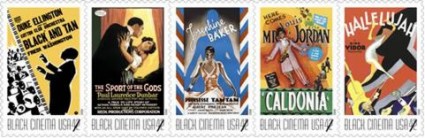
The US Postal Service has issued a series of stamps celebrating African-American performers in early (i.e. pre-1950) films. The titles chosen are each represented by posters and include the 1921 all-black cast The Sport of the Gods, directed by Henry J. Vernot and starring Elizabeth Boyer and Edward R. Abrams. Read more.
Shakespeare goes Hollywood
Director Scott Palmer and the theatrical company Bag & Baggage Productions are putting on a production of A Midsummer Night’s Dream that is set in the world of silent-era Hollywood. Chaplin, Lloyd, Valentino, Theda Bara and Louise Brooks are all referenced, while Puck echoes Murnau’s Nosferatu. The production is being put on for Oregon State University’s Bard in the Quad at Corvallis. Read more.
Telegu silent once more
Telugu comedy actor Brahmanandam, who is recorded in the Guinness Book of Records for having appeared in the most number of films in a single language, is to star in a silent film, which is reckoned will be the first Indian silent commercial feature film since the classic Pushpak. The film, Brahmanandam Drama Company, is a Telegu remake of the 2006 Hindi film Bhagam Bhag. Read more.
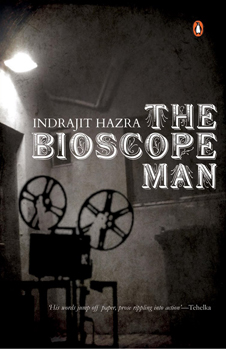
Just recently published in paperback, The Bioscope Man is a novel by Indrajit Hazra, which has its background the days of silent cinema in Calcutta. It tell of the rise and tragic fall of Abani Chatterjee in the 1920s Indian bioscope business, starting as projectionist’s assistant and ending up a star performer, only for ignominy and failure to follow. Other fiction and reality interestingly combine – among the characters in the book are Adela Quested (from E.M. Forster’s A Passage to India) and Fritz Lang, who comes to India to make a film starring Chatterjee but ends up producing Metropolis instead. As with many aspects of Hazra’s book, this has some some grounding in historical reality, as in 1921 Lang and wife Thea von Harbou scripted the two-part Das Indische Grabmal, directed by Joe May and set (but not filmed) in India, and Lang had a lifelong fascination with India. The word ‘bioscope’ was – and remains – a common term for cinema in India, and Hazra notes that the name came from Charles Urban, whose Bioscope cameras and projectors were used by the first Indian filmmakers and exhibitors.
I’ve not read the book yet, but reviews from the Indian press, though mixed, give an interesting flavour of its contents. The Hindustan Times points out the care taken over making the background film history convincing:
The Bioscope Man is set in the Calcutta of early 20th century However, echoes of what is happening on the other coast in Bombay keep intruding into the margins of the story of the rise and fall of his protagonist.
Two years after Dadasaheb Phalke made the first full length feature film in India, Raja Harishchandra, in 1917, a Bengali film, Bilwamangal, produced under the banner of Madan Theatres, was screened in Calcutta. Harishchandra S. Bharvadekhar, a still photographer and dealer in equipment in Bombay was the first to make a film (two, brief films, in fact) in India in the late 19th century. And not too long after, in 1901, Hiralal Sen set up Royal Bioscope in Calcutta to make films: he photographed dance sequences and scenes from plays being staged at Classic Theatres. (‘Bioscope’ is the name of an early film projector for splashing moving images on a screen. It became the generic name for cinema after the American Charles Urban – producer of the world’s first successful natural colour motion picture system, Kinemacolor, as Hazra mentions in his book – popularised it.)
Hazra, a journalist who happens to be a novelist (perhaps it is the other way round), uses his ferreting skills to take the reader behind the silent parde ke peeche, into the fairly cut-throat world of the early pioneers of silent movies in Calcutta.
He also situates his story against a vividly portrayed background of a city whose confidence is being undermined by the decision of the British to shift their capital to Delhi. In the background as well, but palpably present, are the repercussions of the first partition of Bengal – usually through the fringe characters who keep popping up in the novel and the stray remarks tossed occasionally.
While the author has woven many themes into the novel – a critique of Orientalism, a portrait of the Bengali bhadralok in Victorian India, self-deception, the birth and infancy of silent movies – it is the marvellously drawn portrait of the actor whose rapid rise and fall marks him. The actor’s reflections upon his life and work are riveting.
The review in The Newindpress on Sunday shows how the hero’s experiences in the Indian film industry resonate with wider concerns, while describing how Chatterjee meets his downfall:
He starts as a projectionist’s assistant at the Alochhaya Theatre, graduates into being a prompter, and by a lucky twist of fate ends up playing the title-character of Prahalad Parameshwar. He subsequently essays the roles of Othello, Ram, Parasuram and Shivaji, and his silent movies lead to resounding success. He starts getting recognised in street corners and quaint cafes, and is nothing short of being a star.
Hazra successfully experiments with technique, so we find three interludes interspersing the narrative like the titles of the silent films: the stylised stories of Prahalad, Anandhamath and the Black Hole of Calcutta. These bioscopes starring Abani are instant hits with the masses because of their daring portrayal of intimacy and undercurrents of nationalist chic. Yet, he views freedom fighters as “criminals with ambition” and maintains his nonchalance towards nationalism even as various upheavals rock the subcontinent.
Here, brown men (teeming with Bengali pride) share a love-hate relationship with mems: Abani chooses corrosive satire to attack the shape-shifting Annie Besant, though he initially finds her “American” and desirable; Shombu Mama is infatuated with bioscope diva Faith Cooper; and Abani labours under the weight of his undeclared, one-sided love for his onscreen sweetheart Felicia Miller.
On hearing the news of Felicia being shipped to Australia by her disapproving father, Abani enters a trajectory towards ruin when he mistakenly enters a ladies’ restroom. The man with the “bioscope in his bones” falls from grace and spends a decade playing minor roles.
A tart review from The Hindu also focusses on the wider historical background, indicating how the novel may end up being viewed quite differently by audiences within and outside India:
What is it with Indrajit Hazra? Why is he so hung up on the English? A good deal of the novel is a diatribe about the partition of Bengal in 1905 and the shifting of the capital from Calcutta to Delhi in 1911. He tells us about how disastrous it all was for the cultural life of the city and how everything went to seed after that. Curzon, Minto and Hardinge come in for a lot of stick, which is bad enough, but then he goes after old Winston. During a discussion about whether Charlie Chaplin should be called English or American, one of the animated Bengalis inhabiting this novel comes up with this argument: “No, no Shombhu-babu. That doesn’t make him American. Does the British Minister of Munitions become an American just because his mother is American? No, Lahiri babu, Churchill is English.”
There are references galore to period socio-economic gloom, period costume, period food, period politics. Which is all very well but the fact of the matter is that all this does not push the plot forward at all. The author has done huge research, pushed the story into the canopy , then tucked in the ends.
The Bioscope Man is a well-written book in the sense that there is no doubt about Hazra’s command over the language. It is the content one is worried about. Sometimes one wonders which nation he is writing for. In the beginning of the novel he talks about the eating of shingaras and jilipis. Shingaras are, of course, the samosas of Calcutta but take a look at his description of jilipis — “bearing a resemblance to miniature French horns fit for an orchestra of midgets.” No doubt Hazra’s European translators will have a lot of fun with that.
They will also have a lot of fun with the last quarter of the book in which Fritz Lang, German expressionist film maker, turns up in Calcutta to make a film starring Abani Chatterjee. The film is titled: “The Pandit and the Englishman” and is about Pandit Ramlochan Sharma, the Sanskrit tutor of the Orientatlist Sir William Jones. The film is made with great fanfare, but in 1927 the film that is released by the UFA Studio in Berlin is not Abani Chatterjee’s film, but Lang’s Metropolis.
The Bioscope Man is published in India, the UK and the USA. It is Indrajit Hazra’s third novel. Curiously, it is not the only novel set in the early Indian film business to be out at the moment. Tabish Khair’s much-praised Filming: A Love Story, just out in the UK in paperback, centres on 1940s Bombay cinema at the time of partition, but looks back to earlier modes of filmmaking (while echoing these in the novel’s style and framework).
Silent cinema in India has attracted increated critical interest in recent years. There was a major retrospective at the Pordenone Silent Film Festival in 1994, out of which came Suresh Chabria’s book, Light of Asia: Indian Silent Cinema 1912-1934, which includes a lenghty filmography. The major reference source in English is Ashish Rajadhyaksha and Paul Willemen’s monumental Encyclopedia of Indian Cinema. A leading Indian authority is historian P.K. Nair, who writes about the origins of Indian cinema on the Phalke Factory wiki (D.G. Phalke being the creator of India’s first feature film, as noted in The Bioscope Man).
Indian silent films on DVD remain a rarity, but the BFI has issued Franz Osten’s A Throw of Dice (1929), with music by Nitin Sawhney, which strictly speaking is an Anglo-German production, but was filmed in India and has been understandably claimed as an Indian film.
Finally, there was an article recently in The Hindustan Times on preserving India’s film heritage which sadly notes that only twenty-four of the many hundreds of films made in India during the silent era are known to have survived (three of them being films made by Franz Osten).
As evidence of the value of Live Search for searching across the texts of books digitised by the Internet Archive (see previous post), here’s a passage from The Nightside of Japan, by Taizo Fujimoto, published in 1914. It’s a travel book on Japan written for a Western audience by a Japanese writer, and it includes this marvellously vivid portrait of attending a cinema show in Tokyo at this time, complete with benshi narrator, interval acts and food sellers.
The Asakusa is the centre of pleasure in Tokyo. People of every rank in the city crowd in the park day and night old and young, high and low, male and female, rich and poor. It is also a haunt of ruffians, thieves, and pickpockets when the curtain of the dark comes down over the park. All houses and shops along each street in the park are illuminated with the electric and gas lights. The most noisy and crowded part is the site of cinematograph halls. In front of a hall you see many large painted pictures,
illustrating kinds of pictures to be shown in the hall, and, at its entrance, three or four men are crying to call visitors: “Come in, come in! Our pictures are newest ones, most wonderful pictures! Most lately imported from Europe! “Men of another hall cry out: “Our hall gives the photographs of a play performed by the first-class actors in Tokyo; pictures of the revenge of Forty Seven Ronine!” Tickets are sold by girls in a booking-box near the entrance of each hall; they are dressed in beautiful uniforms, their faces painted nicely, receiving guests with charming smiles. Most of the Japanese carry geta (clogs) under their feet, instead of shoes or boots, and specially so are the females. When you come into the door of a hall, tickets are to be handed to the men, who furnish you zori (a pair of straw or grass-slippers) in place of your geta, and you must not forget to receive from them a wood-card marked with numerals or some other signs the card being the cheque for your clogs. When you step on upstairs you are received by another nice girl in uniform, who guides you to a seat in the hall. Now the hall is full of people; it seems that there is no room for a newcomer, but the guide girl finds out a chair among the crowd and adjusts it to you very kindly. Pictures of cinematograph are shown one after another, each being explained by orators in frock or evening coat. Between the photograph shows performance of comic actors or jugglers is given. After the end of each picture or performance there is an entr’acte of three or five minutes, and in this interval sellers of oranges, milk, cakes, sandwiches, etc., come into the crowds, and are crying out: “Don’t you want oranges? Nice cakes! New boiled milk! etc., etc.” The show of cinematograph is closed at about 12 P.M., and all people flow out of the hall. Where will they go hence? Of course most of them go to their home, but a part of them young fellows among others runs to the Dark Streets of the park, or Yoshiwara, the licensed prostitution quarter near the park.
The Nightside of Japan is available from the Internet Archive in the usual range of formats (PDF, DjVu, TXT), and contains a few more references to cinematographs. More such gems as I find them.
In 2004, American filmmaker Arthur Dong was working on a documentary, Hollywood Chinese. He came across two reels of a lost and barely-known silent film from 1916-17. Amazingly, it was made by and for the Chinese-American community. The Curse of Quon Gwon: When the Far East Mingles with the West was all the more remarkable for having been written and directed by a woman, Marion Wong. It was instantly recognised for its national importance, and in 2006 it was added to the National Film Registry of American treasures marked out for permanent preservation.
The film was found in a basement in Oakland, California, Marion Wong’s home town and location for the film. The film’s exhibition this week at the Grand Lake Theater in Oakland has generated a far bit of publicity, and a local news report on ABC7 News which is worth checking out because it has some clips from the film, plus an interview with Dong. The same clips are also available on the site of Deep Focus Productions, which made the documentary Hollywood Chinese, and which has background information on Wong’s film. It’s a graceful, professional-looking production, offering a tantalisingly narrow window on a community and on a little-known strand of American filmmaking.
Little seems known about the film itself. Marion Wong made it for Mandarin Film Productions, and employed mostly family members for its production. Wong herself acts in the film, as do her sister-in-law Violet Wong (whose daughters had held on to film until Arthur Dong discovered it) and her mother Chin See, while other family members worked on costumes, sets and finance. Overall there was a Chinese cast of thirty. The surviving film is incomplete, reels four and seven of what may have been an eight reel feature. A 16mm print duplicates this footage while adding an additional ten minutes. The film is now preserved by the Academy Film Archive.
What other Chinese-American filmmaking existed in the silent era? The Curse of Quon Gwon is thought to be the first Chinese-American film, but what led Marion Wong to produce it, and what followed it? Was it actually shown in public? There doesn’t seem to be any actual evidence that it was screened, just that it lost the family a lot of money. The Deep Focus website tells us that Motion Picture World of 17 July 1917 noted the film, saying that its plot:
… deals with the curse of a Chinese god that follows his people because of the influence of western civilization. The first part is taken in California, showing the intrigues of the Chinese who are living in this country in behalf of the Chinese monarchical government, and those who are working for the revolutionists in favor of a Chinese republic. A love story begins here and is carried through the rest of the production.
Another press notice from May 1916 has Wong’s thoughts on her film:
“I had never seen any Chinese movies,” Miss Wong said today, “so I decided to introduce them to the world. I first wrote the love story. Then I decided that people who are interested in my people and my country would like to see some of the customs and manners of China. So I added to the love drama many scenes depicting these things. I do hope it will be a success.”
There’s a helpful family history for Marion Wong on the CineMedua site, but I’ve found nothing else of Chinese-American filmmaking in the silent era (plenty of Chinese-American characters of course, usually of the tedious ‘yellow peril’ villainous type, alas), certainly not in the American Film Institute catalog. So maybe it’s a remarkable one-off, not a fragment of a lost history but a fleeting vision of a history that might have been. [See comments]











 The Bioscope