The Scottish Screen Archive has released some 1,000 film clips on its impressively-redesigned site. The SSA is Scotland’s national film archive, now part of the National Library of Scotland. It has an excellent record of preserving, contextualising and making accessible a national moving image heritage to a multiplicity of audiences. This latest resource comes courtesy of the Heritage Lottery Fund, and present clips from the 1890s to the 1980s, all integrated into their existing catalogue. The searching and browsing (by place, subject, biography and decade) are all exemplary, and the catalogue descriptions are spot on.
Social films, city films, newsreels, home movies, charity films, advertising films, interest films, documentaries – this is a marvellous collection, not just of Scottish life but of the multifarious forms of the non-fiction film, demonstrating for our period what an important part it plays in what should be our understanding of the silent film overall – somehing of the people, for the people. Go explore.
As was reported a few months ago on The Bioscope, the Cinema Museum in south London comes to the end of its lease this month, and has no new home to move to. Its current home is a former Lambeth workhouse (the same one that once incarcerated Charlie Chaplin’s mother), but this is owned by an NHS trust and it wants to sell the dilapidated property. The Cinema Museum is privately-owned and not open to the general public. It only keeps going financially through its commercial stills business. It is an absolute treasure trove of cinema memorabilia – posters, designs, seats, uniforms, costumes, books, journals, equipment, and a sizeable film collection, as well as a million stills.
The Cinema Museum may be struggling to find a base, but it is doing very well at drumming up publicity. There have been press reports, such as this account in The Times, and yesterday there was a report on Channel 4 News, which you can see on its site (as well as the uncut original interview with owner Ronald Grant, no less).
The lease runs out on March 25, and no one knows what will happen thereafter. Anyone with a large (10,000 sq ft) space in London not doing that much who might like to provide a home for the collection should get in touch with Ronald Grant or Martin Humphries asap. It’s an irony that while the Cinema Museum faces eviction, on London’s South Bank we have the peculiar, opportunistic Movieum of London just opened, dedicatd to British cinema, sort of, though I doubt much that it devotes much space, if any, to the silent era.
If you want to see what’s held in the Cinema Museum, take a look at their wonderful promo film available on YouTube.
Update (23 March): The Cinema Museum reports that the NHS Trust which owns the building has given them a two-month reprieve (i.e. to the end of May). Meetings are taking place regarding the museum’s long-term prospects, but this will still leave them needing to find a new home in the short-term. Also their website is active again, having gone down for a short while. More news as I find it.
The appearance of the above film on the BFI’s YouTube site has inspired me to revive the Lost and Found strand on this blog (film collections once lost that have now been recovered), and to tell you something of the remarkable story of the Henville collection.
Cast your minds back to 1995. It was the year of the Oklahoma City bombing, Yitzhak Rabin was assassinated, the Aum Shinrikyo cult relased sarin gas on the Tokyo underground, Jacques Chirac became president of France, Eric Cantona attacked a football fan in the crowd, a new moving image format, the DVD, was announced, and in film archives and cinematheques across the globe those dedicated to film history and numerology sought various ways to mark the centenary of cinema.
It was a busy time for me, as the British Film Institute’s pet early film enthusiast, if not quite expert, with screenings, events, conferences and writing a book on Victorian cinema. And somewhere early on in that manic year, a collection of films turned up. There were some seventeen cans, single reel subjects, non-standard perforations, all readily identifiable as films from the 1890s. Films from the 1890s generally only turn up in dribs and drabs, so seventeen titles in one go was quite a coup. And the archivist who took in the films let me inspect a few (they were in a very fragile state), and one I looked at was clearly filmed at Epsom. ‘Oh no’, I said, ‘it’s another Derby’. We had other early Derby films, all looking very much the same, and it was a pain in the neck trying to tell one from another. I set it to one side…
The collection had come from one Ray Henville, a collector of vintage radios. At an auction he picked up some vintage radios and with them acquired some cans of unidentified films. Henville knew nothing of old film, but one of them featured a sailing boat, so he sent in a photograph to a yachting magazine in the hope that someone might be able to identify it. Happily the photograph was seen by Bill Barnes, film historian and twin brother of John Barnes, author of the esteemed The Beginnings of the Cinema in England series.
Bill alerted that BFI, we took them in, and I ended up trying to identify them. This was a slow process, not least on account of the fragility of the films which meant that for a long period I only had frame stills to go on. But it soon became clear that here was a remarkable collection of films from the 1890s, several of them likely to have been taken by Birt Acres, the first person to take a 35mm cinematograph film in Britain.
Birt Acres filming the 1895 Derby
What distinguished these Acres films was an indistinct frameline and a lack of sharpness to the image. These were characteristics of the Derby film, and the more I looked at it the more I felt that it could be the Derby of 1895, which would make it an extraordinary coup in the centenary year. But how to identity it for certain? There were no contemporary frame stills that I could use to compare, but the angle of the camera matched the position known to have been taken by Acres in the above photograph. Then, having checked race reports and horse racing sources, I looked at the colours of the jockeys (albeit in black-and-white), which matched the winner for 1895, and the fact that it showed a close finish between three horses, such as featured in 1895 but not any other Derby 1896-1900.
It wasn’t quite a eureka moment, and there were arguments against the identification. The film had perforations which suggested it was a later production by Acres’ great rival Robert Paul, who was effectively the producer of the 1895 Derby (it turned out to be a reprint), and once a dupe print had been painstakingly created by archivist João Oliveira and we could screen it, we discovered the film ran satisfactorily at 24 fps, when a film shot for the Kinetoscope peepshow (which was the case with the 1895 Derby) ought to have run at 40 fps. There isn’t space here to go into the complexities of this particular argument – suffice to say that one should judge things by what one finds, not what one expects to find, and that though some doubts were raised over the film’s identity I believe I was right, and the discovery recently of further Acres films from this period which similarly run at a speed seemingly too slow for the Kinetoscope tends to verify the original identification.
What is believed to be the Derby of 1895, filmed by Birt Acres
It took a while to identify all the films in the Henville collection, and in some cases original identifications were overturned, but here’s the list of films, with titles in brackets for those still unidentified (links are to their entries on the BFI database):
I remember the Yarmouth film in particular because David Cleveland, then head of the East Anglian Film Archive had asked me what the likelihood was of this, the earliest film taken his region, ever turning up. I said it was next to impossible. A few weeks later, we had a copy. Now it’s on YouTube.
But what is also of interest is what happened next. A huge fuss made was made about the collection, especially the Derby film. The BFI went to town on it. We had reams of press coverage, television news reports, even a mention on Barry Norman’s Film 95. But this in turn raised the interest of the donor, who felt that there had to be great commercial value in these films, and eventually he took back the nitrate originals, with the BFI retaining the dupe copies it had made. The films were put up for auction in Germany, where I think one or two titles were sold (including the Georges Méliès dramatisation of a scene from the Greco-Turkish War, La Prise de Tournavos, I think), and then the remainder went up for auction at Sotheby’s in 2000. As I recall, the collection was bought by a London antiquarian bookdealer apparently without any knowledge of film.
And then what? A mystery. Perhaps the films lie crumbling on that same bookseller’s shelves, or maybe they have passed on to other hands, convinced that the great excitement generated by the films’ discovery had to mean that they had a great commercial value. Of course, they did not, except what one might get for them at auction – in all other respects, there was nothing to be made from them. This is a folly which has been repeated again and again, dreaming of treasures when all one is left with is unshowable, inflammable and not even necessarily unique (at least six of the Henville films were duplicated in other collections), fascinating to the specialist but of only passing interest to the general viewer. And arguably of minimal aesthetic interest.
But the duplicate copies remain, and so the 1895 Derby is preserved for posterity, until some bright spark comes along and tells me it was the 1896 Oaks all along…
Update (2019):
In September 2019 theatre and film historian Barry Anthony uncovered an image taken from the Acres Derby film which clearly corresponds with the print held by the BFI. The image, which is heavily retouched and printed the wrong way round, with the background removed, was found in The Field, 21 September 1895, p. 510, submitted by one IMPECUNIOSUS (a horse-racing enthusiast), who writes that it shows the closing stage of that year’s Derby. In a later issue of the same journal (5 October) Acres complains that the image had been used without his permission. The Field is available on the British Newspaper Archive subscription site.
So it was the 1895 Derby all along. Here are the original image, the image flipped, and a still from the film:
We continue with our series on the history of early colour cinematography, but take a diversion out of the past to the present day – Monday February 25th, to be precise – for the very best of reasons. Because today, at the British Film Institute’s J. Paul Getty Conservation Centre in Berkhamsted, Hertfordshire, we witnessed a rare recreation of ‘true’ Kinemacolor.
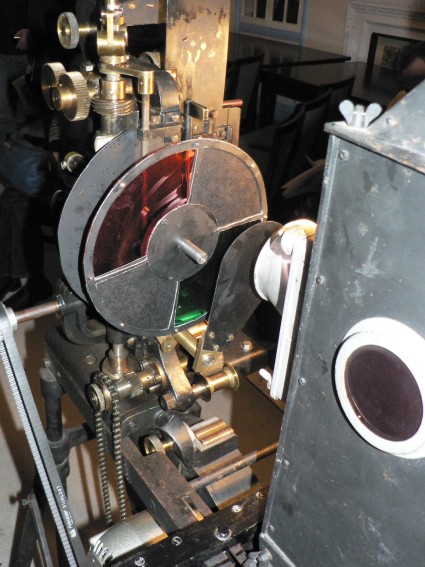
The screening was organised by film archivists David Cleveland and Brian Pritchard, who decided to mark the centenary of Kinemacolor by exhibiting the world’s first natural colour motion picture system in its correct form, using an original Kinemacolor projector. Kinemacolor films have been shown in composite colour or computer synthesized forms, or so customised that they will run at normal speed on a normal projector, but not since 1995 at the Museum of the Moving Image has anyone attempted to show Kinemacolor as it was originally done – black-and-white film run through a projector fitted with a red and green rotating filter, at double speed (thirty or more frames per second). It is rarer still to employ an original projector (the MOMI show used a customised 1920s Ernemann projector).
The projector was generously loaned by Wirral Museum, which also allowed the archivists to replace missing parts and to make the machine operable, so long as it would be returned to its original museum state once they had finished with it. It is Kinemacolor projector no. 19, with original colour filter. Cleveland and Pritchard aimed to be as authentic as possible, with two limitations – they could not show nitrate films, fairly obviously, and for similar health and safety reasons they could not use an arc light (they used a filament blub instead).
We gathered in a small room, with chandelier adding an appropriate touch of class to the proceedings (less so the windows necessarily blacked out with black bags and tape). The small audience comprised archivists from the BFI National Archive, a smattering of academics, and as guests of honour, Kinemacolor’s producer Charles Urban’s step-grandson Bruce Mousell and his two daughters.
David introduced the event and the projector, then we were shown three of the sample Kinemacolor films held in the BFI National Film Archive. Tragically few Kinemacolor films survive today, and all that the UK’s national archive holds are some test films which were never shown publicly. These were retained by the system’s inventor G.A. Smith, who passed them on to Brighton collector Graham Head, whose collection in turn went to the Cinema Museum in London. Two of the prints we saw were therefore struck from original negatives, with a third taken from a dupe neg. This film was shown first, Cat Studies (c.1908), a short single shot of a cat (a black-and-white cat at that), which served to help make adjustments to the filter, since we started off with the wooden board with a hole through which the cat looked appearing green, because the rotating filter had been aligned incorrectly.
Projection of Kinemacolor test film Woman Draped in Patterned Handkerchiefs
There then followed Woman Draped in Patterened Handkerchiefs (c.1908), whose action is self-explanatory, a film clearly designed to demonstrate basic colour effects; and Pageant of New Romney, Hythe and Sandwich (1910), an actuality film rejected at the time for being too contrasty. In truth, the sample Kinemacolor films held by the BFI are poor examples of the colour system, showing little in the way of effective colour, and the latter film in particular demonstrating the hazards of fringing (the alternating red/green records meant that the film record could not always keep up with movement, resulting in red or green ‘fringes’).
But, after a pause for reloading and a talk from Brian Pritchard on the customising of the projector and Smith’s ingenious use of sensitizing chemicals (without which Kinemacolor would not have worked at all), we were shown a beautiful Kinemacolor film loaned by the Nederlands Filmmuseum. This was Lake Garda, Italy (1910), a travelogue of the Italian beauty spot, whose picture postcard images showed up the colour to exquisite effect. We saw panoramic views of the lake, buildings, boats with red and yellow sails, and a delightful sequence where three musicians in a small boat serenaded the camera. Being full of gentle motion, the muted, subtle colour was shown to its best effect, being particularly good at rendering white buildings and reflections in the water. Kinemacolor, using as it did red and green filters, could not logically depict blue, yet blue we saw in the sky and water. This is all down to our gullible brains, reconstituting what seems optically logical to us. The sky should be blue, so we see blue.
What was also interesting was the colossal noise. The motorised projector had to rattle through at a speed of thirty frames per second, and the racket drowned out all conversation. The image on the screen had to be kept quite small, to retain as much brightness as possible (Kinemacolor absorbs a great deal of light). We all wondered how on earth they coped projecting Kinemacolor in large theatres, where the throw would have been considerable. We also marvelled at the skill of the original projectionists, who had to cope not only with a double-speed projector, but changing colour effects owing to differences in filters used (the cameramen would change then accoding to the light conditions encountered) and all of the hazards of correct colour synchronisation.
David Cleveland (right) with Charles Urban’s step-grandson Bruce Mousell and his daughters
The demonstration revealed many of the problems, but also several of the beauties of Kinemacolor, and made one wish for more such screenings to be organised. As David Cleveland explained in his notes to the show:
Several archives have a few examples of Kinemacolor films in their collections, and the usual process is to make a composite film copy of the red and green images onto one new Eastman Color inter-negative, and normal colour prints therefrom. Of course this takes on Eastman Color characteristics, and the colour is not the same as originally seen. Scanning is probably the answer, but here again it needs to be carefully done so that the colour is as near to the original filters as possible … and that the result is not a smooth ‘television’ type picture, but an image that resembles the projected picture of a century ago. Only this way can Kinemacolor be put into context with the development of colour films.
It is a great shame that, in its centenary year, Kinemacolor remains so elusive. Cleveland and Pritchard had the greatest difficulty getting films from other archives, and it is to be hoped that there may be greater co-operation over any future events. So few Kinemacolor films survive (maybe thirty or so, out of the hundreds originally produced), and more must be done to preserve them, to make them accessible in original as well as the more convenient composite form, and to uncover more – because there are undoubtedly ‘lost’ Kinemacolor films out there. Kinemacolor appears to be ordinary silent black-and-white film to the untrained eye. Only when you look closely do you see alterations in tonal emphasis from frame to frame. Many archives, I am sure, are sitting on Kinemacolor films and are not aware of the fact. 2008 would be a good year in which to start conducting a search to locate them.
Announced today is a plan by Lobster Films of Paris, with a number of partner organisations, to release up to 500 film titles from thirty-seven European archives, online and for free, with 50% funding from the European MEDIA programme, which is all about expanding markets for films and exposing content to new audiences. The partners include the British Film Institute and the Danish Film Institute. The project, European Film Treasures, launches in April.
PARIS (Hollywood Reporter) – Where do you go if you want to watch rare archive films such as a 1916 document about life on a German submarine or John Ford’s 53-minute Western “Bucking Broadway” from the following year?
Until now, the answer would have been a trip to one of the film archives that house these prints, respectively London’s Imperial War Museum and the French Film Archive.
But that is about to change with the launch in April of a Europe-wide video-on-demand platform bringing together content from 37 film archives and cinematheques across the continent. And the good news for film buffs is that it’s free.
European Film Treasures, as the site will be known, is the brainchild of Serge Bromberg, founder of Paris-based historic film and restoration specialist Lobster Films. The European Union’s MEDIA Program has pledged to put up half of the approximately 500,000 euros ($725,000) needed to fund the project for its first year.
European Film Treasures is hoping to tap into a chunk of the huge audience for free on-line video sites like YouTube and Bebo. “The difficulty today is not so much to find old films and restore them, it’s finding an audience for them,” Bromberg says. “These are some of the best films shot in Europe over more than 80 years, but it’s often difficult to convince people to see films like these.”
Each partner archive will propose films, and a jury of historic film specialists will decide which to include on the VoD site based on criteria such as historical interest and artistic quality. Footage will be accessible for streaming only, not download, but the site may in the future extend to associated DVD sales.
Films will be available in their original language with translation where needed into English, French, German, Italian and Spanish.
The site is expected to launch with about 100 titles, but the aim is to include as many as 500 films once fully loaded. Lobster is coming up with original music to accompany silent films.
It took two years to convince all the archives to come on board. “They thought it was a good idea but considered it was impossible. The idea is not just to show their films, but also to present the archives and their work,” Bromberg says.
The only major national archive that decided not to be represented was from Belgium. “That is to their great shame,” Bromberg opines.
Bryony Dixon, curator (silent film) at the British Film Institute’s National Archive, says that VoD is a well-adapted platform for these early and short films, which are otherwise difficult to program. “Theatrical, you may get a few thousand viewers. On the Web, you can get hundreds of thousands or even millions. If you put it out there, people will find it. You get that long-tale effect.”
As with the other partner archives, the BFI is not putting in any financing but simply making films available. “We’re in a good position to do that as probably the biggest film archive in Europe,” Dixon says.
Among films the BFI is submitting are “Daisy Doodad’s Dial,” a 1913 British-made comedy starring U.S. actress Florence Turner, and a rare film of a French boxing champion. “We’ll pick things that have appeal, like the boxing film, which will be really interesting for the boxing community because it’s not seen before,” Dixon contends.
For its part, the Danish Film Institute is submitting a 1923 Danish film that is one of the earliest examples of a viable talking film; an animated sausage commercial film from the mid-1930s that uses Dufay Color, a mosaic screen additive system that predates Technicolor; and a raunchy 1910 one-reeler about Copenhagen nightlife.
“These are films that we restored recently. They’re all entertaining films, one about color and cinema, one about sound and cinema. It’s broadening people’s idea of the development of cinema,” said Thomas Christensen, curator of the DFI.
“It’s great that there’s this kind of channel for content that is otherwise sitting fallow in the archive,” said Christensen. “I don’t expect it to become a blockbuster phenomenon. It might never be more than marginal but it’s an interesting channel to be represented on. I think this is very much a transition time, and we have to explore the possibilities.”
This is exciting news, though it doesn’t explain where the other 50% of the money has come from, or what happens after the first year. Also, some of those films may have been already made available online elsewhere (Daisy Doodad’s Dial is being offered by the BFI for free downloading on its Creative Archive site). But the more exposure the better, because it is all about finding those new audiences.
So roll on the 1910 scenes of raunchy Copenhagen nightlife, and shame on Belgium.
Update (June 2008): The site is now available, from www.europafilmtreasures.eu. An initial review of the site fom The Bioscope is here.
The Library of Congress has announced twenty-five new titles that have been added to the National Film Registry. Under the terms of the National Film Preservation Act of 1992, each year the Librarian of Congress, with advice from the National Film Preservation Board, names twenty-five American films deemed “culturally, historically or aesthetically” significant that are to be added to the National Film Registry, “to be preserved for all time”. Which is ambitious. This year’s twenty-five bring the number of motion pictures added to the registry to 475.
The films named include such titles as Bullitt, Dance, Girl, Dance, Close Encounters of the Third Kind, and Oklahoma! But there are always some silents included, and this year among the twenty-five are the following (with the descriptions provided by the Library of Congress):
Mighty Like a Moose (1926)
Actor/director/screenwriter Charley Chase is underappreciated in the arena of early comedy shorts. Chase began his film career in the teens, working for Mack Sennett with the likes of Charlie Chaplin and Fatty Arbuckle. Moving on to the Hal Roach Studios, Chase starred in his own series of shorts. “Mighty Like a Moose,” directed by Leo McCarey, is one of the funniest of his silents. A title card at the beginning tells us this is “a story of homely people—a wife with a face that would stop a clock—and her husband with a face that would start it again.” Unbeknownst to each other Mr. and Mrs. Moose have surgery on the same day to correct his buckteeth and her big nose. They meet on the street later, but don’t recognize each other; they flirt and arrange to meet later at a party. A side-splitting series of sight gags follows including Charley’s “fight with himself.”
The Strong Man (1926)
Harry Langdon, widely considered one of the great silent comedians, had a career that can only be described as meteoric. A vaudevillian for much of his professional life, Harry Langdon was discovered and brought to Hollywood by Mack Sennett in the early 1920s. But he languished until lightning struck in 1925, when director Harry Edwards and then-gagman Frank Capra worked with him on three features and several shorts. The features, “Tramp, Tramp, Tramp,” “Long Pants” and “The Strong Man” put Langdon solidly into the foursome Walter Kerr calls “The Four Silent Clowns” —with Charlie Chaplin, Buster Keaton and Harold Lloyd. “The Strong Man” predated “City Lights” by several years with its plot of a meek man in love with a blind woman.
Tol’able David (1921)
Henry King (1886-1982) had a 50-year career in Hollywood, winning a reputation as one of the most talented directors in capturing the values, culture, history, personality, and character of the nation. His nostalgia was honest, and often bittersweet. In “Tol’able David,” King tells a coming-of-age story about a youth who must overcome savage, bullying neighbors as he takes on his first job delivering mail in rural Virginia. “Tol’able David” was studied by Russian filmmakers of the 1920s. They were inspired by King’s memorable conjunctions of shots that evoked personalities and emotions without a need for explanatory titles. “Tol’able David” remains a powerful drama and is also known for its craftsmanship, which was tremendously influential on subsequent filmmaking.
Also from the 1920s, though a sound film, is the Robert Benchley comic short, The Sex Life of the Polyp (1928).
The full list of films selected for the National Film Registry 1989-2006 is available here. These are the silents on the Registry (excluding post-1930 amateur, news and experimental films):
Ben-Hur (1926) Big Business (1929) [Laurel and Hardy] The Big Parade (1925) The Birth of a Nation (1915) The Black Pirate (1926) Blacksmith Scene (1893) The Blue Bird (1918) Broken Blossoms (1919) The Cameraman (1928) The Cheat (1915) The Chechahcos (1924) [independent feature filmed in Alaska] Civilization (1916) Clash of the Wolves (1925) [starring Rin Tin Tin] Cops (1922) A Corner in Wheat (1909) The Crowd (1928) The Curse of Quon Gwon (1916-17) [the earliet known Chinese-American feature] Dickson Experimental Sound Film (1894-95) [OK, not a silent] The Docks of New York (1928) Evidence of the Film (1913) [Thanhouser crime film set in a film studio] The Exploits of Elaine (1914) Fall of the House of Usher (1928) [experimental film] Fatty’s Tintype Tangle (1915) Flesh and the Devil (1927) The Four Horsemen of the Apocalypse (1921) The Freshman (1925) From the Manger to the Cross (1912) The General (1927) Gertie the Dinosaur (1914) [animation] The Gold Rush (1925) Grass (1925) [documentary] The Great Train Robbery (1903) Greed (1924) H20 (1929) [experimental film] Hands Up (1926) Hell’s Hinges (1926) The Immigrant (1917) In the Land of the Head Hunters (1914) [documentary] Intolerance (1916) It (1927) The Italian (1915) Jeffries-Johnson World’s Championship Boxing Contest (1910) The Kiss (1896) Lady Helen’s Escapade (1909) Lady Windermere’s Fan (1925) Land Beyond the Sunset (1912) The Last Command (1928) The Last of the Mohicans (1920) The Life and Death of 9413 – A Hollywood Extra (1927) [experimental film] The Lost World (1925) Making of an American (1920) [public information film] Manhatta (1921) [experimental film] Matrimony’s Speed Limit (1913) Miss Lulu Bett (1922) Nanook of the North (1922) [documentary] Pass the Gravy (1928) Peter Pan (1924) Phantom of the Opera (1925) The Poor Little Rich Girl (1917) Power of the Press (1928) President McKinley Inauguration Footage (1901) [Edison film taken at time of his assassination] Princess Nicotine; or The Smoke Fairy (1909) Regeneration (1915) Rip Van Winkle (1896) Safety Last (1923) Salome (1922) San Francisco Earthquake and Fire, April 18, 1906 (1906) [news footage] Seventh Heaven (1927) Sherlock Jr. (1924) Show People (1928) Sky High (1922) The Son of the Sheik (1926) Star Theatre (1901) [building shown being constructed using stop-frame animation] Sunrise (1927) Tess of the Storm Country (1914) There it is (1928) The Thief of Bagdad (1924) Traffic in Souls (1913) The Wedding March (1928) Westinghouse Works, 1904 (1904) [industrial footage] Where Are My Children? (1916) [Lois Weber’s anti-abortion drama] Wild and Wooly (1917) The Wind (1928) Wings (1927) Within our Gates (1920) [Oscar Micheaux’s all-African American drama]
Want to vote for the 2008 selection? They do take into account public nominations – not sure if you have to be a United States citizen for this, but details on where to send your suggestions (limited to fifty titles per year) are here.
How long do you have to be deceased before you start generating a heritage? In Charlie Chaplin’s case, it would seem to be thirty years, pretty much to the day (he died Christmas day, 1977). Rumours of a Chaplin museum have been confirmed. The mansion at Corsier-sur-Vevey, Switzlerland, where Chaplin spent the last twenty-four years of his life, is to become a museum commemorating his life – or, to be precise, a Charlie Chaplin Heritage Site. A Charlie Chaplin Museum Foundation has sold the Manoir de Ban to some Luxembourg investors. The project is costed at 30 million dollars (21 million euros).
Remarkably, there is already a Chaplin Museum website. This coldly fascinating document promises a “unique, must-see cultural attraction for those seeking a profound experience of discernment and variety”, featuring the following:
a MANOR, beckoning visitors to enter the very private world of Chaplin the man (“Private Encounter”);
OUTBUILDINGS converted into exhibit halls dedicated to the humorous and moving works of the artist and filmmaker (“From Laughter to Tears”) and to the heyday of silent movies ( “The Spectacular Beauty of Silence”);
the MAGIC ZONE, a tribute to the earliest forms of cinematic expression (“The Magic Labyrinth”);
the Charlie Chaplin MOVIE THEATER highlighting repertory films and film offerings from the emerging generation;
an OUTDOOR STAGE under a marquee that provides the setting for an annual line-up of pantomime and cinematic activities and festivals;
a SHOPPING AREA where visitors can obtain exquisite souvenirs related to the artist and his adopted domicile;
TRAINING activities and gatherings targeting young people worldwide that will be organized with the same attention to perfection and human elements for which Chaplin was renowned, as well as his passion for pantomime, image and film;
its DINING AREAS and vantage points nestled among the luxuriant garden-park and pathways that offer unparalleled views of the Swiss landscape.
A news report states that “visitors to the museum will have access to the most intimate rooms occupied by the Chaplin family, including the first floor room where he died on Christmas Day 1977”, while “in the vast vaulted cellars the museum’s designers plan to install a “Hollywood street” complete with street lamps to recreate the atmosphere of the 1920s.”
Is it too cruel to suggest that ‘heritage’ is what phenomena attain when they have lost all real popular appeal or social meaning, and that as Chaplin’s films retreat to little more than a certain archaeological fascination, so a heritage site represents the ultimate embalming of his artistic reputation? Or, just as heritage masks history, is all this corporatising of the Chaplin legend (e.g. charliechaplin.com, discoverchaplin.com, simplychaplin.com, chaplinmuseum.com) only hiding the genius of films whose time must return one day, when we have need of their real insight once again?
The museum is expected to open at the end of 2009.
It is sad to have to report the death of Brian Coe on 18 October 2007. To anyone with an interest in the history of the technologies of cinematography or photography his work over four decades has been, and remains, indispensible. He joined Kodak in 1952, where he helped found its education service. He made a particular impact with his writings in the early 1960s which forensically overturned the romantic myths which had seen William Friese-Greene chauvinistically championed as a pioneer of cinematography.
He was Curator of the Kodak Museum from 1969 to 1984, building up the collection to be one of international renown, and curating many pioneering exhibitions. When the collection moved to the National Museum of Photography Film and Television in Bradford, Brian became Curator at the Royal Photographic Society’s collection in Bath. In 1989 he joined the Museum of the Moving Image as special events co-ordinator, organising shows, events and organisations on an extraordinary range of topics, all underpinned by exemplary research and presented with enthusiasm, finding a perfect balance between scholarship and entertainment.
At Kodak he built up not only a great collection but considerable personal expertise, which found lasting expression in his many publications. The remarkable thing about his books is that they have not dated. Twenty or thirty years on they are still relied upon as standard reference works, notable as much for their clarity of exposition as their steadfastly reliable content. They include The Birth of Photography (1976), Colour Photography (1978), Cameras: From daguerrotypes to instant pictures (1978), and the incomparable The History of Movie Photography (1981). This is still the best book on cinema technology that exists, and it is hard to see how it could be bettered. It is particularly strong on early cinema technologies – magic lanterns, the optical toys and chronophotographic experiments of the so-called ‘pre-cinema’ era, the first cameras and projectors, the development of colour cinematography, early widescreen systems, the birth of home movies. Its illustrations have been plundered by countless other sources. Film archivists swear by the book – it used to be (and I hope it still is) standard reading for anyone working at the National Film and Television Archive’s preservation centre. Another gem is Muybridge and the Chronophotographers (1992), a small exhibition book reportedly thrown together in a great hurry, but a handy reference guide that I turn back to again and again.
Sadly Brian suffered a serious stroke in 1995, and took no further active part in the worlds of film and photography to which he had contributed such invaluable knowledge. It was a sad curtailment to a varied and richly productive career, recognised through such honours as his Fellowship of the Royal Society Arts, but leaving him little known to the general film enthusiast. Check out one of his books – they’ll be in the local library or second-hand book store. They look beautiful, and they wisely and reliably inform. Thank you, Brian.
The Cinema Museum, one of London’s hidden cinematic treasures, is under notice to quit from the former Lambeth workhouse building (where Charlie Chaplin’s mother was incarcerated) by March of next year. There’s an article in The Observer with the background story and an affectionate portrait of the museum itself.
The Deutsche Kinematek has initiated a ‘Lost Films’ project, the main expression of which so far is a Lost Films Wiki. As the site puts it:
We have set it up to bring together titles of films that are presumed to be lost. Furthermore we hope that archivists and film historians will add information about fragments and related documents. The idea is not to build up a comprehensive database but rather to focus on important movies, current restoration work etc. Besides the project we would like to work with this Wiki on a regular basis parallel to it and in the long run.
They invite researchers to look for films on the wiki, to add information if they have any, or to create a new record if the film is not recorded there. The emphasis is on German films, and many titles by Lubitsch, Murnau et al are listed. The site names participating archives in their project to “reconstruct and render visible the invisible legacy of German film”. All of which begs the question how people are supposed to know that is a film is lost for certain, and how many films might be added to the wiki in the belief that they are lost when they are not. Doubtless, in the way of wikis, all will sort itself out in the long run. At the moment there is little beyond a list of titles on the site. A Lost Films project web page is promised for summer 2008.
How curious is the cult of the lost film. Few other media can elicit the same amount of interest, nostalgia and speculation for those creations that are no more. Of course, one is always delighted when a ‘lost’ film re-emerges, even if the actuality frequently fails to match the anticipation, but some films actually seem better lost. Greed and The Magnificent Ambersons always have that extra allure through our sense of the footage that is no longer there. There is some other reality that lost films possess, a history that might have been, a virtual archive. Indeed, the Lost Films Wiki revealingly talks about creating “a collection of lost films”.
And there are other websites dedicated to the theme – Moving Image Collections’ Lost Films list, which gives you updates on films that have been rediscovered, wholly or partially; and Silent Era’s Presumed Lost section, which naturally enough concentrates on silents, and likewise tries to keep things up-to-date by reporting on rediscoveries. Its long, long list of films previously noted as being missing and now locatd in archives across the world shows just how much good work is being done. Indeed, archivists have rather used the label of ‘lost’ to arouse interest in their work, and to encourage interest in key titles with the hope of footage turning up somewhere. Sometimes, in fact, they have been well aware that the so-called lost films are out there, and have used lost film ‘searches’ to tease them out of collectors’ hands. How hard it is too say with any finality that a film is truly lost.
Nevertheless, I’ve created a new category for Lost Films, and will regale you in due course with stories of some of the more fascinating examples, whose legend endures by simple virtue of their unavailability.






 The Bioscope