Caught on film

Just a quick note to let folks know that tomorrow (Tuesday 26 August) at 11.30am there’s a programme on BBC Radio 4 on film archives and silent film, produced at last month’s Bologna film festival. Entitled Caught on Film, the BBC blurb describes it thus:

Our cinematic heritage is literally rotting away. Critic Matthew Sweet visits the Festival Il Cinema Ritrovato in Bologna to explore the vulnerability of film and discovers why both cinematic gems and historically unique documentary films are rapidly disintegrating.

The half-hour programme will be available through the Listen Again service for a week after the broadcast.

Crazy once more

Crazy Cinématographe has returned, and has a fabulous poster to prove it:

Last year saw the launch of Crazy Cinématographe, a project with multiple outlets based on the programmes of films shows presented in the touring fairground booths of Europe in the early years of the twentieth century. In 2007 it gave us a touring show (mostly in Luxembourg, but it also visited Germany, France and Belgium), a conference (in Luxembourg) and finally a DVD, published by the highly commendable Editions Filmmuseum.

The Crazy Cinématographe tent in 2007

Except that it wasn’t ‘finally’, because Crazy Cinématographe edition 2 has been announced. Taking place 22 August-10 September in Schueberfouer, Luxembourg, the new show opens the tent flaps once more to present a highly variegated programme of bizarre and surprising early cinema subjects taken from fifteen film archives around Europe. There is now a Crazy Cinématographe site, with details of the programme, in German. Among the promised delights are acrobatic sisters, a ‘Cabinet of Crazy Animals’ (including Percy Smith‘s acrobatic fly, Max Skladanowsky‘s boxing kangaroo, monkeys dining in a restaurant, and – according to my translation software – rabbits eating giant snakes, though possibly it may be the other way around), an evening of early erotic films, a ‘Live-Mix Crazystyle’ by DJ Kuston Beater, and a ‘best of 2007’ programme. I’m promised more information in English, and will pass this on in due course.

Behind all the showmanship, Crazy Cinématographe is a bold and interesting attempt to combine scholarship with entertainment, or rather making an entertainment out of a scholarly enthusiasm, both for the archival films themselves and for the renowed ‘cinema of attractions’ concept (a cinema of spectacle that preceded the cinema of narrative), which has proved so fruitful in early cinema studies.

To give you a flavour of the entertainment, here’s the promo video (look out for the acrobatic fly at the end).

There’s also a video report on last year’s show (on YouTube, in French), which gives a good idea of the presentation style.

Welcome to Newsfilm Online

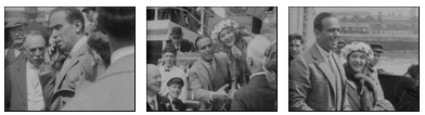
Southampton: Arrival of Mary Pickford & Douglas Fairbanks, Gaumont Graphic, 21 June 1920, from http://www.nfo.ac.uk

Quietly launched this week (with an official launch due in October) is Newsfilm Online. This is 3,000 hours of UK cinema newsreel and television news content, dating 1910s-2000s, all of it taken from the collection of ITN Source. ITN is the UK’s largest commercial footage library, (if you don’t count the BBC as such), and doesn’t just own ITN news programmes, such as News at Ten and Channel 4 News, but most of the UK’s newsreel archives (Pathe, Paramount, Gaumont, Universal). The 3,000 hours (about 2% of the ITN news collection) have been digitised and made available for free downloading and re-use, so long as you are a member of a subscribing UK institution of higher or further education. Sadly that’s going to leave out a lot of you, but the project was funded by the Joint Information Systems Committee, which exists to support UK HE/FE (as we call it in the trade), and the conditions under which the newsfilms were digitised stipulated that they would be available to HE/FE users only.

But despair not, because although you may not be able to see the films, the catalogue records are searchable and browsable by all. And for the silent era, there are 1,241 news stories from the 1910s and 5,091 from the 1920s, making this a marvellously rich resource for historical study, even without the films themselves – not least because you get thumbnail images, like those of Doug and Mary illustrated above. It’s supposed to be every example of the Gaumont Graphic newsreel held by ITN, and shopws how alert the newsreels were to the stories, concerns, fads and personalities of their era. The thumbnails alone excitingly bring the 1910s and 20s back to vivid, varied life.

Remarkably, the publication of Newsfilm Online means that the majority of British newsreels (I’d guess between 80-85%), 1910-1979, are now digitised, encoded and available on the Web in one form or another, albeit with restricted access in some cases (the Paramount and Universal newsreels are the big gaps). That’s a sensational thing to be able to report, achieved in little over five years by a mixture of public money (around £3.5M, at a rough guess, though the £2M that Newsfilm Online cost was for TV news as well as its Gaumont newsreels) and private (no idea how much). The four main sources (with the silent newsreels that they include) are:

  • British Pathe – including Pathe Gazette, Eve’s Film Review, freely available (low resolution)
  • British Movietone News – Movietone itself was a sound newsreel, but the site include a rag-bag collection of silent actualities, freely available (low and middling resolution)
  • Newsfilm Online – includes Gaumont Graphic, movies available to subscribing UK educational institutions only
  • Screenonline – the BFI online ‘encyclopedia’ has many examples of the Topical Budget newsreel, movies available to UK schools, colleges and libraries only

What a fantastic achievement. Having played a small part in making NfO (as we call it in the trade) happen, I’m just a little bit chuffed to see it published at last. For a record of most British newsreel stories in one place, I warmly recommend the British Universities Newsreel Database (still has some gaps to fill for silent newsreels), which also lists other digitised newsreel collections around the world (Australia, France, Germany, Italy, Sweden – America, alas, lags seriously behind).

Let’s have every newsreel around the world available online – it can be done; it would delight and benefit so many if it could be done.

Lost version of Metropolis discovered

Previously lost scene showing Maria fleeing, from the rediscovered print of Metropolis, from http://www.zeit.de © Friedrich-Wilhelm-Murnau-Stiftung; Bildbearbeitung: Dennis Neuschäfer-Rube

The wires are a-buzzing with the sensational news that a 16mm print of a lost version of Fritz Lang’s Metropolis has surfaced in Argentina, which may well be the original cut – around a quarter of the original film is missing from existing prints. The German newspaper Die Zeit has reported the news and published a gallery of startling images from the previously lost sequences of the film.

Word is that the Friedrich-Wilhelm-Murnau-Stiftung will work with the Museo del Cine Pablo C. Ducros Hicken in Buenos Aires on restoring the lost scenes, but it’s too early for any concrete details. More information is promised is tomorrow’s Die Zeit, meanwhile, here’s a press release (in somewhat quaint English) from the Friedrich-Wilhelm-Murnau-Stiftung:

Sensational discovery in Buenos Aires: Lost scenes from “Metropolis” rediscovered

Staff members of the Museo del Cine Pablo C. Ducros Hicken in Buenos Aires, found the missing scenes which had been considered lost up to now, in a 16mm Negative.

The tale of the concision of “Metropolis” is well-known. The film is renowned for the story of its restoration which began in the 1960s in the national Film archive of the German Democratic Republic, to the source critical reconstruction of the Film museum Munich (E. Patalas) in the 1980s, up until the film was digitally restored through Mr. Martin Koerber on behalf of the Friedrich-Wilhelm-Murnau-Stiftung, Wiesbaden in the year 2001. This restoration, which is based on the version of the Film museum Munich and on materials of the Bundesarchiv-Filmarchiv (Federal Archive / Filmarchive), Berlin, was completed not only with these two institutions but also with other partners of the Deutscher Kinematheksverbund (Association of German Film Archives)

In addition to this, Enno Patalas developed a study version of the film in collaboration with the University of Arts in Berlin. They supplemented the survived fragments in their original relation to the film in written form or with pictures and musical resources.

Because of these survived sources, the hiatuses which weren’t able to be found even after decades of research in national and international Film archives and private converts, were sorely cognizant. Pictures gave us the impression of what was missing – the to a supernumerary reduced figure of Georgy, the man named Slim, Josaphat, the car journey through Metropolis, the observation of Georgy through Slim, Freders delirium of Slim in which he changes into a apocalypse preaching monk. With this discovery in Buenos Aires these scenes will finally come back to life. Even if the quality of the picture is in a deplorable condition, thanks to the Argentinean material, the dream of the completion of “Metropolis” will finally come true.

According to Anke Wilkening, restorer of the Murnau Foundation “Hitherto incomprehensible is now intelligible, the sometimes puzzling relations of the figures among each other now make sense.” The story of the instauration can now come to an end.

Helmut Poßmann, managing director of the Murnau Foundation states that: “In continuance of the restoration from 2001, the Murnau Foundation would very much like to compile a complete version of the film together with the former partners and the Museo del Cine Pablo C. Ducros Hicken in Buenos Aires and to open it to the public, all the more because “Metropolis” is the first film which has been affiliated in this restored version from 2001 – safety lug Nr. 1 – to the Memory of the World register of the UNESCO.”

“This sensational discovery places the Murnau Foundation into a position being able to restore the film to a very large degree. That way it could be achieved to come as close to the masterwork of Fritz Lang as never before possible and present it to the world”, says Eberhard Junkersdorf, head of the board of trustees.

For the past 42 years the Friedrich-Wilhelm-Murnau Foundation has applied itself to save, preserve, restore and reconstruct a bulk of the German cinematic heritage of 2.000 silent films, 1.000 talkies and about 3.000 filmlets (commercials, documentaries, etc.) from the beginning of film up to the 1960s, trying to make these films accessible to the public.

Among films as “Metropolis”, German classics like “Das Cabinet des Dr. Caligari”, “Nibelungen”, “Der blaue Engel”, “Die Drei von der Tankstelle”, “Münchhausen”, “Große Freiheit Nr. 7“ just as a multitude of productions of important German-speaking directors such as Friedrich Wilhelm Murnau, Fritz Lang, Ernst Lubitsch, Detlef Sierck, Helmut Käutner and Wolfgang Liebeneiner.

The current extensive restoration project is Fritz Lang’s monumental film “Die Nibelungen” which is planned to premiere with a new musical score at the Berlin Film Festival in 2010.

Truly wonders will never cease, and lost films will only remain lost until someone finds them. More news here as it emerges.

Update: There’s more news, including a history of the print’s rediscovery and further images, in The Metropolis case follow-up post.

Treasures from Europe

Bucking Broadway

John Ford’s Bucking Broadway (1917), from Europa Film Treasures

It’s here at last folks, Europa Film Treasures, the long-awaited online archive of assorted gems and oddities from film archives across Europe, created by the continually wonderful Lobster Films of Paris.

It’s a collection of truly disparate material, fiction and non-fiction, live action and animation, short and feature-length, ranging from 1898 to 1999. There are films from Austria, Denmark, Finland, Great Britain, the Netherlands, the USA and more. Participating archives include the Deutsche Kinemathek, Det Danske Filminstitut, GosFilmoFond, Filmarchiv Austria, the Scottish Screen Archive, the Imperial War Museum Film and Video Archive, Lobster Films itself, and many more, though several archives only contribute the one title (and some, such as the BFI, which had previously announced that they would be contributing, have not done so – yet).

And what will you find there? Well, there are early actualities by Danish cinematographer Peter Elfelt, pornography from Austria, Biblical lands film from 1906 (these are some of the films shown at Pordenone in 2007 when they were thought to be of an earlier date – see this post – clearly more identification work has been done since then), dance films, a Russian fish processing factory documentary, comedies (including Max Linder), trick films, science fiction (Walter Booth’s The Airship Destroyer from 1909, an important film listed here under a German title, Der Luftkrieg der Zukunft), Spanish newsfilm, Russian Yiddish drama, one of John Ford’s first Westerns Bucking Broadway (1917) – the only non-European title on view, the extraordinary Der Magische Gürtel (1917) – tracking the trail of destruction wreaked by a German U-Boat, French public health films, abstract animation from Viking Eggling, Soviet puppet animation, and more, much more.

This is a wonderful treasure trove, certainly highly eclectic. Some may be disappointed not to find a greater range or more familiar material, but they should be encouraged to explore. They will be amazed and delighted, I hope. Each film comes with credits, background description (in somewhat quaint English, clearly translated none too comfortably from French), and the films are all shown in Flash. A library of documentation and teaching resources are promised soon. There are a number of search options, allowing you to search by archive (the search option says Films), time period, country, genre etc, but finding an individual title (especially as few are in English) is a little laborious. And it’s available in English, French, Spanish, German and Italian.

There’s background information on the European-funded project in an earlier post. Up to 500 titles are promised eventually (there’s around fifty up so far), so clearly it’s a site to visit again and again. There were reports that the funding would only support the site for a year – and then what? I’ll try to find out. Meanwhile, go explore.

John Barnes RIP

It is with sadness that I have to report the death of John Barnes, film historian, collector, curator and filmmaker. John is best known for the five volume series The Beginnings of Cinema in England, 1894-1901, his unparalled study of the earliest years of English cinema. Begun in 1976, completed in 1998, it is as much a work of archaeology as historiography. John’s real passion was for the technology of film in the 1890s, and he was prodigious and exhaustive in tracking down every kind of motion picture machine from the period, explaining its distinctive qualities, tracing its use and recording its ownership.

Around this deep understanding of the technology of the era, he weaved stories of the personalities of the time (his great hero was Robert Paul, whose battles with fellow pioneer and rival Birt Acres he recorded with journalistic fervour), the modes of exhibition, and especially the films – each volume of his history contained filmographies of the whole of British film production for one year, information gleaned from catalogues, journals, posters, flyers, and a host of other sources. Details of hundreds of films from this era have been identified from Barnes’ work alone, a huge benefit to scholars and film archivists alike. An era of cinema that previously had been idly documented and frequently misinterpreted was enriched by an exhaustive study that has inspired a huge range of subsequent studies. No one has been able to write about this period of cinema history without reference to the works of John Barnes. He found the material, provided the signposts, and his work remains the sure foundations on which all other research in the field must be built.

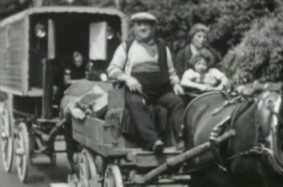
With the Gypsies in Kent (c.1938), film by John and Bill Barnes, from Screen Search

John and his twin brother William (who survives him) were born in 1920 and discovered film during the 1930s, becoming enthusiastic amateur filmmakers while still at school. Two of their films, Gems of the Cornish Riviera (1936) and Cornish Nets (1938) featured at the Pordenone silent film festival in 1997, the year in which both were awarded the prestigious Prix Jean Mitry for services to silent film scholarship. Eighteen of their silent films are now held by Screen Archive South East in Brighton, including The Wheat Harvest (c.1935), In the Garden of England (c.1938) and With the Gypsies in Kent (c.1938), clips from which can be seen on the Archive’s Screen Search site.

On leaving school the brothers studied film design and technique at Edward Carrick’s AAT film school, at which time they began collecting Victorian optical toys and associated literature, often frequenting the bookshops of London’s Cecil Court which three decades before had been ‘Flicker Alley’, home to the nascent British film industry. They hatched a plan to collect artefacts and documents that would trace the history of motion pictures from the 17th to the 20th centuries, an ambition put on hold while they served in the Royal Navy during the Second World War.

After the war, the brothers moved to St Ives in Cornwall, where Bill opened a second-hand bookshop. It was in rooms above this shop in 1951, during the Festival of Britain, that the brothers put on the first exhibition of their film history artefacts, the success of which encouraged them to collect all the more. This was at a time when relatively little was appreciated about pre-cinema tchnologies, and John’s great work was not simply to collect such objects but to understand them, explain them and to be able to contextualise them. Eventually the bookshop was closed and the brothers sold by catalogue alone, supplying books and artefacts to scholars and film museums around the world.

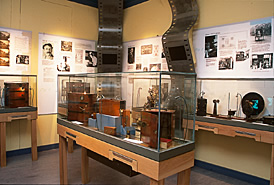
Objects collected by John and Bill Barnes now in Hove Museum

In the 1960s, while Bill went filming overseas, John and his wife Carmen (who also survives him) opened the Barnes Museum of Cinematography in St Ives. This famous collection attracted film scholars from around the world, and its catalogues became treasured documentary sources as serious interest grew in the roots of cinema. Collecting continued, and many objects were lent to museums around the world or formed the subject of illustrations in numerous text books. The Museum never found a London home, as John had hoped, and closed in 1986, its pre-cinema holdings going to the Museo Nazionale del Cinema in Turin, while much of the remainder is now housed in Hove Museum, near Brighton.
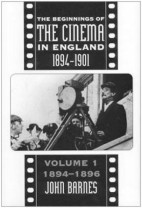
But John’s greatest monument is The Beginnings of the Cinema in England. The series began in 1976 with the book of that title, which documented the arrival of film in England, 1894-1896. Establishing his style, the book traced the history through the machinery, out of which followed the personalities involved, the modes of exhibition, and a thorough filmography for the period. It would be hard to underestimate the value this book (which was revised and republished in 1998) to the early cinema specialist. It simply defined a period. Subsequent research has built on his work, and occasionally challenged its findings (Barnes’ arguments around the so-called ‘Paul-Acres camera’), but those solid foundations remain. It was followed by volumes doggedly documenting the cinema in Britain (he wavered between England and Britain in his descriptions) for 1897 (perhaps his best work), 1898, 1899 and 1900, the whole series eventually being republished in a uniform edition by University of Exeter Press in 1998. While the original volumes are quite rare, the re-issued set can be found relatively easily and cheaply and is strongly recommended to any serious student of early film. In the historiography of British film, only Denis Gifford and Rachael Low can match John Barnes’ achievements.

John Barnes devoted his life to the history of cinema. He was as much a pioneer in his field as were those whose lives and technologies he championed in theirs. He faced innumerable battles with publishers and institutions, but that all goes with the part played in being an independent scholar-collector. His knowledge, unfailing help and sturdy friendship were valued by scholars and enthusiasts around the world, and his parting (he died on June 1st) will be recognised as a huge loss. But few of us who work in this field will be able to leave behind so much of such solid and lasting value: objects rescued, identified and their importance recognised; documents saved, preserved and republished; films identified and treasured; and books written that preserve the knowledge of a lifetime and which will benefit research for many years to come.

I’ll finish with a section from a review I made of The Beginnings of Cinema in England when the series was republished, as it rather sums things up for me:

Enthusiasm is the key to John Barnes’ history. Perhaps the chief reason why this area of film studies is so vital, is that in the hearts of its enthusiasts it is as if it were happening now. While other areas of academic cinema history seem doomed to atrophy, as films that were once entertaining no longer entertain, Victorian cinema is alive with debate and discovery … This is perhaps Barnes’ greatest achievement, to have achieved the trick that film has always claimed to do, to abolish time. Thanks to the finest work of empirical early film history that there is, the cinema of the 1890s is very much with us still.

Thank you John.

Seeing the unseen world

Francis Martin Duncan with microcinematographical equipment

Opening today is an exhibition at the Science Museum on the history of the science film. Entitled Films of Fact, it looks at the development of scientific films and television programmes from 1903 to 1965. Its subject, and that of the book that accompanies it, is not really scientific film as in film used in the study of science, but rather the presentation of science on film. So it’s about popularisation and communication.

Films of Fact as a title comes from the name of the company of social documentarist Paul Rotha, once renowned not just as a filmmaker but as a theorist and film historian. But the exhibition also focuses on an earlier period, when science film meant films of nature, and it has generated quite a bit of press interest in one film in particular, Cheese Mites, made by zoologist Francis Martin Duncan in 1903 using microcinematopgrahic equipment (microscope + cine camera, basically) for producer Charles Urban. Urban had had the extraordinary idea of putting science films before a music hall audience, in a show he called The Unseen World. This contemporary review from the Daily Telegraph gives an idea of the astonished audience reaction:

Science has just added a new marvel to the marvelous powers of the Bioscope. A few years ago it was thought sufficiently wonderful to show the picture of a frog jumping. Go to the Alhambra this week and you may seen upon the screen the blood circulating in that same frog’s foot. This sounds a trifle incredible, but it is an exact statement of the truth. The new miracle has been performed by the adaptation of the microscope to the camera which takes the Bioscope films. Last night The Charles Urban Trading Company Ltd, who has taken the photographs, had many other miracles to show and explain to a fascinated audience. There was a blood-curdling picture of cheese-mites taking their walks abroad, the tiny creatures looking on the screen as large as small crabs. The minute hydra which lives in stagnant water appeared shooting out its tentacles and taking a meal … Twenty-five minutes, the length of the exhibition, is a long time to give to a Bioscope turn, but the rapt attention of the audience and the thunders of applause at the conclusion testified to the way in which popularity had been at once secured by these unique pictures.

Cheese Mites (1903)

Cheese Mites was the hit of the show, and is only one the Unseen World films to survive (the BFI has it). Originally the film just showed the magnified creatures. Later Urban added a comic framing story, as this Charles Urban Trading Company catalogue entry explains:

A gentleman reading the paper and seated at lunch, suddenly detects something the matter with his cheese. He examines it with his magnifying glass, starts up and flings the cheese away, frightened at the sight of the creeping mites which his magnifying glass reveals. A ripe piece of Stilton, the size of a shilling, will contain several hundred cheese mites. In this remarkable film, the mites are seen crawling and creeping about in all directions, looking like great uncanny crabs, bristling with long spiny hairs and legs.

Unfortunately, these extra scenes don’t survive. There’s a news report on the BBC site about the exhibition, which include the Cheese Mites film, so do take a look, and ponder the alarm that was said at the time to have spread among cheese manufacturers, who begged for the film to be stopped being shown. There’s also an article in this week’s New Scientist magazine which tells the story behind the film and that of Percy Smith, a later collaborator with Charles Urban, who made such classics as The Balancing Bluebottle (1908) and The Birth of a Flower (1910), employing time-lapse photography, before going on to make the once-famous series The Secrets of Nature in the 1920s and 1930s.

The Acrobatic Fly (a retitled version of The Balancing Bluebottle), made by Percy Smith in 1908. As Smith explained, “The fly is quite uninjured and is merely supported by a silken band when performing with weights which would otherwise overbalance it. When its feats are accomplished it is allowed to fly away.”

And then there’s the book. Timothy Boon’s Films of Fact: A History of Science in Documentary Film and Television is something quite special. It’s a history of a type of film which has barely been covered by historians, and has much that is new or revalatory, for the silent era and beyond. But it’s also a cultural history, which addresses why these films were made, what the popularisation of science means, and how science relates to society at large. It’s an exciting read, and I’ll try and give it more space at another time, while looking at the literature of the early science film in general. Anyway, Charles Urban, F. Martin Duncan and Percy Smith are the flavour of the moment, which is unexpected but should be fun while it lasts. I saw Cheese Mites and Percy Smith’s The Acrobatic Fly shown before an audience this evening, and they excited much the same mixture of amusement and amazement as they did a century ago. The filmmakers of old did know a thing or two.

The Science Museum exhibition runs until February 2009.

It’s an ill wind…

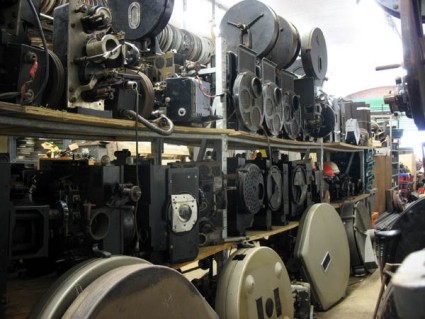
Projectors, sound systems and projection miscellanea, from http://www.cinemamuseum.org.uk

Good news re the Cinema Museum in London, which had been facing a bleak future when it was asked to move out of its current location at a former Lambeth workhouse, as it had not been able to find any suitable new home. Owing to the downturn in the UK property market, the NHS Trust which owns the building has decided not to put it on the market until their signs of upturn. So they have put the Museum on a monthly rolling contract for the next six months after which the position will be reviewed. The search is still on for a long term solution, but for the time being the collection is safe. Here’s hoping a new home emerges, just in time for those green shoots of recovery…

Neversink Valley Area Museum

The Neversink Valley Area Museum is in Cuddebackville, NY, an area know to film historians as a popular location for New York film companies in the pre-Hollywood era. In particular it was a favoured location of D.W. Griffith and the Biograph company, which filmed in Cuddebackville six times over the period 1909-1911. The local museum (which takes its name from the optimistically-named Neversink river) has a section on filmmaking in the area (Thanhouser and the Victor Film Company were other visitors). But more than that, it has established competitions for silent filmmaking today and writing scores or silent films. The rules for the silent film competition are as follows:

We will accept any film up to 18 minutes in length, it may be from any country and does not have to premiere at our festival. Films currently in distribution are not eligible.
Film makers to submit entries on DVD (all region compatible, as one judge is UK-based).
Length not to exceed 18 minutes.
No synchronized sound.
Music, if used, must be original or provide proof of licensing.
Intertitles acceptable.
DVD should be marked with Title Only.
Enclose sheet with all credits in submission packet.

And here are the rules for the original film score competition:

Entrant to compose an original score for one of these three films: King Lear, The Vagabonds and The Marvelous Marathoner, all made by Thanhouser Motion Picture Company.
Thanhouser will provide a copy of the film to interested entrants.
The winning entry (i.e. film + winner’s music) will be posted on the Thanhouser web site for viewing the winner can use the film with their music royalty free.

Prizes are to be announced later. All screenings to take place 23 August. Further details and application form on the museum’s website.

Brighton beach memoirs

G.A. Smith’s Brighton studio in 1902, with the rooftop set for Mary’s Jane’s Mishap

It is probably not possible to pick up a book on early film studies and not find mention of the symposium ‘Cinema 1900-1906’ held at 1978 FIAF congress in Brighton. This formative, and now practically legendary event, took place thirty years ago, and the Giornate del Cinema Muto at Pordenone is going to mark the anniversary by having a special programme at this October’s festival where some of those who participated in 1978 each choose a couple of films that were shown at the original symposium.

The programme notes are on the Pordenone site, and John Barnes, Eileen Bowser, Michael Chanan, Tjitte de Vries, Jon Gartenberg, André Gaudreault, Tom Gunning, David Levy, Charles Musser, Barry Salt, Martin Sopocy and Paul Spehr each choose the two titles, provide their explanations and sometimes their misty memories of thirty years ago. Each demonstrates the extraordinary rich field that early cinema represents for those with the eyes to see, and the undimmed enthusiasm among those who have been working on this territory for three decades and more.

The International Federation of Film Archives (FIAF) holds annual congresses, and in 1978 in was Britain’s turn. David Francis, the Curator of the National Film Archive, decided to hold a symposium on film 1900-1906, reflecting both the active academic and archival interests in this area, and the role of Brighton (where the congress was held) as a hot-bed of creative filmmaking at this period (the so-called ‘Brighton School’ of filmmakers such as G.A. Smith, James Williamson and Esme Collings). 548 films were shown in Brighton, either during pre-screenings or at the symposium itself. These were contributed by film archives around the world, many of which, as David Francis notes in his memoir of the event, had not been preserved, so two negatives and two prints were produced of each title (one set for the donating archive, one set to stay at the NFA). The two-volume proceedings of the symposium (above), with papers and filmography, were edited by Roger Holman and published in 1982, and are still available from FIAF.

Huge efforts were therefore made to bring together practically every available film for the period (fiction film, that is – non-fiction film, ever the bridesmaid, was not included). 1900 to 1906 was chosen so as to avoid the contentious 1890s (which could have ended up as a ‘we-invented-the-cinema’ exercise in futile national boasting) while examining film form and style before the era of cinemas brought about its changes. The experience of seeing so many films for a well-defined period, allowing scholars to make reasoned assessments for film at this time based on unmatched access to the projected films themselves, had considerable repercussions. As said, hardly any writer on early film can avoid noting 1978 as a major milestone, if not starting point, for the whole field. Out of that gathering of academics eventually came the organisation, Domitor, which still represents scholarly interest in early film studies. Tom Gunning and André Gaudreault’s notion of the ‘cinema of attractions’ (another essential reference point for practically any writing on early cinema) was undoubtedly formed to some degree by the experience.

It could be argued that FIAF 1978 had its detrimental side, given that bias towards the fiction film, film form and the elevation of some films whose crudities, to the general observer, tend to outweigh their stylistic innovations. But it’s all part of a process, and if a gathering together of films 1900 to 1906 today would give rise to many different kinds of questions (particularly, I would like to think, on their social and contextual functions), that just shows the vitality of the medium and its continued relevance in the light of new kinds of questions and new theories.

But will we get other such gatherings of early films? David Francis makes it clear what a gargantuan effort effort it was to bring together, preserve, make accessible and exhibit 548 films in one place at one time. There hasn’t really been anything quite like it since (though David notes the slapstick symposium at the 1985 FIAF Congress in New York). One of the most memorable early film events I ever attended was the pre-screenings of pre-1914 films on religious themes, organised at the National Film Theatre in advance of the first Domitor conference in 1990 (in Québec). I’ve no idea how many films were shown, but it took up the whole of a weekend, and we were on our knees by the end of it. But what an experience – and what was so interesting was to encounter the papers that came out it, and to see how enriching it has been for those scholars who attended.

There should be renewed efforts to put on such epic surveys. Of course, the DVD box set can now bring us such astonishing treats as the entire (almost) extant works of Georges Méliès, but there are still vast number of early films that remain unseen by most, and of course many more films have been discovered for the period since 1978. Moreover, it is the experience of seeing such films projected, with an interested audience, that is so important. David Francis calls for year-by-year analyses of fiction and non-fiction films, which would be welcome – and not impractical – though I would still hope different kinds of arrangement, so that we don’t just get a lesson in emerging kinds of film form. The impact of FIAF 1978 has resounded for thirty years, surely a sound return for the investment in time, money and effort. Someone should try do something similar in the light of the critical perceptions we have today. It would be more than worth it.