Good news for the Cinema Museum

cinemamuseum

http://www.cinemamuseum.org.uk

Those who have been following the saga of the Cinema Museum, the Aladdin’s cave of cine-memorabilia managed by Ronald Grant, based in Lambeth, south London, will know that it has been under serious threat of closing down, because the lease was up and they were unable to find a new home. Happily the news has come through that they have successfully negotiated a new three-year lease with the landlord, and can now go ahead with fundraising plans with new confidence. Let’s hope a long-term home for the Museum is eventually found.

Electric Silents

thering

The Ring

A programme has now been published for the festival of silent films at the Electric Palace, Harwich, UK, 7-10 May – and the festival has a name, Electric Silents. Here are the programme details:

A Festival of Silent Cinema

Thursday 7th May – Sunday 10th May 2009
A four day programme of silent films aiming to show exactly what these first films looked like and what the audience were seeing between 1896 and the late 1920s.

7 May Thursday at 7.30pm
THE RING (1927)
Duration 85 mins
Directed by Alfred Hitchcock
U certificate
Live musical accompaniment by Terry Ladlow
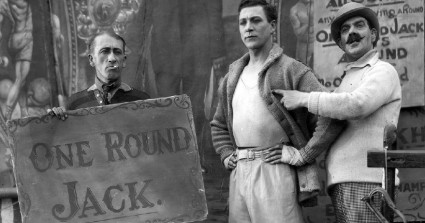
‘One round’ Jack Sander (Carl Brisson) works in a carnival boxing ring and easily defeats his opponents. He is confident both in his ability to win and in the love of his girl (Lillian Hart-Davies). He befriends Bob Corby (Ian Hunter) a champion boxer who encourages him to take up boxing professionally. Friendship turns to rivalry over the girl and Jack finds himself fighting for everything he holds dear.

Hitchcock directs from his own script to produce a film rich in experimentation and visual innovation. Particularly impressive are the montage sequences that appear throughout the film which show Hitchcock’s growing confidence as a director.

8 May Friday at 4.00pm
MYSTERY AND MELODRAMA
A DVD screening of three rarely seen titles showing the early fascination of cinema with action, mystery and melodrama.

The Master Mystery: Chapter One (1920)
40 mins
Directed by Burton King
U certificate
Harry Houdini is a government agent on the trail of a secret society. The film features the silver screen first robot.

The Dying Swan (1913)
50 mins B&W
Directed by Evgenii Bauer
U certificate
A Russian melodrama of the relationship between a dancer and an artist.

Fantomas: Chapter One (1913)
55 mins B&W
Directed by Louis Feuillade 1913 U certificate
Can anyone capture arch criminal and master of disguise Fantomas?

8 May Friday at 7.30pm
COTTAGE ON DARTMOOR (1929)
100 mins B&W
Directed by Anthony Asquith
U certificate
Live musical accompaniment by Stephen Horne who will introduce the screening and answer questions on his experience of composing for silent film.

A convict (Uno Henning) escapes from Dartmoor prison and flees across the moors. Inside a nearby cottage, Sally (Nora Baring), is putting her child to bed. She goes downstairs and is confronted by the convict who has broken into the cottage. Through flashback we learn they knew each other before he was imprisoned and a story of spurned love and jealousy unfolds.

Asquith creates a simple but beautifully realised tale of sexual jealousy, that easily counters the view that British cinema of the time was theatrical and lacking emotion.

9 May Saturday at 2.30pm
STEAMBOAT BILL JNR (1928)
90 mins B&W
Directed by Charles Reisner
U certificate
Live musical accompaniment by Stephen Horne

Tough steamboat captain Bill Canfield (Ernest Torrence) is facing competition in the town of River Junction. The return of his son (Buster Keaton) fills him with hope, but first impressions of the beret-wearing, ukulele-playing dandy his son has become are not good. Can Buster measure up to the expectation of his father?

A great comedy which combines romance, stunts and slapstick. The famous climax during the cyclone that pits Keaton against the elements.

Plus: Buster Keaton in The Electric House (1922)
16 min B&W U certificate

9 May Saturday at 7.30pm
PICCADILLY (1929)
108 Mins B&W
Directed by E.A. Dupont
PG certificate
Live musical accompaniment by Stephen Horne. Introduced by Bryony Dixon, BFI Curator of Silent Film

Shosho (Anna May Wong) works as a maid in a sophisticated London nightclub. The owner of the nightclub Valentine Wilmot (Jameson Thomas) spots her star potential as a dancer and makes her the toast of the town. Complications arise due to his own obsessions and the jealousy of his former star dancer Mabel (Gilda Grey).

One of the true greats of British silent films, Piccadilly still oozes sophistication and captures something of its jazz-age setting. It also features an early appearance by Charles Laughton.

10 May Sunday at 2.30pm
THE ADVENTURES OF PRINCE ACHMED (1926)
90 mins B&W
Directed by Lotte Reiniger
PG certificate
Live musical accompaniment by Stephen Horne

An evil sorcerer tricks Prince Achmed into riding a magical flying horse. Carried far from home he falls in love with a beautiful Princess. Helped by Aladdin and a witch he must defeat an army of demons to win her heart. Based on stories from “The Arabian Nights”.
Lotte Reiniger was a pioneer of animated film, developing a beautiful delicate and elegant silhouette technique. This was the first feature-length animated film.

Plus Ko-Ko the Clown in Ko-ko Gets Egg-cited (1926) and Ko-ko the Convict (1926)

10 May Sunday at 7.30pm
SUNRISE (1927)
95 mins B&W
Directed by F. W. Murnau
U certificate
Introduced by Kevin Brownlow

Life in a quiet village is hard for a farmer (George O’Brien) and his neglected wife (Janet Gaynor). Unknown to her, his head has been turned by the attentions of a woman from the City and they are plotting to drown her.

From this simple starting point Murnau creates a film rich in poetry and a sense of fable. One where town and country life is contrasted and the audience is immersed in the fate of these simple characters. Sunrise is the swansong of the silent era and was awarded three Oscars. One for Janet Gaynor for ‘Best Actress’, one to Charles Rosher and Karl Struss for ‘Best Cinematography’ and one for its status as a ‘Unique and Artistic Picture’. This is the only time such an award has been given.

As well as the above programme, the festival will feature presentations and commentary contributions by film archivists and film historians:

Friday 8 May – Presentation session 1
11.00 Magic lanterns before film – Richard Rigby
12.00 Cecil Hepworth’s early films – Tony Fletcher
13.00 The films of Mitchell and Kenyon – Martin Humphries
14.00 The films of Arthur Melbourne Cooper – Tjitte de Vries

Saturday 9 May – Presentation session 2
17.00 ‘Pictures and Variety’: magazine shorts of the 1920s, with live variety acts featuring Julien Vincent and members of the Dovercourt Theatre Group
18.00 ‘Opening Night’: selections from the BFI National Archive – Bryony Dixon, Curator of Silent Film, BFI

Sunday 10 May – Presentation session 3
16.45 History of the Electric Palace – Chris Strachan, Chairman, Electric Palace Trust
17.30 ‘Surprising Silents’: Keynote presentation by special festival guest Kevin Brownlow

Live musical accompaniment by Stephen Horne and Terry Hadlow

Films will be shown on the Electric Palace’s Kalee 35mm projectors and, in the case of some very early films, on a specially installed Gaumont Chrono projector. All films will be projected onto the cinema’s original hand-painted screen. In addition, there will be an exhibition of early cinema technology as well as a display of pre-cinema media.

TICKETS WILL BE AVAILABLE FROM FRIDAY 10TH APRIL

All tickets £5.50 per screening/presentation session (no concessions)
Day Pass £14.00 (to all films and presentations on one day)

Electric Palace Membership pa available from Box Office, by e-mail, or by writing. £4 adults, £2 seniors & concessions, £1 children under 15; one day membership £1.

Normal Box Office hours: Fridays 7.00 pm to 7.45 pm, Saturdays and Sundays 2.00 pm to 2.45 pm and 7.00 pm to 7.45 pm. Box office open additionally from 30mins before each screening /presentation.

Only day tickets bookable in advance: by personal application or post payable to Electric Palace (Harwich) Limited, Kings Quay Street, Harwich CO12 3ER enclosing SAE & cheque (must include £1 booking charge). E-mail reservations (boxoffice@electricpalace.com) must be promptly paid for. No phone bookings but e-mail reservations may be made for the 7.30 p.m. shows on the day but tickets must be paid for and collected 30 minutes before otherwise the tickets may be sold.

The last trains to London 21.54 hours (21.53 Sunday)

All in all an excellent introduction to silent film for the lucky denizens of Harwich, and hopefully those from a bit further afield. The Electric Palace itself is one of the oldest cinemas in Britain stilloperating as a cinema, having opened in 1911. It still has its silent screen, original projection room and ornamental footage intact. You can read about the history of the cinema here.

All details, as usual, from the festival site.

A hero of the valleys

dlg8

The young David Lloyd George’s dream of David and Goliath. All images in this post are frame grabs from the DVD of The Life Story of David Lloyd George

How do we judge a film that no one saw? The audience gives a film meaning, or at least historical specificity. There are many examples of films that have never been seen (quite a few from recent British cinema history) because they were deemed uncommercial, and other grand projects that were never completed, such as Sergei Eisenstein’s Que Viva Mexico or Orson Welles’ Don Quixote. But the completed film that stands up as an exceptional work of art, that was a strong commercial possibility in its time, and whose exhibition could have changed film history (in a modest way) – such examples are rare.

One such example has just found its way to a DVD release after a remarkable history of idealism, political intrigue, slander, subterfuge, disappearance, rediscovery and restoration. The Life Story of David Lloyd George was made in 1918, vanished before any cinema audience had a chance to see it, and re-emerged to astonished acclaim in 1994. Its place must be in virtual history rather than actual film history, because its story is one of if onlys and maybes. But what a story it is.

dlg5

Norman Page as David Lloyd George, Alma Reville as his daughter Megan

The story begins with the Ideal Film Company, formed by the brothers Harry and Simon Rowson in 1911 to distribute films, before moving into production in 1915. Excited by the interest shown by the public in official films of the war, the Rowsons decided to make an epic drama about the origins and purpose of the war, employing none other than Winston Churchill – then in the political wilderness following the Dardanelles disaster – to furnish ideas which would be turned into a scenario by Eliot Stannard. When Churchill returned to the cabinet in summer 1916 the original project was dropped, only to transmogrify into a biography of the new Liberal prime minister, David Lloyd George (the Rowsons were strong supporters of the Liberal party). Conceived as an epic story of a man who from humble beginnings rises to lead his country through to victory in the greatest war known to man, it was an undertaking unlike anything attempted in cinema to that date, nor would it have any subsequent parallel until the American and Soviet biopics of the 1930s onwards (Young Mr Lincoln, Wilson, Lenin in October etc.). But those conform to the classical dramatic conventions of their time, and their subjects were long dead – Lloyd George was, and remains, unique in subject and form.

The script was written by a noted historian (though without film experience) Sidney Low. The director was Maurice Elvey, gradually rising to the top of his profession, at least in British film terms. The cast were a mixture of Ideal stalwarts and lookalikes, most notably in the latter case the stage actor Norman Page, whose uncanny performance as Lloyd George carries the film (Page watched Lloyd George in full flow in the House of Commons and gives us what is probably a highly accurate record of his mannerisms). Alma Reville, later to marry Alfred Hitchcock, plays Lloyd George’s daughter Megan, and Ernest Thesiger can be spotted as Joseph Chamberlain. Helen Haye (not credited on the DVD but recently identified) plays Lloyd George’s mother.

dlg3

The Birmingham Town Hall riot scenes

The film’s production was announced to the trade press in February 1918, under the title The Man Who Saved the Empire. It was not the only propagandist feature film epic to be made in Britain at this time, with American directors brought in by British official film interests to make Hearts of the World (D.W. Griffith) and Victory and Peace (Herbert Brenon), but it was the only one made on such a scale with private money only. Filming proper began towards the end of August and astonishingly was completed by the end of September. It took place in several of the historical locations, including the north Wales of Lloyd George’s childhood, Birmingham and London. Shaping up to be two-and-a-half hours long, there were suggestions that the film could be released as a serial, but excitement was high at what promised to be the outstanding British film release of the year.

In October the trouble started. Horatio Bottomley, the rabble-rousing, influential owner of the nationalistic journal John Bull, began a campaign against the film. Essentially his line was that the film was a disgrace because it was being made by Germans. The Rowsons were Jews, real name Rosenbaum, and in Bottomley’s nakedly bigoted mind, Jews were equated with Germans. Bottomley’s campaign against the film (Ideal won a libel suit against him) brought a lot of unwelcome publicity, and may have added to a sense of awkwardness felt by some in the government at the production of a film lauding the achievements of the prime minister at the time of an impending general election (one took place in December 1918, just after the war ended).

In the end, none of the evidence that we have really explains what happened next. The Ideal company were paid off, to the sum of £20,000 (around half a million pounds in today’s money), which was the cost of the film’s production – though no recompense for the anticipated returns. Lawyers for the government turned up, paid Ideal in twenty one thousand pound notes, took the negative away with them in a taxi – and that was the last that anyone saw of it, publicly at least. Someone in power thought it worth a lot of money to prevent the film from being shown, but to this day no one can really say why, and the documentary record (including a memoir written by Harry Rowson) is tantalisingly vague.

dlg6

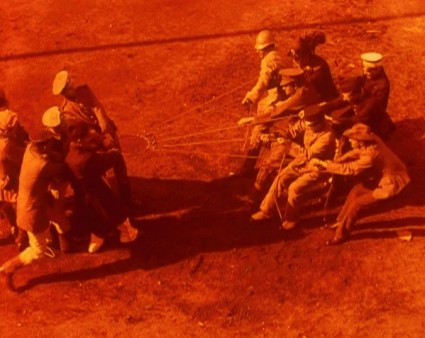
Symbolic illustration of a theme from one of Lloyd George’s speeches, showing the Allies learning to pull together

The only evidence we have for the film after this date is a reference in the diary of Frances Stevenson – Lloyd George’s secretary and mistress – over a year later. On 24 February 1920 she wrote:

Last night went to see a film of D’s life which Captain Guest had put on the screen in No 12 [Downing Street] – a perfectly appalling thing. The idea was all right but the man who was supposed to be D. was simply a caricature. I begged D. not to let it be shown. Mrs Ll. G. very angry with D. because she said I had put D. against it because I had objected to the domestic scenes in it!

Were there plans to show the film in 1920? Is Stevenson referring to this time, or 1918, when she says “I begged D. not to let it be shown”? Might she be speaking of a different film entirely? We do not know. The Life Story of David Lloyd George was no more, unseen by anyone, little more than a footnote in a history or two. British film historian Denis Gifford interviewed Maurice Elvey in 1967, shortly before he died, when Elvey said (with remarkable sang froid in the circumstances):

This I suppose must have been one of the best films I ever made or ever shall make … It is such a shame it has disappeared.

In 1994 the film was discovered. It was in a barn at the home of Viscount Tenby, David Lloyd George’s grandson. It was in pristine condition, though in an unassembled form. Considerable effort and ingenuity effort was required from the only recently-formed Wales Film and Television Archive to piece the film together. As the first sequences were constructed and shown to film historians and Lloyd George experts, the general reaction was astonishment. Instead of the quaint drama that, to be honest, we had been expecting, here was a film of skill and power, possessed of a fervour and a commitment to the issues of the day that were electrifying. The film had its premiere – literally so – on 5 May 1996 (precided by a showing on 27 April for an invited audience) at the MGM cinema, Cardiff, accompanied by the Cardiff Olympia Orchestra playing a score by Welsh composer John Hardy. Since that time it has had screenings around the world, usually with Neil Brand accompanying on piano, and it gained recognition as a unique classic. But there has been a huge struggle on the part of the National Screen and Sound Archive of Wales (as they are now called) to get the film issued on DVD. Now, at last, with pseudo-orchestral score by Brand, it is available for all to see – and it is a film that demands to be seen.
dlg4

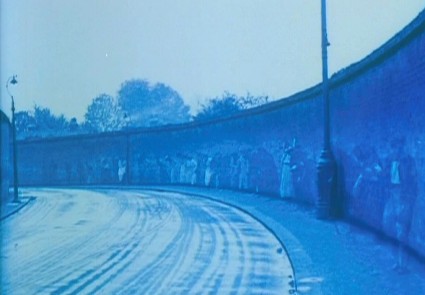
Elderly inhabitants of the workhouse, freed by Lloyd George’s introduction of an old age pension scheme, materialise outside the workhouse walls

The Life Story of David Lloyd George tells the story of its subject from childhood to wartime victory (the film was completed before the war was won), relayed in key scenes selected to demonstrate a calling to national duty and a desire to overturn injustice. The early scenes, showing Lloyd George’s upbringing in Wales, have not been given the praise that should be their due. They capture an atmosphere of modesty, devoutness and dedication towards one’s fellow man which is moving in its general effect, and deeply touching in its detail, grounded as it is in an affectionate portrait of late Victorian Welsh society.

Lloyd George is shown triumphing in the law and local politics through his oratory and commitment to noble causes. He gains notoriety through his anti-Boer War (1899-1902) stance, illustrated by a speech he gave at Birmingham Town Hall which occasioned a near riot in the streets, which the film recreates with truly extraordinary newsreel-style realism, helped by many hundreds of extras. If these scenes impress by their documentary quality, the film’s greater power comes in how it illustrates the revolutionary effect of Lloyd George’s time as Chancellor of the Exchequer, introducing old age pensions and and the National Insurance Act (1911). The very rightness of the actions moves us now, and surely must have had – or would have had – an overpowering effect on a contemporary audience, for whom these great changes were recent occurrences.
dlg7

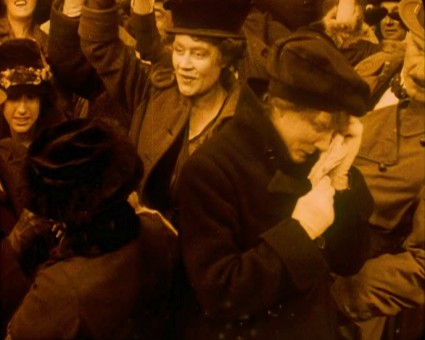
While most celebrate the homecoming of loved ones after the war, one woman represents those mourning the dead

Other vigorous tableaux follow, clearly inspired by the newsreels (Lloyd George himself was a consumate performer for the news cameras), notably the Queen’s Hall suffragette riots. The film makes much use of an impressive House of Commons interior set, peopled by lookalikes, shot and perfomed with an easy realism that could fool some into thinking they were watching actuality. The film dips somewhat in its second half when the First World War begins. Lloyd George served brilliantly as minister of munitions before becoming prime minister in 1916, but there is paradoxically less drama on show once the film has arrived at the climactic stage to which its first half has been building. The battle scenes are convincing, likewise Lloyd George’s visit to the Front, and there is a prolonged sequence inside a munitions factory which may lack dramatic interest but as a seemingly documentary record is superbly shot. But our emotions are not re-engaged until the film’s final scenes, when the war comes to an end. Troops line up on the parade ground in their hundreds, fall out, then run to their waiting loved ones, at which point they materialise into civilian clothes. Amid all the happiness, one woman turning her head and weeping stands for all those whose loved ones were not returning home. Shown live, it catches the audience’s breath every time.

It is not a film for every one. Those hoping for either a more conventional human interest story, or a political drama, may be disappointed. Its newsreel-style – a deliberate aesthetic choice to reflect the way in which many of the audience were most familiar with Lloyd Geoge as a public figure – lessens the emotion while it heightens the sense of living history. It is unlike any other silent film in intent and form. But watch The Life Story of David Lloyd George, and then try and take seriously one of the conventional dramas of the war made duing the war – Hearts of the World for example – and they come across as pitiable, not so much in their execution or use of dramatic convention as in their absence of real social and political feeling. The Life Story of David Lloyd George is not realistic as such, despite its newsreel inspiration. It is pure hagiography. But more than any other film of the period it manages to articulate what people were fighting for. Which is what the Rowsons had wanted for their epic war film, right from the beginning.
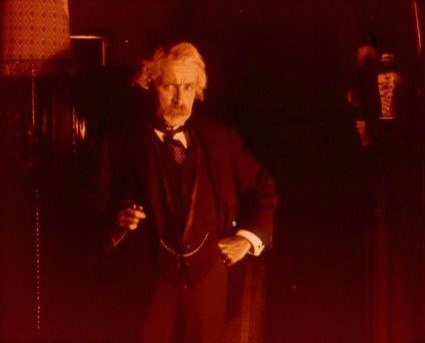
dlg9a

Lloyd George addresses the camera in the film’s final scene: ‘There must be no “next time”‘

The film runs for 152 minutes. Viewers will see from time to time sequences which clearly do not quite fit. Titles referring to Moses are followed by film of Boadicea (the film has several such emblematic sequences); Lloyd George’s vision of his prime ministerial predecessors has obvious re-take shots; longueurs in the latter half would undoubtedly have been edited down had the film been completed for release. The film had to be pieced together without a running order, and a place found for every extant shot, somehow. Tinting records came with the film, the colour richly but sensitively reproduced by the Wales archive.

On the DVD you get 47 mins of extras, including an interview with composer Neil Brand which goes beyond the thinking behind his sumptuous score to consider the value of silent film generally. It is a tour de force from Neil which I would recommend showing to anyone wanting to understand what the silent film means for us today. Kevin Brownlow is interviewed, stating that the film would have changed film history (particularly in Britain) had it been shown – Britain’s The Birth of a Nation. Would it have been a huge financial success though? I think Ideal may have ended up with a problem on their hands – a long film, without stars, partisan in politics, perhaps too reliant on the patriotic uplift occasioned by the war. But we’ll never know.

The DVD is available for purchase online from the National Library of Wales’ shop, price £18.99, or if you are passing through Aberystwyth, visit the shop in person. Those intrigued by the history should certainly check out David Berry and Simon Horrocks’ book David Lloyd George: The Movie Mystery (1998), which includes Harry Rowson’s memoir, and essays from Lloyd George’s biographer John Grigg, Nicholas Hiley, Sarah Street, Roberta Pearson, John Reed (who restored the film) and others. Information on the film, the archive that restored it, and a short video clips can be found on the Moving History website. Finally, on my personal site, there the text of a talk I gave on the British epic film of the silent era which puts The Life Story of David Lloyd George in that particular context.

The Life Story of David Lloyd George will never fit easily into film history, because it was never seen, and because there has never been anything else like it. But it is a major work irrespective of film history, and the National Screen and Sound Archive of Wales have done us a great service in making available to all.
National Film Registry

foolish_wives1

Foolish Wives, from http://www.kino.com

Twenty-five films have been announced as being added to the National Film Registry. Each year the Librarian of Congress, with advice from the National Film Preservation Board (and with recommendations made by the public), names twenty-five American films deemed “culturally, historically or aesthetically” significant that are to be added to the National Film Registry, “to be preserved for all time”. The idea is that such films are not selected as the “best” American films of all time, but rather as “works of enduring significance to American culture”.

These are the silents (excluding amateur films) included among the list just announced, which they describe as follows:

Foolish Wives (1922)
Director Erich von Stroheim’s third feature, staged with costly and elaborate sets of Monte Carlo, tells the story of a criminal who passes himself off as a Russian count in order to seduce women of society and steal their money. This brilliant and, at the time, controversial film fully established von Stroheim’s reputation within the industry as a challenging and difficult-to-manage creative genius.

One Week (1920)
“One Week” is the first publicly released two-reel short film starring Buster Keaton. One of Keaton’s finest films and one of the greatest short comedies produced during the 1920s, the film, as critic Walter Kerr noted, shows Keaton as “a garden at the moment of blooming.” Considered astonishingly creative even by contemporary standards, “One Week” is rife with hilarious comic, often surrealist, sequences chronicling the ill-fated attempts of a newlywed couple to assemble their new home.

The Perils of Pauline (1914)
“The Perils of Pauline” was among the very first American movie serials. Produced in 20 episodes, in a groundbreaking long-form motion-picture narrative structure, the series starred Pearl White as a young and wealthy heiress whose ingenuity, self-reliance and pluck enable her to regularly outwit a guardian intent on stealing her fortune. The film became an international hit and spawned a succession of elaborate American adventure serial productions that persisted until the advent of regularly scheduled television programs in the 1950s. Although now regarded as a satirical cliché of the movie industry, “Perils of Pauline” in its day inspired a generation of women on the verge of gaining the right to vote in America by showing actress Pearl White performing her own stunts and overcoming a persistent male enemy.

So’s Your Old Man (1926)
While W.C. Fields’ talents are better suited for sound films — where his verbal jabs and asides still delight and astound — Fields also starred in some memorable silent films. Fields began his career as a vaudevillian juggler and that humor and dexterity shines through in “So’s Your Old Man.” The craziness is aided immeasurably through the deft comic touches of director Gregory LaCava. In the film, Fields plays inventor Samuel Bisbee, who is considered a vulgarian by the town’s elite. His road to financial success takes many hilarious detours including a disastrous demo for potential investors, a bungled suicide attempt, a foray into his classic “golf game” routine and an inspired pantomime to a Spanish princess.

White Fawn’s Devotion (1910)
James Young Deer is now recognized as the first documented movie director of Native American ancestry. Born in Dakota City, Neb., as a member of the Winnebago Indian tribe, James Young Deer (aka: J. Younger Johnston) began his show-business career in circus and Wild West shows in the 1890s. When Pathé Frères of France established its American studio in 1910, in part to produce more authentically American-style Western films, Young Deer was hired as a director and scenario writer. Frequently in collaboration with his wife, actress Princess Red Wing (aka: Lillian St. Cyr), also of Winnebago ancestry, Young Deer is believed to have written and directed more than 100 movies for Pathé from 1910-1913. Many details of Young Deer’s life and movie career remain undocumented and fewer than 10 of his films have been discovered and preserved by U.S. film archives.

For the record, the other titles on the list are The Asphalt Jungle (1950), Deliverance (1972), Disneyland Dream (1956), A Face in the Crowd (1957), Flower Drum Song (1961), Free Radicals (1979), Hallelujah (1929), In Cold Blood (1967), The Invisible Man (1933), Johnny Guitar (1954), The Killers (1946), The March (1964), No Lies (1973), On the Bowery (1957), The Pawnbroker (1965), Sergeant York (1941), The 7th Voyage of Sinbad (1958), George Stevens WW2 Footage (1943-46), The Terminator (1984), Water and Power (1989).

The full list of films entered on the National Film Registry since 1989 can be found here, while this is the list of all silents on the Registry 1989-2007:

Ben-Hur (1926)
Big Business (1929)
The Big Parade (1925)
The Birth of a Nation (1915)
The Black Pirate (1926)
Blacksmith Scene (1893)
The Blue Bird (1918)
Broken Blossoms (1919)
The Cameraman (1928)
The Cheat (1915)
The Chechahcos (1924)
Civilization (1916)
Clash of the Wolves (1925)
Cops (1922)
A Corner in Wheat (1909)
The Crowd (1928)
The Curse of Quon Gwon (1916-17)
Dickson Experimental Sound Film (1894-95) [not strictly a silent, of course]
The Docks of New York (1928)
Evidence of the Film (1913)
The Exploits of Elaine (1914)
Fall of the House of Usher (1928)
Fatty’s Tintype Tangle (1915)
Flesh and the Devil (1927)
The Four Horsemen of the Apocalypse (1921)
The Freshman (1925)
From the Manger to the Cross (1912)
The General (1927)
Gertie the Dinosaur (1914)
The Gold Rush (1925)
Grass (1925)
The Great Train Robbery (1903)
Greed (1924)
H20 (1929)
Hands Up (1926)
Hell’s Hinges (1926)
The Immigrant (1917)
In the Land of the Head Hunters (1914)
Intolerance (1916)
It (1927)
The Italian (1915)
Jeffries-Johnson World’s Championship Boxing Contest (1910)
The Kiss (1896)
Lady Helen’s Escapade (1909)
Lady Windermere’s Fan (1925)
Land Beyond the Sunset (1912)
The Last Command (1928)
The Last of the Mohicans (1920)
The Life and Death of 9413 – A Hollywood Extra (1927)
The Lost World (1925)
Making of an American (1920)
Manhatta (1921)
Matrimony’s Speed Limit (1913)
Mighty Like a Moose (1926)
Miss Lulu Bett (1922)
Nanook of the North (1922)
Pass the Gravy (1928)
Peter Pan (1924)
Phantom of the Opera (1925)
The Poor Little Rich Girl (1917)
Power of the Press (1928)
President McKinley Inauguration Footage (1901)
Princess Nicotine; or The Smoke Fairy (1909)
Regeneration (1915)
Rip Van Winkle (1896)
Safety Last (1923)
Salome (1922)
San Francisco Earthquake and Fire, April 18, 1906 (1906)
Seventh Heaven (1927)
Sherlock Jr. (1924)
Show People (1928)
Sky High (1922)
The Son of the Sheik (1926)
Star Theatre (1901)
The Strong Man (1926)
Sunrise (1927)
Tess of the Storm Country (1914)
There it is (1928)
The Thief of Bagdad (1924)
Tol’able David (1921)
Traffic in Souls (1913)
The Wedding March (1928)
Westinghouse Works, 1904 (1904)
Where Are My Children? (1916)
Wild and Wooly (1917)
The Wind (1928)
Wings (1927)
Within our Gates (1920)

The Researcher’s Guide to Screen Heritage

screenheritage

UK Screen Heritage Network

Today saw the launch at the British Library of the Researcher’s Guide to Screen Heritage. This is the the result of a project, led by the UK Screen Heritage Network, to map artefacts held in UK museums and archvies which relate to screen history. So this isn’t the films, or television programmes, but rather the costumes, sets, cameras, projectors, toys, documents, scripts, sheet music etc, and embracing a broader idea of screen history to inlcude magic lanterns, other kinds of slide presentation, digital media artefacts of today, and even art installations.

The resultant directory has been combined with an existing directory of moving image collections in the UK and Ireland, so that you can now search across the full range of moving image-related collections which are open to researchers. It a collection-level database, so you’ll find information on collections rather than individual titles; and it’s not everything, but it’s a strong start in attempting to map what what has generally lain scattered across the museums and seldom known about by film (or screen) historians.

So you are encouraged to explore for yourselves, but some of the gems from our area that you may learn about are:

  • the Black Country Living Museum in Dudley, which includes a complete 1920s cinema reconstructed and placed within the museum, plus a complete cinema percussionist’s kit used at the Picture House, Willenhall from 1923-27;
  • a collection of cinema slides dating from the First World War, consisting mainly of hand painted film publicity/advertising subjects, at the Clevedon Curzon Community Centre for the Arts;
  • the Barnes Collection of material relating to early film production in the South East, including Brighton and Hove pioneers George Albert Smith, James Williamson, William Friese-Greene, Esme Collings, Alfred Darling and Charles Urban, held by Hove Museum & Art Gallery;
  • early trade catalogues, oral history interviews on cinema-going and working in cinemas held by Beamish, The North of England Open Air Museum;
  • the collection of magic lantern slides used by the Congo Reform Association in their campaign to raise awareness about the abuses taking place under King Leopold II of Belgium’s regime in the Belgian Congo c.1880 to c.1909, held by Anti-Slavery International;
  • record of the Hepworth and Nettlefold studios at Elmbridge Museum.

As well as collections tucked away in unexpected corners, there are the leading museums in the field in the UK: the National Media Museum, Kingston Museum, the Cinema Museum, and the University of Exeter’s Bill Douglas Centre. The Researcher’s Guide to Screen Heritage is hosted by the British Universities Film & Video Council, and was developed for the UK Screen Heritage Network by the BUFVC, the National Media Museum and Screen Archive South East. Go explore.

Harold Brown RIP

harold_brown

Harold Brown, on left in the 1940s (from the British Film Institute), on the right in 2008 (courtesy of Eve Watson)

You will not find the name of Harold Brown in many film history books, but there are quite a number of film histories that could not have been written without him. Harold, who died on Friday 14 November, essentially invented the art and science of film preservation. Countless films have been preserved either by his hands, or by the hands of those he tutored, or those archives around the world who adopted his methods.

It was in 1935 that Harold Brown (born 1919) started as office boy at the newly-formed British Film Institute, where Ernest Lindgren was setting up the National Film Library. Brown was subsequently to become its first preservation officer. In the early 1930s there were no film archives, or almost none. In that decade the four great national archives that were to become pillars of the film archiving movement were established: the Museum of Modern Art Film Library (New York), the Reichsfilmarchiv (Berlin) and the National Film Library (London) in 1935, the Cinémathèque Française (Paris) in 1936. These archives were established by a dedicated band of pioneer archivists with a passion for the film as art. They were driven in particular by the passing of the silent film era, and the imminent loss of the films of that first period of cinema history, films which were being dumped by the studios who saw no value in a heritage that they could no longer sell to anyone.

mark4

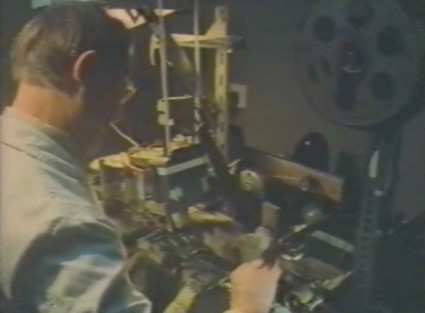
Harold Brown printing a film using the Mark IV

Ernest Lindgren, as Curator of the National Film Library (later the National Film Archive and now the BFI National Archive), laid down principles and Harold Brown came up with the working methods which formed the basis for film preservation. The original film was, as far as possible, inviolate. It needed to be copied, in a form as faithful to the original as possible. Films needed to be treated not only according to their importance but to the extent of, or their potential for, chemical decay. One of Harold’s most notable achievements was the artificial ageing test, which enabled archivists to determine when a film was likely to start deteriorating, and at what time it should be copied. This allowed archives to plan sensibly for the future. A noticeable legacy of Harold’s is the punch holes that you will see occasionally in National Film Archive prints, created so that a circle of film could be put through the ageing test. Another famous Brown creation was the Mark IV, a step printer for dealing with shrunken and non-standard perforation film, built out of bits of toy Meccano, string, rubber bands and parts from a 1905 Gaumont projector.

physical_characteristics

Harold was a self-taught pioneer. His investigations established basic methods for the identification of early film formats, the repair of damaged film, the storage of film, and the treatment of colour film (his work on Douglas Fairbanks’ 1926 film The Black Pirate, in two-colour Technicolor, was an early classic of film restoration). Awarded an MBE in 1967, he carried working at the National Film Archive until 1984, though he continued as a mentor and consultant to film archives internationally, well into retirement. He passed on his knowledge not only in person, but through some key publications. His Basic Film Handling (1985) and Physical Characteristics of Early Films as Aids to Identification (1990) are standard reference guide to the film archiving profession, and the latter is still available from the site of the Federation of International Film Archives (FIAF). Nor was he solely a nitrate era or early film specialist. He stayed abreast of issues in film archiving throughout, and it was he who gave the name ‘vinegar syndrome’ to the phenomenon of the degredation of acetate film which film archives discovered, to their alarm, in the 1980s.

You can see Harold at work in his prime in a 1963 Pathe Pictorial report on the work of the National Film Archive, available from the British Pathe site (just type in ‘film archive’, or click here for the same film from ITN Source). He features towards the end, delicately handling four frames of film, then seen operating the Mark IV. If you can, check out his modest four-page memoir in the FIAF publication This Film is Dangerous: A Celebration of Nitrate Film, edited by Roger Smither. Or you can read about how Brown and Lindgren went about creating a film archive in Penelope Houston’s Keepers of the Frames: The Film Archives (1994). Or read this text by David Francis (Lindgren’s successor as Curator of the National Film Archive) for this year’s Pordenone Silent Film Festival catalogue on Brown’s role overseeing the projection of the 548 films dating 1900-1906 shown at the seminal 1978 FIAF symposium on early film. Or get a copy of the BFI compilation DVD, Early Cinema: Primitives and Pioneers, most of the examples of which are films that Harold took in, preserved, and made available for future generations.

Harold was a wise, methodical, determined and kindly man. I was lucky enough to know him and to exchange information with him on early film formats at my time at the BFI, in the mid-1990s. I was rather awe-struck just to be holding conversations with him, but I found him to be every inch a gentleman. He has been held in reverence by generations of budding film archivists, and even as his pioneering methods have been superseded by more sophisticated technology, and as the film archiving profession now encounters the digital frontier, his understanding of the life – and the after-life – of a film underpins all that a film archive stands for. Gladly would he learn and gladly teach. Thank you, Harold.

The dead

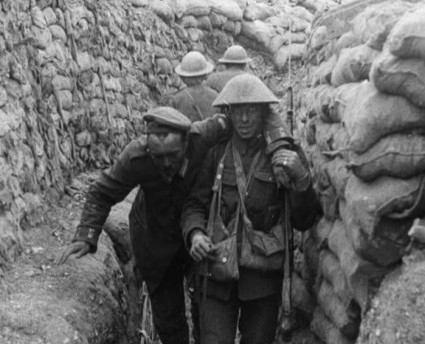
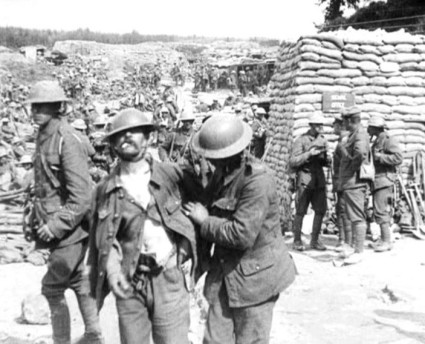
All images in this post are frame grabs from the DVD of The Battle of the Somme (1916)

Is it right to let us see men dying? Yes. Is it a sacrilege? No. If our spirit be purged of curiosity and purified with awe the sight is hallowed. There is no sacrilege if we are fit for the seeing … I say it is regenerative and resurrective for us to see war stripped bare. Heaven knows that we need the supreme katharsis, the ultimate cleansing. We grow indifferent too quickly … These are dreadful sights but their dreadfulness is as wholesome as Tolstoy’s ‘War and Peace’. It shakes the kaleidoscope of war into human reality … I say that these pictures are good for us.

Those words were written by James Douglas in The Star (25 September 1916, p. 2). He was reacting to a screening of the film The Battle of the Somme, a film whose impact upon audiences was unprecedented and – it could be argued – has never been repeated. Douglas, like many commentators, was trying to rationalise what he saw, to express the meaning and to find justification for a film whose stark images of the war that was still raging shocked audiences into a realisation of sacrifice and death. It was the images of death in the film that so disturbed many. If soldiers were not shown being killed (and some apparently were), then every face that stared at the camera was likewise facing death. The audience had been made witness to this, complicit in the soldiers’ fate.

While some called for the film not to be shown, for most it was justified, to the point of becoming almost a moral obligation. Through watching The Battle of the Somme, they gained a sense of the enormity of what troops in their name were undergoing, what the sacrifice (the optimum word) was that army and nation were making. Douglas’ evocation of religious feeling put the film in terms that many would understand. It is not a pure reaction to the film itself – that is not possible. Instead he saw the film through his own thoughts on the meaning of war. Any image, any film, is identified by us through expectations and understandings that are informed by time, place and culture. The Battle of the Somme in 1916 was a different film to The Battle of the Somme in 2008.

This we can now judge through the release of the film for the first time on DVD, produced by the Imperial War Museum, whose archive preserves the film. Alert to the complexities of authenticity, the IWM presents the film in a form that encourages us to question how we see what we see. Firstly, the film (for which no original negative survives) has undergone a digital restoration which has brought out details which were hitherto obscured. Even for those familiar with the film (and all of us must be familiar with it to some extent, given the widespread use of sequences from the film in television documentaries etc.), it is like seeing the film anew. But the major coup is the music. We are given two music tracks. One is a modern score by Laura Rossi, a symphonic work for full orchestra. The other is a recreation by Stephen Horne of a likely original score, taken from a contemporary cue sheet which suggested the sort of musical passages musicians might want to adopt in accompanying the film in 1916.

The latter will amaze many. Jaunty marches and popular airs accompany scenes of troops marching to the killing fields of the Somme, the scenes of battle and their aftermath. What were they thinking of in 1916? It is a complicated question to answer. Partly the musicians of the time were responding to what might have seemed just another war actuality film, which required patriotic accompaniment. But also the audience of the time saw heroism and uplift where we, after almost a century of awful contemplation of the futility of that war, bolstered by poems, novels and films, see something profoundly pitiable. It is with consciousness of such modern expectations, but equally with a sense of being true to the film’s original vision, that Rossi supplies a rich, subtle and binding score that connects 2008 to 1916. Which of these two very different scores will you prefer to listen to, and why? Or might your preferred option be to witness the film in silence?

The digital restoration, which allows us to see so much, is perhaps most striking when it comes to the famous ‘over the top’ sequence. This is the part of the film that will be most familiar. It is shown on television (at least in the UK) every time a shot is needed to evoke the First World War. Troops clamber over the top of a slope, then march slowly over barbed wire away from the camera, a couple of men falling down as they do so, shot dead.

Oh God, they’re dead!

a woman is reported to have exclaimed in a cinema showing the film, and it was this sequence that aroused the greatest comment at the time, the greatest need to explain the film’s significance. But they were not dead. As is now known, the sequence is a fake, set up in a trench mortar battery school some time afterwards, simply because the actual scenes taken of troops going over the top were deemed disappointing. At the time, no one knew of this subterfuge, and as far as reception is concerned, it did not matter. People believed they were witnessing death on screen; and producers and exhibitors felt this to be an acceptable thing to show. Which you may think is extraordinary.

What seldom gets shown on television is the shot that immediately follows the ‘over the top’ sequence in the film. This shows genuine footage of troops going over the top. But we see them only in the far distance. The cameramen (there were just two, J.B. McDowell and Geoffrey Malins, who shot both ‘over the top’ sequences) were greatly restricted in what they could shoot. Their hand-cranked cameras had single 50mm lenses with poor depth of field, they had no telephoto lenses, the orthochromatic film stock was slow, making filming action in the distance or in poor light difficult. But there was also military control and official censorship, each preventing them from filming anything other than officially-sanctioned images. And there was the danger. The most obvious indication of the ‘fake’ nature of the first sequence is that the cameraman would have been in absolute peril of his life had it been genuine. But for the above shot, Malins is a long way off, and far in the distance we can just pick out tiny figures on the horizon – British troops, coming over the top and marching into no-man’s land. Looking closer into the middle ground, the digital restoration now reveals to us a sight not previously detected in the film: a number of troops proceeding leftwards, one or two of whom fall down. Oh God, they’re dead.

Do we want to look that closely? Can they really seem dead when viewed at such a distance? Is the death we seek not in the falling bodies, or even in the corpses seen later in the film, but rather in the eyes of the still living, whose fate awaits them, and who are all dead now of course. That was a line the film historian Denis Gifford would sometimes come out with when we were in the basement theatre at the British Film Institute, watching some collection of British silent shorts. The figures would parade to and fro, some of whom he knew, having interviewed them in the 1960s, but then that sad moment of realisation:

They’re all dead now, of course.

This is a poignancy that seems particularly linked to the non-fiction film. Dramatic films, of whatever age, are attempting to entertain. Either they do or they don’t. But the film of actuality trades on the depiction of life, and then the distance created by time. This was recognised even in 1916. Sir Henry Newbolt wrote a poem inspired by the experience of watching the film, entitled ‘The War Films’, but made memorable by its opening line:

O living pictures of the dead,
O songs without a sound,
O fellowship whose phantom tread
Hallows a phantom ground —
How in a gleam have these revealed
The faith we had not found.

The Battle of the Somme captures the point of loss, the ghosts on the screen, the living pictures of the dead. Of course it is a deeply partial record. It shows no real fighting beyond shellfire, no serious injuries, no pain, little hatred (look for the shove that one British soldier gives to a captured German who stumbles past him). And of course it shows only the Allied point of view (the Germans would respond with their own film, Bei unseren Helden an der Somme, in 1917). But we recognise it for what it is able to show, not for what it leaves out. It is a profoundly memorably expression of the hopes and fears of its age.

The Battle of the Somme was filmed by Malins and McDowell, two experienced newsreel cameramen, who knew well how to capture plain packages of actuality. McDowell was the senior of the two, who ran his own film company (British & Colonial). Malins had been filming on the war front for longer, and is the better known, not least for his somewhat vainglorious memoir, How I Filmed the War (available from The Internet Archive). Malins co-edited the film with Charles Urban, to whom credit should be given for seeing that the footage Malins and McDowell has shot would work best at feature length, rather than as a series of ten-minute shorts which had been the practice up til then. His vision gave the film the presence it needed to capture the audience that it found. The producer was William Jury, and the film was made for the British Topical Committee for War Films, a trade body working under War Office sanction, which would be replaced by the War Office Cinematograph Committee once the film started to enjoy huge success. It has been estimated that it was seen by 20,000,000 people in the UK in six weeks – almost half the population.

The DVD comes with the alternative music scores, commentaries, interviews with archivists and musicians, and five ‘missing’ scenes and fragments. We do not know what the original The Battle of the Somme was like exactly; the version that survives was re-edited, and the footage used in multiple other films, during and after the war. Rather than insert these extra scenes where it is not quite certain they should go, the IWM has chosen to present these (without music) separately. There is a booklet as well, with information on the film’s production, reception, restoration and particularly its music. A website, www.iwm.org.uk/somme-film, will provide viewing notes, additional information, suggestions for further reading and teaching resources. It is a magnificent achievement, one whose influence on research, teaching and the appreciation of First World War history is likely to be considerable. The only possible disappointment is the menu, which simply divides the film into its five parts, where a more detailed use of chapters could have helpfully guided researchers to particular points of action, regiments, location etc.

More will follow. The booklet notes the publication next year of Alastair H. Fraser, Andrew Robertshaw, and Steve Roberts’ Ghosts on the Somme, a book which analyses the film in great detail, overturning some of the traditional understanding of who filmed what, which regiments are shown, and which locations are featured, while confirming that the vast majority of the film is genuine actuality. There is still more to be discovered about The Battle of the Somme. It is a film we will have to return to, again and again.

The DVD is available from the Imperial War Museum Shop (Region 0, PAL, duration 74 mins with 58 mins extras).

A CD of Laura Rossi’s score is available from Virtuosa Records.

On the weekend of 15/16 November 2008 there will be two screenings of the film at the IWM in London, the ‘original’ score on Saturday, the Rossi score (not played live) on the Sunday. Both screenings are free, and start at 14.00.

The Battle of the Somme has been recognised by UNESCO by being accepted for inscription on its Memory of the World register.

Things European

1903 amateur film by Julius Neubronner of a Kronberg bank employee, Moren, performing a number of dances and female impersonations in Neubronner’s garden, from the Deutsches Filminstitut

I’ve written before about filmarchives online, the European-funded project providing integrated access to filmographic and technical information on selected films from archives across Europe. When we last visited the subject (May 2007), there were some 4,000 films (predominantly non-fiction) documented, from five partner archives: Deutsche Filminstitut, the British Film Institute, La Cineteca di Bologna, the DEFA-Foundation and Národní Filmový Archiv Prague.

A year and a half on, and there are now eighteen institutions taking part, of which those contributing content are the British Film Institute, Cinémathèque Royale de Belgique, Cineteca del Comune di Bologna, DEFA Stiftung, Deutsches Filminstitut, Fondazione Cineteca Italiana, IWF Knowledge and Media, LICHTSPIEL / Kinemathek Bern, Magyar Nemzeti Filmarchívum, Národní Filmový Archiv and Tainiothiki tis Ellados. All the participating archives are part of MIDAS (Moving Image Database for Access and Re-use of European film collections), a project funded by the European Union’s MEDIA pogramme to encourage more efficient distribution of historic content in European film collections. The target is 20,000 records to be published by the end of 2008. Individual records come with rich cataloguing details and – rare for online film archive initiatives – technical information on the film elements held.

A selection of films (74 and rising) has been made available for viewing online, the majority of which are early non-fiction titles (a lot of them Mitchell and Kenyon productions from Britain and the ‘amateur’ efforts of Julius Neubronner from Germany). The same films can be found on the project’s YouTube channel. There are plenty of genuinely fascinating gems in there, with a clear emphasis on historic film’s documentary qualities.

While we’re on the subject of European film archive initiatives, it’s worth noting the European Film Gateway, a recently-announced three-year project planning to develop an online portal, “providing direct access to about 790,000 digital objects including films, photos, posters, drawings, sound material and text documents”. Film archives from across Europe (but not Britain) are participating. The project is funded by the European eContentplus programme, and the results will eventually be linked to the Europeana, a planned European digital library, museum and archive. More on this project once it’s properly underway.

You’ll already know about European Film Treasures, also funded by the MEDIA programme, which is delivering a library of historic titles from collections across Europe (including Britain this time), silent and sound.

Go explore.

Mystery movies

Unidentified film with a 1923 edge code, from The Nitrate Film Interest Group

The Nitrate Film Interest Group is a new interest group set up by the Association of Moving Image Archivists, or AMIA. The group, which describes itself below, is dedicated to promoting understanding about nitrate film and, through its Flickr pages, providing an online space for placing images of unidentified films, inviting comment.

This FLICKR account is to help archives around the world identify unknown films in their collection. We will do our best to post what information is known about each film along with the frame scans. If you are able to provide any information such as title, actor, approximate date, or anything helpful then please leave a comment.

Films that have multiple frame scans have been grouped into sets that can be found along the right side of the screen. By clicking on the set information will appear that applies to all of the frame scans from that reel of film. We suggest that you navigate these photos through their sets so as to see all of the information that is provided.

The Nitrate Film Interest Group is a part of the Association of Moving Image Archivists’ interest groups. Check out AMIA at http://www.amianet.org. The Nitrate Film Interest Group is dedicated to promoting education about nitrate film as well as functioning as a resource for those interested in and working with nitrate film by becoming a major resource for archivists’ needs.

Questions about these scans can be posted to the scan comments. If you have a frame scan of an unidentified film, any questions about the Nitrate Film Interest Group or this account an email can be sent to nitratefilminterestgroup@yahoo.com

To check the frame stills of unidentified film (which include sound films), click on the Photostream link on the Flickr page. If you know something, do add a comment – no one has done as yet.

Pordenone diary 2008 – day six

Market day in Pordenone

The 2008 Giornate del Cinema Muto was filled with many interesting and worthwhile titles across a wide range of what comprises silent film, but as day six dawned it felt like we had experienced little in the way of cast-iron classics. Plenty to intrigue and inform, few that would have made you want to rush out into the streets and drag in the nearest passer-by, telling them that they just had to see this. Sparrows (though it disappointed me) already enjoyed classic status; the Griffiths were a surprise, but they weren’t going to upset the pantheon; Ed’s Co-ed was very enjoyable, but it was an amateur college movie when you got down to it.

So it was on day six that we had the popular hit of the festival, and the first (but not the last) rediscovered classic of cast-iron certainty. The popular choice came at 9.00am, an odd slot for the silent film that had enjoyed the greatest publicity over the past year. It was only at the end of last year that it was announced that a print had been discovered of the long-lost Bardelys the Magnificent (1926), directed by King Vidor and staring John Gilbert, each fresh from their triumph with The Big Parade. Following some scepticism (a bogus announcement for the supposed rediscovery of Murnau’s The Four Devils occurred at about the same time), it transpired that a print had indeed been uncovered by the indefatigable Lobster Films of Paris. Just under a year later, it enjoyed its re-premiere at Pordenone, albeit in DigiBeta form. The tape copy may have been the reason for the less-than-prime-time slot, or it may have been a reflection of the disappointment reported by those few who had seen the film. Kevin Brownlow, in the festival catalogue, was less than enthusiastic, declaring:

It has a lush, gauzed look, but does not compare visually with Rosita or Dorothy Vernon, and the plot is so thin I found myself wondering why they made it at all.

All of which may be a warning not to judge films too much by how they appear on a monitor, without music or audience. On the big screen, slightly bothersome tape quality notwithstanding, with an audience out to enjoy itself and Neil Brand in commanding form on the piano, Bardelys the Magnificent was a triumph. It is an adaptation of a Rafael Sabatini novel, he of Scaramouche, The Sea Hawk and Captain Blood, set in seventeenth century France. Bardelys, played with rogueish aplomb by Gilbert, is a devil-may-care courtier notorious for his success with women. He takes on a bet that he can marry Roxalanne de Lavedan (Eleanor Boardman), daughter of a landowner believed to be inimical to the king. In a sequence of stills, representing the missing reel from the film, Bardelys comes across a dying rebel whose name he takes as a ruse to enable him to enter the castle, with plenty of attendant problems when he finds that he is now believed to be a notorious anti-royalist.

The centrepiece of the plot is Bardelys’ wooing of Roxalanne, which swiftly moves from challenge to real affection, leaving Bardelys and the film with the moral dilemma of how to negotiate the bet that underlies his actions. We won’t give the game away, as the film has yet to receive its American premiere and is going to be a treat for many audiences, but just to say that Gilbert and Boardman are both of top form, capturing the spirit of the text and the age in witty style. Wit is the optimum word; that sort of wit coming out of crisis that characterises the best of the Sabatini and Dumas school. The film climaxes with an escape from the scaffold sequence that spoofs Douglas Fairbanks, with assorted outlandish bounds to freedom, culminating in Gilbert leaping off battlements with a makeshift parachute. This sequence is the part of the film that has come for the highest praise, but I felt it veered on the facetious side – the film would have been better without it.

The film has some modest failings. The plot is a little thin, perhaps lacking a good sub-plot to add strength to the brew. There’s evidence of economies in some of the sets, which makes the film less of a visual treat than it ought to have been. But the audience relished every minute of it, through to its satisfying conclusion. Definitely a film to catch when you get the chance.

D.W. Griffith’s final silent film was Lady of the Pavements (1929), in which the old master achieved the near impossible in making Lupe Velez sympathetic. Mind you, it didn’t look that way early on in the film. The story is a take on Pygmalion, where a German diplomat Count Karl von Arnim (William Boyd) tells his cheating duchess fiancee (Jetta Goudal) that he would rather marry a woman of the streets than her. The rest of the plot you could probably come up with yourselves. The duchess gets one of her retinue to recruit a singer from the lowest dive in town, and to train her to appear to be a gently-born lady. Karl will then fall in love with her, which he duly does, and when the deception is revealed … well, of course, he marries her anyway. The singer they recruit is played by Lupe Velez, the Mexican bombshell whose film performances are invariably cranked up to eleven. It’s no different here, and for much of the early part of the film she is pretty much unbearable, an unexceedingly unlikely future mate for the fastidious Karl.

And then some modest magic occurs, and we start to care for her. Remarkably, Velez has a soft pedal and is able to do poignant. She reveals unexpected sensitivity of performance as her predicament worsens, and one feels for her. She is the best thing in the film, as most of the rest of the cast go through the motions, though I quite liked Goudal’s vindictive duchess. It’s not a great film, but it is a more than competent one, with some stylish camera movement, though with a sense that sheer studio power was carrying Griffith along. In the end, the film was another commercial flop for him, its greatest success coming from an Irving Berlin song Velez sings, ‘Where is the song of songs for me?’ (memorably recreated for us by Joanna Seaton), a recording of which was a hit for her (the film was released with synchronised orchestral score and songs from Velez). For the cognoscenti, the highlight was probably the scene towards the end where Velez, back in the restaurant where she started, sings a sad song and Karl appears to her in place of everyone in the room through progressive multiple exposures. So farewell then, D.W. Griffith the silent filmmaker.

Pordenone regularly dedicates a section of the festival to the work of one of the world’s film archives. This year it was the Slovenian Film Archive, or Slovenski Filmski Archiv, celebrating its fortieth aniversary. I only caught the first few titles in its programme of actualities ranging from 1905 to 1937, but there was some magic there. The first Solvenian films were shot by Karol Grossmann in 1905/06, and we saw a striking high-angle view of townsfolk coming out of church in 1905, which had a real sense of pulling back the curtains to reveal the past; and delightful film of Grossman’s children, which has been used as part of the archive’s animated logo. But the real treasure was Postojnska Jama (Postojna Cave) (1926). Postojna Cave is a spectacular cave system and a top Slovenian tourist site. The film showed us the interior of the caves (the catalogue claimed that it was the first film ever taken underground, which may well be the case), through which a train travelled, with the passengers carrying flares. The result was a phantasmagorical tour de force, as white lights and smoke lit up the fantastical shapes within the cave, looking for all the world like a tourist trip through Dante’s Inferno. The interpolation of some still photographs deadened the effect slightly, but this short film (five minutes) provided perhaps the most dazzling visual effect of any film shown at the festival.

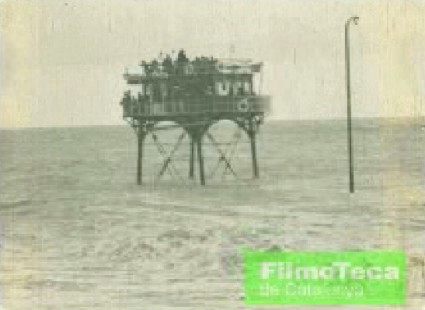
Brighton Sea-Going Electric Car (1897), from Filmoteca de Catalunya

Another anniversary marked by the festival was the thirtieth anniversary of the celebrated FIAF congress of 1978, held in Brighton in the UK, which held a symposium which examined films from around the world made 1900-1906. This epic undertaking (548 films were screened) effectively kick-started the serious study of early film, and had huge repercussions on scholarly understanding, publishing, video releases and some notable academic careers. To mark the occasion, the festival invited some of those who were at the original symposium to select two films each from the 1900-1906 period, and to say why they still excited their imaginations.

I was greatly looking forward to this part of the festival, and it’s sad to have to report that it was, in all honesty, a bit of a shambles. There was no sense of a governing idea, several of the prints were quite poor and appeared to be (and some certainly were) the prints shown at the original symposium, in some cases with quaint introductory titles. In at least one instance the wrong version of a film was shown, and there were some titles that weren’t in the catalogue at all but got shown because they were on the same reel as one of the scheduled films. I didn’t stay for the second half of what was a long session, but others reported similar disappointment. Of course, classic titles such as The Life of an American Fireman (1903) and The Great Train Robbery (1903) are never going to fail, but the highlight, ironically enough, was a new discovery. George Albert Smith’s Brighton Sea-going Electric Car (1897), discovered this year by the Filmoteca de Catalunya is a mysterious masterpiece in miniature. This was an elevated, sea-going platform, a sort of maritime tram, invented by Magnus Volk, which is seen to traverse the screen from right to left, like some bizarre vision of modernity drfiting into view then out again.

Alice O’Fredericks and Mona Mårtenson (right) in Laila, from http://www.nfi.no

The rediscovery that sent us out into the streets, if not with the intention of dragging in passers-by then certainly floating on air, was unexpected. Laila (1929) is a late Norwegian silent, a daunting 165 minutes long. Expectations were not high from those like me who knew little of this period of Norwegian cinema, though the presence of George Schnéevoigt, cinematographer on a number of Carl Th. Dreyer film, as director, had aroused curiosity.

So, we’re amid the snowy wastes of Norway, at some time in the past. It’s nighttime. Merchant Lind and his wife are being drawn by dog sleigh through the snow, taking their baby daughter Laila to her christening. A pack of wolves attackes them. In the frantic chase, the baby falls out of her sleigh. With the dawn, they seek desperately for the child, only to find an empty papoose. The child must have been devoured by the wolves. But the baby had been found by Jåmpa, the wild-looking servant of the wealthy Lapp Aslag Laagje, whose wife is childless. They decide to adopt the child, but then learn of her true identity. Sorrowfully, they return Laila to her true parents. But then her parents die of the plague…

We were gripped, and we stayed gripped throughout, as this immaculately-paced drama in the remotest of landscapes held you like only the best of silent films can. Exoticism was certainly part of the appeal – age-old, etched faces, rampaging wolves (running over the camera at one point), clashes between Lapps and Norwegians (disparagingly referred to by the former as ‘daros’), some fine ski-ing, and an awful lot of reindeer. Lying just underneath the narrative was a miscenegation theme, as the grown-up Laila (brightly played by Mona Mårtenson), kept in ignorance of her Norwegian parentage, is brought up to expect marriage to Laagje’s foster son Mellet. The film seeks to rescue her from this fate, preferring that she marry instead her first cousin, Anders Lind (Harald Schwenzen), who ends up rescuing her at the altar in a satisfyingly dramatic conclusion, thanks to an intervention from Jåmpa (Trygve Larssen), who puts Laila’s happiness above loyalty to his master (and gets savaged by a pack of wolves for his pains).

This was a work on both an intimate and an epic scale (it is based on a novel by J.A. Friis), excellently played in a fine naturalistic style by all concerned. It was good human drama. It’s hard to make a dull-looking film when you have so much snow to work with, and Schnéevoigt did not fluff a single scene. The only disappointment was the print, which was a TV print with rounded corners. This was something of a distraction. Presumably it is the only material that survives. We were told that the film had previously only been available in sound speed form, but has now been re-photographed at 16fps. Fresh, unusual and soundly executed throughout, Laila was the outstanding feature film of the Giornate.

Flagging a little by this stage, and with no desire to see the new documentary on Mary Pickford which was the main evening screening, that was the end of Thursday for me. Day seven, and the last of these reports, will follow, bringing us a poignant tale of class divisions, a paean to London at its imperial zenith, a ballet master turned puppet master, two Lillian Harveys, and one minimalist.

Pordenone diary 2008 – day one
Pordenone diary 2008 – day two
Pordenone diary 2008 – day three
Pordenone diary 2008 – day four
Pordenone diary 2008 – day five
Pordenone diary 2008 – day seven