Saving motion

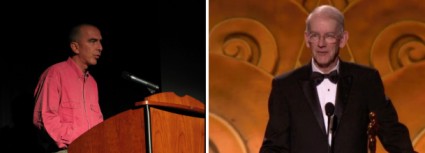
Paolo Cherchi Usai (left) and Kevin Brownlow

On 19 January 2011 there is to be a notable event held at the Kenneth Clark Lecture Theatre of the Courtauld Institute of Art, Strand, London, by the International Institute for Conservation of Historic and Artistic Works. This august institution is devoted to promoting the knowledge, methods and working standards needed to protect and preserve historic and artistic works from around the world, but as well as the paintings, sculptures, buildings, museum artefacts and such like that are its usual concern, it also considers moving images. As one of its series of ‘Dialogues for the New Century’ is inviting Kevin Brownlow and Paolo Cherchi Usai to debate Saving Motion – the conservation of the moving image.

Here’s how the IIC describes the event:

Motion pictures, the movies, enjoy a position of both mass entertainment and valued products of our creative heritage. From the era of silent films to today’s high budget features, masterpieces abound, as do intimate personal moments and historic documentaries that capture the intangible aspects of what surrounds us.

Moving image heritage makes up a large portion of the world’s memory and both commercial and personal examples are found in every country and in every size and type of institution across the world. Archives, libraries, and museums struggle to conserve these records in a manner that attempts to respect the authenticity and inherent values while assuring and encouraging broad access. As the idea of digitization presents itself as a solution to both preservation and accessibility, questions arise regarding the value of the original footage, the qualities unique to film based material, our stewardship responsibilities to preserve these works in their unique original form, and the essential role and definition of film archives.

Kevin Brownlow and Paolo Cherchi Usai will explore a wide range of issues pertaining to the preservation of moving image heritage (films, video and digital materials) as well as the particular challenges of access. This dialogue between two of the leading pioneers and experts of the preservation of motion pictures will also explore the reasons for an apparent disconnect between those pursuing the preservation of film and the larger conservation community working toward the preservation of heritage in other art forms.

Kevin Brownlow is a filmmaker, film historian, author, and Academy Award recipient, best known for his documentation of the history of silent films. He is the creator of the alternative-history film, It Happened Here and the 1975 film Winstanley. Brownlow has written numerous works on silent and classic films including The Parade’s Gone By (1968). In collaboration with David Gill he produced a number of documentaries on the silent film era, including the 1983 Unknown Chaplin and the 1995 Cinema Europe: the Other Hollywood. His book The Search for Charlie Chaplin was published this year, 2010.

Paolo Cherchi Usai, is director of the Haghefilm Foundation in Amsterdam, cofounder and co-director of the Pordenone Silent Film Festival and of the L. Jeffrey Selznick School of Film Preservation at George Eastman House. He has authored numerous works on film and its preservation including Burning Passions: An Introduction to the Study of Silent Cinema (1994), The Death of Cinema: History, Cultural Memory, and the Digital Dark Age (2001) and co-author of Film Curatorship: Archives, Museums, and the Digital Marketplace (2008).

The event promises to be a fascinating one, with a strong bias toward silent film, and with two of the most prominent, thoughtful and opinionated people in our field addressing an audience of general conservationsists rather than the usual film crowd. In particular the theme of a disconnect between the conservation of film and the conservation of other heritage works promises much. Does the care of film exist in a world of its own, separate from the conservation or preservation of other media, and if so then why so, and is it a good or bad thing? If we could hang films in national galleries or museums might they be better cared for? Or might those who care for other heritage media have something to learn from how film archives manage huge problems with minimal resources while contending with thorny issues such as copyright which do not affect those caring for old masters or archaeological sites?

Previous such dialogues have been made available in transcript form on the ICC site, so if you can’t be there you can still read about it. The event takes place at 19:00 and is free to all.

Three Mexican silents

The Cineteca Nacional after the fire

On 24 March 1982 fire broke out in Mexico’s national film archive, the Cineteca Nacional. Smoke was reported as coming out of all four vaults (one of which held nitrate film) and the fire brigade was called. People were told to evacuate the building, but a screening was going on the the archive’s main theatre. The director went to stop the screening:

I was asking the audience to leave at once because there was an emergency: I asked them to do it calmly. The doors were opened and everybody seemed to cooperate … There was a group of youngsters left behind; they were claiming their money back. Then there came the eruption, and a big flame coming out of the screen reached us. I saw the ceiling fall down. I threw myself to the floor …

There were three explosions, and the fire was to rage for fourteen hours. Five people died, maybe more. The effect on Mexican film heritage was devasting: the exact figures are unclear, but perhaps as much as 99% of the archive film collection was lost, some 5,000 films (other sources say 6,500), of which around half were feature films and short subjects. The archive’s library and public records on film production were also lost. Although the fire was apparently caused by overheating of electrical wiring but what made it so devastating was the nitrate cellulose – highly flammable, indeed explosive, and able to continue burning without oxygen, so making it resistant to all the usual means of containing fires.

This sobering tale – the greatest disaster ever to visit a national film archive in terms of percentage of films lost (a greater number of films overall was probably lost in the Cinémathèque Française fire of 1980) – is worth recalling when we consider films from Mexico’s silent era. Feature films got underway in Mexico in 1917 (after the revolution) when a drop in foreign films owing to the First World War encouraged local producers to fill the gap. But after a flurry of activity production was constrained during the 1920s, as Hollywood competition returned. Producers struggled to get films made and shown, and the greatest and most prolific period of Mexican cinema would not come until the 1940s-50s.

Therefore there were few Mexican silent feature films made, and so few survive today. Those that do exist, however, are championed not simply because their fortunate survival, but because of their quality and distinctive style. Some have made it to festivals and retrospectives and it is very pleasing to be able to report that another Mexican archive, the Filmoteca CINE UNAM, has just made three Mexican silent feature films freely available on its website, streamed in high quality.

Tepeyac (1917), from http://www.filmoteca.unam.mx/cinema

Tepeyac was made in 1917 by José Manuel Ramos, Carlos E. González, and Fernando Sáyago. Its subject is the miraculous appearance of the Virgin of Guadalupe to Juan Diego (a Mexican Indian) in 1531. The opening sequences take in the present, where the heroine (played by Pilar Cotta with a touch of the Italian diva about her), distraught at her lover having been drowned at sea, reads a book about the Virgin of Guadalupe whereupon the film takes us back to the sixteenth century and the conflict between the Spaniards and the native peoples. The technique is faltering, but the film’s ambition and distinctive style are noteworthy. It uses national history, myth, location and religion to carve out an idea of a cinema that was distrinctively Mexican. Rudimentary though it may be, its very difference is what appeals. The film is presented in six parts, 47 mins in total, with modern Spanish titles replacing lost originals. It is also shown silent, as with the other two films on the Filmoteca UNAM site.

El tren fantasma (1927), from http://www.filmoteca.unam.mx/cinema

The other two films were made by Mexico’s leading filmmaker of the silent era, Gabriel García Moreno. The first is El tren fantasma (The Ghost Train) (1927), a marvellous thriller about a bandit gang sabotaging a railway line. It is filled with chases, fights (including bullights) and hair’s breadth escapes – and the actors performed all their own stunts. Fast-moving, technically adventurous and ably performed, El tren fantasma is the sort of silent film to which you point people to demonstrate just how much silent films can be. The 70 minute film is presented silent, with Spanish and English intertitles.

The morphine injection scene from El puño de hierro (1927), from http://www.filmoteca.unam.mx/cinema

And then there is El puño de hierro (The Iron Fist) (1927), the most remarkable of the three. Again directed by Gabriel García Moreno, this was a quite different work to the populist adventures of El tren fantasma. It is an extraordinary tale, sadly with striking modern-day resonance, of drug addiction and criminal gangs in Mexico. It portrays in often delirious fashion a dark underside of Mexican life not previously shown on the screen, and is strongly reminiscent of Louis Feuillade’s serials of crime and mystery, Fantomas and Les Vampires, with its Bat gang of hooded criminals and its surrealist imaginings of fantastical happenings in realistic settings. It was all a bit too much for Mexican film audiences, who rejected the film out of hand, bringing about the end of Moreno’s career as a director, alas. But two masterpieces in one year is quite a cinematic legacy, and El puño de hierro is undoubtedly a film to see. It runs for 77 minutes in five parts and is shown silent, with Spanish and English subtitles.

Grateful thanks must go to the Filmoteca CINE UNAM for making the films available to all, and congratulations are to it on its 50th birthday. It had its own fire in 1977, but though some original nitrate films were lost, almost all had been copied onto modern stock, so actual losses were few). Its sister archive, the Cineteca Nacional, was rebuilt in 1984, and flourishes once more under far better management, it is good to report.

Information on the Cineteca Nacional fire comes from Roger Smither, This Film is Dangerous:a Celebration of Nitrate Film (2002). For information on Gabriel García Moreno I recommend the essay ‘El Puño de Hierro, a Mexican Silent Film Classic‘ by William M. Drew and Esperanza Vázquez Bernal (originally published in the FIAF Journal of FIlm Preservation). For information on Mexican silent cinema in general, see Thomas Böhnke’s Der Stummfilm in Lateinamerika, which is in German but is the first place to go for information on Latin American silent cinema. And, just in case you missed the link, the three films can be found at www.filmoteca.unam.mx/cinema.

From Russia with love

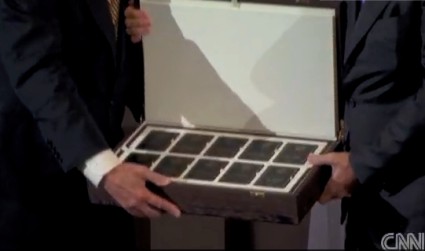
Digital copies of the ten American silent films donated to the Library of Congress by the government of Russia, from CNN

The discovery of silent films in countries other than those where they were produced and their repatration to the lands of their birth continues. Following on from the news of American silents found in New Zealand and last year in Australia now returned to the US, comes news of ten American silents held by the Russian state film archive Gosfilmofond, which have been donated in digital form to the Library of Congress. The ten titles, none of which are preserved in US film archives, are (with links to their IMDb entries):

  • Valley of the Giants (Famous Players, 1919 d. James Cruze), with Wallace Reid, Alice Terry
  • You’re Fired (Famous Players, 1919 d. James Cruze), Wallace Reid, Wanda Hawley
  • The Conquest of Canaan (Famous Players, 1921 d. Roy William Neill), with Thomas Meighan, Doris Kenyon
  • Kick In (Famous Players, 1922 d. George Fitzmaurice), with Betty Compson, May McAvoy
  • The Call of the Canyon (Famous Players, 1923 d. Victor Fleming), with Richard Dix, Lois Wilson
  • Canyon of the Fools (R-C Pictures, 1923 d. Val Paul), with Harry Carey
  • Circus Days (First National, 1923 d. Edward F. Cline), with Jackie Coogan, Claire McDowell
  • The Eternal Struggle (Metro Pictures, Louis B. Mayer, 1923 d. Reginald Barker), wtih Renée Adorée, Barbara LaMarr
  • The Arab (Metro, 1924 d. Rex Ingram), with Ramon Novarro, Alice Terry
  • Keep Smiling (Monty Banks, 1925 d. Albert Austin/Gilbert Pratt), with Monty Banks, Anne Cornwall

The films were handed over at a ceremony on 21 October at the Library Congress (reported on by CNN, which struggles hard to make a box of hard drives look fascinating). Reports suggest that these ten titles will be the first of 200 or so that will be repatriated over time. Russia tended to keep the films that were sent to it for distribution, whereas American studios all too often disposed of their silent features once they no longer had any commercial value. The Library of Congress is negotiating not only with Russia but with archives in France, Czechoslovakia and the Netherlands, so we can look forward to many more such happy homecomings.

Pordenone diary 2010 – day two

Verdi theatre, Pordenone

There’s no time for slouching at Pordenone if you are serious about your film-watching. A few habitués of the Giornate del Cinema Muto seem to have come for the sun and conversation, taking up near permanent residence in the pavement cafés, but for the rest of us breakfast was swiftly followed by the first film of the day at 9.00am sharp and the final film of the day concluding around midnight. They do let you out for lunch and dinner, but in general it’s a tough regime we had to follow.

And so we move to day two, Sunday 3 October, and what was to become the daily routine of starting off with a long Japanese film, just to test our stamina. Our 9.00am offering was Nanatsu No Umi (Seven Seas) (Japan 1931-32), made in two parts and shown back-to-back over 150 minutes. The films were made by Hiroshi Shimizu, director of the previous day’s Japanese Girls at the Harbour, and there were clear similarities in preoccupations and style.

The film tells of Yumie (played by Hiroko Kawasaki) who is torn between two brothers. She is engaged to the first but seduced by the second, following which her father dies and her sister goes mad. She marries her seducer but takes her revenge by refusing to let him touch her and spending all his money on her sister’s care in a mental hospital. It was pure soap opera, with a somewhat discontinuous narrative (particularly in part 1) characterised by seemingly random elements (just who was it who committed suicide in part 1, and why?) and unclear connections between some of the characters. Then it all ended with a happy ending so rapidly organised that you suspected that a reel was missing. As with Saturday, Shimizu showed off plenty of directorial tricks but lacked the basic skill of connecting one shot with another to propel a narrative forward. But he also showed the same intriguing, codified cultural elements, dividing the action up into public lives that showed the influence of the West (clothing, occupations, the key location of a sports shop) and traditional Japanese dress and manners within the private sphere. You felt you had been given a privileged glimpse into early 1930s Japanese life in the kind of middle-brow film that doesn’t usually make it to retrospectives. Japan’s leading silent film pianist Mie Yanashita was an excellent accompanist for this and all the other Japanese films that featured in the festival.

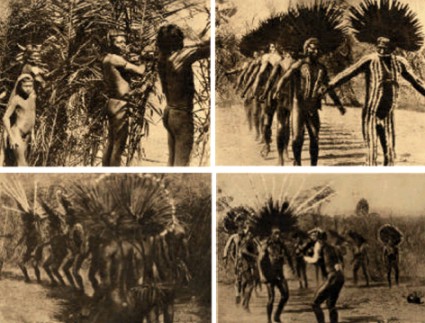
Scenes from Rituaes e festas Borôro (1916), from http://www.scielo.br

Now these dramatic films are fine in themselves, and even the severest of film critics likes to see a story told well, but regulars will know that what really stirs the heart of the Bioscope is the non-fiction film. So I was looking forward greatly to what was next on the list – Brazilian documentaries – and was not disappointed. In particular the first film of three, Rituaes e festas Borôro (Rituals and Festivals of the Borôro) (Brazil 1916) was one of the highlights of the festival. The filmmaker was Luiz Thomas Reis, photographer and cinematographer with the Commission of Strategic Telegraph Lines from the Mato Grosso to the Amazon, more simply known as the Rondon Commission. The Commission was tasked with mapping the unknown regions of Brazil and making contact with remote tribes. Reis documented this work on film, in part with the hope that the exhibition of such films would raise further funding.

Rituaes e festas Borôro is an extraordinary work, simply by letting the extraordinary speak for itself. Its subject is the Borôro people of the Mato Grosso region, specifically the funeral ceremonies for an elder of the village. I am no expert in anthropology, but the film seemed to me notable for its observant, unpatronising, humane manner. The camera never intruded, only witnessed, and the Borôro were not looked upon as objects of curiosity but as people respected for their customary practices and milieu. This was somewhat charmingly exemplified by the dogs. Stray dogs in early films are something of a Bioscope fetish, and Reis’ film captured not just the dances of the Borôro but the dogs who casually wandered in and out of the frame, surveying the strange things that these humans do in whatever part of the globe that humans happen to gather. The only questionable note was the assurance made by the film’s titles that these rites were not permitted to be seen by whites or women – yet here was the camera filming them. Such are the paradoxes of the anthropological film, a subject to which the Giornate would find itself returning in subsequent days.

Two other Reis films made for the Rondon Commission followed, Parima, fronteiras do Brasil (Brazil 1927) and Viagem ao Roroima (Brazil 1927). Each just under 30mins in length, these were more conventionally ‘travelogue’ in style. The first documented an inspection of the Brazilian-French Guiana border, following the river, with some thrilling shots taken from the front of a travelling canoe (the Brazilian version of the phantom ride), but with plenty of signs of encroaching colonisation in the builings that littered the banks of the river. The second explored the borderland between Brazil, Venezuela and British Guiana and concluded with breathtaking views of 1,000-foot high rock faces. In both films there were sequences where they came upon tribes, so positioned in the film as to be the big pay-off shots, the exotic conclusions which would capture the interest and wallets of likely funders. Rituaes e festas Borôro was in every sense the better film.

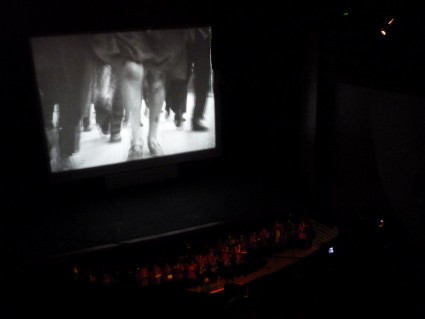
Mutter Krausens Fahrt ins Glück, with a band in the understage area playing the Internationale

So that was the morning session. A foul snack lunch and earnest conversations about budget cuts (again) and we were back at 14:30 for Mutter Krausens Fahrt ins Glück (Mother Krause’s Journey to Happiness) (Germany 1929). This was being shown as pat of the Giornate’s ‘The Canon Revisited’ strand. There is an occasional air of pompousness about the festival, and this idea of re-assessing canonical films exemplifies it. It’s a good idea to revisit classics, especially for the new audiences the festival is attracting, but a number of these films were titles that many of us had not had any chance to see the first time round; indeed I suspect most of us had not even heard of them. Mutter Krausens Fahrt ins Glück was a case in point; a film I’d vaguely heard of, but never seen, though I will admit it’s a classic of sorts and certainly merits being brought back to the screen once more.

Mutter Krausens Fahrt ins Glück is as agit-prop a film as you could expect to see. Directed by Piel Jutzi, it combines melodrama with documentary realism in its depiction of the ground-down lives of the Berlin proletariat. It tells of the family and tenants of an apartment managed by the aged Mother Krause (Alexandra Schmidt), pitting the apathy and resignation of the individualised poor (generally the elderly) against the positive binding together of those who follow the Communist party (generally the young). Its highpoint is where the harassed daughter (Ilse Trautschold) joins her boyfriend in a protest march to the sounds of the Internationale – literally so in our case, because at this point a marching band of red-suited musicians entered the Verdi theatre and played the marching song to much applause. It was a wonderful thearical coup – typical of the imagination that goes into the Giornate.

However, despite such rousing gestures, the film’s message was an unsettling one. We were supposed to reject Mother Krause’s miserablist view of her fate, but only after the film had done all it could to make us feel sorry for her, so that the ending – where she gasses herself and a sleeping child, because life simply isn’t worth it for either of them – was distasteful and the conclusion ambiguous. It was a stylish and imaginatively experimental film, but what it expounded was more posture than principle.

Next up came a selection of Pathé short comedies with surprisingly sophisticated live musical accompaniment from pupils of the Scuola Media “Balliana-Nievo” from nearby Sacile, music that was a good deal richer in colour and instrumentation than other schools’ work with silent films that I have heard. They were followed by pupils of Pordenone’s Scuola Media Centro Storico, who took on the truly bizarre Charley Bowers, an American comedian whose gimmick was to combine comedy with stop-frame animation. In There it is (USA 1928) he plays a Scottish detective from Scotland Yard who tackles the case of a haunted house with the aid of his cockroach sidekick, MacGregor. It wasn’t strictly funny, but it left this viewer – whose first Bowers film it was – opened-mouthed at its unabashed weirdness. If Salvador Dali had been employed by Leo McCarey, he might have made There it is.

In need of a break, I missed the new documentary Palace of Silents (USA 2010) on the story of Los Angeles’ Silent Movie Theater, returning for the evening’s screenings. The Giornate was celebrating the 75th anniversary of two of the world’s leading film archives, MOMA and the BFI National Archive. To mark its 75th year, the BFI took the interesting decision to try and recreate part of a programme of the Film Society. The Film Society was formed in London in 1925 by a bunch of radicals led by the Hon. Ivor Montagu, which eventually included such notables as Anthony Asquith, Iris Barry, Sidney Bernstein, Roger Fry, Julian Huxley, Augustus John, Bernard Shaw and H.G. Wells. The Society (the first of its kind in the world) put on films of artistic, historic or political interest at the New Gallery Kinema in Regent Street, often showing films from the USSR which had been refused a licence by the British Board of Film Censorship (they could do so because the films were shown to members of a private club). The Film Society had a huge influence on British film culture, and after it ceased operating in 1939 its collection went to the BFI.

On 10 November 1929 the members of the Society witnessed perhaps the most remarkable film programming coup ever – the world premiere of John Grierson’s Drifters, the cornerstone of the British documentary movement, and the UK premiere of Sergei Eisenstein’s Battleship Potemkin, plus James Sibley Watson’s avant garde classic The Fall of the House of Usher (USA 1928) and Walt Disney’s Barn Dance (USA 1929). Now that’s programming.

Drifters (1929)

Audiences were made of sterner stuff in 1929, because we were only shown the first two. Drifters (UK 1929) is one of those classics more cited than seen and those who have seen it generally did years ago. Looking at it again after twenty years in my case, it is a work that easily merits its high reputation. It documents the work herring fishermen, and by its Soviet-inspired use of montage combined with a very British tatse for understated realism it immediately stands out from any other film of actuality produced in the UK (or anywhere else) to that date. One understands why its effect on audiences at the time was so electric, and why it did indeed inspire a whole school of documentary filmmaking.

However, it is also an odd film. It falls into three parts. The first, where the fishermen go out to sea, is in classic documentary style, showing man pitted against the elements, elevated (but not excessively ennobled) by toil. Part two, the night-time sequence, is strange. The fishermen sleep, but in the seas beneath we see the herring shoals swimming to and fro, menaced by dogfish. What has this to do with documentary? It tells us nothing of the people involved. Are we mean to gain insight into the lives of the fish? What is going on? It’s a sequence that dosn’t seem to get discussed much in studies of Drifters, yet here is the archetypal Griersonian documentary, and at its heart it slips into a strange, blue-tinted reverie, a fisherman’s dream. Part three is where the catch is taken to harbour, with often exhilaratingly scenes of commerce, industrialisation and human interaction. As Russell Merritt notes in the Giornate catalogue, “Grierson claimed the sequence was pointed social critique, exposing capital’s exploitation of the workers”. It is no such thing. It is unabashed championing of the power of the marketplace. Grierson the instinctive filmmaker was not the political filmmaker that he thought that he should be – he was too good for that.

Do you really need my thoughts on Bronenosets Potemkin (Battleship Potemkin) (USSR 1925)? As probably the most discussed film in history outside of Citizen Kane, I guess not. It was an odd way of celebrating the anniversary of the BFI National Archive, especially as the print came from the Deutsche Kinemathek, but it was enriching to compare and contrast with Drifters. It’s a film that disappointed me greatly when I first saw it (with the original Edmund Meisel score), probably because I was so expecting to be impressed and because of the absence of conventional narrative. As a story, it hasn’t got much going for it. As cinematic posturing, particularly as one of a planned series of films celebrating the 1905 revolution, it makes absolute sense. Every scene is overplayed, but it is always compelling to watch. There is not a dull composition in it.

And that was enough for a Sunday. I did see the first twenty minutes or so of Dmitri Buchowetski’s Karusellen (Sweden 1923), which looked fabulous. but I was sceptical of any story where a circus sharpshooter somehow is able to afford a vast country house and where the happily married wife instantly falls for a stranger because that’s what always happens with strangers. Enough of such artificiality – give me the kine-truth of documentary, and better still the unvarnished simplicity of actuality. For all of the canonical classics on show, the film of the day was a plain record of tribal dances from the Amazonian forest in 1916. So often the simplest is best.

Pordenone diary 2010 – day one
Pordenone diary 2010 – day three
Pordenone diary 2010 – day four
Pordenone diary 2010 – day five
Pordenone diary 2010 – day six
Pordenone diary 2010 – day seven
Pordenone diary 2010 – day eight

Sam Kula

Photograph of Sam Kula by Lois Siegel, www.siegelproductions.ca/ottawarocks/avtrust.htm

This is just a short notice to mark the sad passing of Sam Kula, one of the leading figures in international film archiving for many years. He was 77 years old and died at Ottawa General Hospital on Wednesday, 8 September 8, 2010. Sam joined the BFI in 1958 and became deputy curator under Ernest Lindgren, before joining the American Film Institute (where he was among those who oversaw the publication of the multi-volume AFI Catalog) and then the National Archives of Canada, where he established its film, sound and television section, serving as the director of the audiovisual archives 1973-1989. He served on the executive committee of FIAF, the international federation of film archives, and its television equivalent, FIAT, and was president of the Association of Moving Image Archivists (AMIA) for two terms. He was also founding member of Canada’s Board of the AV Preservation Trust. He was the author of The Archival Apprisal of Moving Images (1983) and Appraising Moving Images: Assessing the Archival and Monetary Value of Film and Video Records (2002), and made notable contributions to moving image history and archiving in numerous authoritative articles.

Sam’s work encompassed the moving image medium in all its forms and for all periods. However one of the most notable incidents in his archival career related to the silent era: the Dawson City collection. He played a major role in the discovery, care and historiography of the extraordinary discovery of over 500 reels of silent film that were found in 1978 underneath a boarded-up swimming pool in Dawson City in the Yukon Territory, where the films had been buried in the permafrost (ideal archival conditions) for forty-nine years. The story of the find has been documented in an earlier Bioscope post. It is the film archivist’s romantic tale par excellence, and alone serves as memorial to one of world audiovisual archiving’s most dedicated servants.

There is a memorial web page with a guest book to sign.

The photograph of Sam Kula is by Lois Siegel, www.siegelproductions.ca/ottawarocks/avtrust.htm.

At the Cinema Museum

The Cinema Museum, located in the administration block of the former Lambeth workhouse in which Charlie Chaplin’s mother was incarcerated

As part of a new fund-raising campaign which aims to secure its future and establish it as an exciting new London venue, the Cinema Museum announces a programme of events presented by key film industry figures and film historians. These are the silent-related ones:

Saturday – 11th September

The Silent Majority: Glenn Mitchell
Glenn Mitchell, the author of “The A-Z of Silent Film Comedy”, will show and talk about films from the less well known comedians, many of whom he regards as geniuses in their own right. There will be films of Charlie Chase, Billy Bevan, Alice Howell, Ben Turpin, Snub Pollard, Charlie Bowers, Al St. John, Lupino Lane, Lloyd Hamilton, to name just a few of these forgotten comic heroes of the silent screen.

Wednesday – 22nd September

Chaplin’s London in Hollywood: David Trigg
Charlie Chaplin was born in Walworth, not far from here. His father left when Charlie was only three, and he then lived at various addresses in and around the Kennington area with his mother Hannah for the next few years. With two young children and no work she slid into destitution, and eventually the family were admitted to this site – The Lambeth Workhouse. The memories and stigma of the extreme poverty never left him.

A hundred years ago to this day Charlie Chaplin left for America. The film historian David Trigg marks the event with a screening of “The Immigrant” – Chaplin’s take on what it was like to cross the Atlantic and start a new life. Chaplin made this in 1917; three years after his film career began. This will be accompanied live on the piano by Cyrus Gabrysch.

David Trigg, will also show clips from other Chaplin films demonstrating how much the film star’s life in the Kennington area influenced his film making, even to the extent of having sets built based on his own London childhood. David points out that one even resembles the building that is now the home of the Cinema Museum, where Chaplin and his mother spent some considerable time.

Thursday – 21st October

Clapperboard: Graham Murray
Graham Murray wrote and compiled around 500 editions of the popular film programme “Clapperboard” which ran from 1972-1982. Clapperboard was a programme about film history, and was presented each week by Chris Kelly. The series covered all aspects of film making and cinema history. Graham will show some clips of the programme plus a full 45 minute Bank Holiday edition of “Clapperboard”.

Film historian Graham Murray was born in Liverpool and came to London in the late 1950’s. In 1959 he joined the film division of the government’s Central Office of Information, and then joined Granada in 1962. He has worked over the years on a large number of mainly archive film based programmes starting with “All Our Yesterdays” – which looked at our history through the newsreels.

Thursday – 2nd December

From the Picturedrome to the Phoenix
Film historian Gerry Turvey explains how the Phoenix Cinema in East Finchley (built 1910), featuring a later unique art deco auditorium has outlived rival cinemas, including those of the big chains. Moving from mainstream to art-house programming, then becoming a charitable trust and servicing North London’s local communities.

Gerry Turvey’s illustrated talk is based on his new book The Phoenix Cinema, A Century of Film in East Finchley published by Phoenix Cinema Trust. Following its fortunes through the various name changes (Picturedrome, Coliseum, Rex, and Phoenix), physical transformations and programming policies that have helped it to endure and outlast its rivals. The wide-ranging account will describe the Phoenix’s construction in the 1910s, the introduction of orchestras and live variety acts in the 1920s, and the response to the threat from the super-cinemas of the 1930s, how it dealt with the decline of cinema-going in the 1950s, the introduction of ‘art-cinema’ films in the 1970s. The story of this unique cinema will be of interest not only to its past and present audiences but also to all those with an enthusiasm for local history, cinema history and twentieth century development in popular culture and entertainment.

Other events taking which veer into the strange world of talking pictures include A Conversation with Julie Harris (7 October), A Conversation with Angela Allen MBE (4 November) and A Conversation with Burt Kwouk (18 November). And taking place at the Museum on 16 October is the annual Home Movie Day, London’s contribution to the international event promoting the personal film. Members of the public can bring in their home movies for inspection, projection and advice. More information on this from www.homemovieday.com/london.html.

Finally on 18-19 September there is a weekend fundraising event, a film and movie memorabilia bazaar between 10:00 and 17:00, entrance price £5. There will be dealers’ tables with books, psoters, stills, films, equipment, campaign books, DVDs and more.

More information on the and other upcoming events from the Cinema Museum site.

Kevin, Roger and Metropolis

Kevin’s wineglass

Well, it’s been quite a day. As all the silent world knows by now, the Academy of Motion Picture Arts and Sciences has decided to award an honorary Oscar to Kevin Brownlow. Together with Francis Ford Coppola (who is receiving the Irving G. Thalberg Memorial Award), Jean-Luc Godard and Eli Wallach, he will be receiving his Academy Award at the Academy’s 2nd Annual Governors Awards dinner on Saturday, November 13, at the Grand Ballroom at Hollywood & Highland Center. To quote from the Academy’s press release:

Brownlow is widely regarded as the preeminent historian of the silent film era as well as a preservationist. Among his many silent film restoration projects are Abel Gance’s 1927 epic “Napoleon,” Rex Ingram’s “The Four Horsemen of the Apocalypse” (1921) and “The Thief of Bagdad” (1924), starring Douglas Fairbanks. Brownlow has authored, among others, The Parade’s Gone By; The War, the West, and the Wilderness; Hollywood: The Pioneers; Behind the Mask of Innocence; David Lean; and Mary Pickford Rediscovered. His documentaries include “Hollywood,” “Unknown Chaplin,” “Buster Keaton: A Hard Act to Follow,” “Harold Lloyd: The Third Genius” and “D.W. Griffith: Father of Film,” all with David Gill; Brownlow also directed “Cecil B. DeMille: American Epic” and “Garbo,” the latter with Christopher Bird.

Never was an Academy Award more richly deserved, nor – so far as I know – has such an award ever gone to a film historian [correction – he’s the third – see comments]. Brownlow is far more than a historian, of course, being a filmmaker, film preservationist and programme maker, but it is his principled and dedicated investigation into silent film history (out of which has come preservation, exhibition, writing and programmes) that stands out. He made silent films special once again.

By happy chance I met Kevin today, being warmly congratulated by all. I asked if I could take a photo of him for the Bioscope – he said I could take the photo, but not publish it online (there have been too many photos, he said), so I have acceded to this request and instead have published a quick snap made of the wineglass he was holding. Cheers to you Kevin.

The event we were both at was a retirement party for Roger Smither, held at the Imperial War Museum in London. Now while Kevin Brownlow is famed among all who revere silent films, Roger will only be known by a few, but his contribution to film history and film culture has been no less important. He retires as Keeper of the IWM’s Film and Video Archive, arguably the world’s oldest film archive (it was founded in 1919), and has presided over the British official film record of the First and Second World Wars, including hundreds of classic titles, and for the First World War a marvellously rich collection of silent film material documenting evey aspect of the war, including the home front experience. He was instrumental in the restoration of The Battle of the Somme (1916) and its inscription on the UNESCO Memory of the World register. He has written knowledgeably on the Somme and other war films in many publications, and he edited the weighty classic This Film is Dangerous, a history of nitrate film, published by FIAF – a body of which he was Secretary-General for some years. He has been an exceptional servant to film archives and the Bioscope warmly wishes him a happy retirement.

Metropolis

And then I left the party to go and see another filmed inscribed on the UNESCO Memory of the World, Metropolis – specifically the 2010 restored version receiving its UK premiere at the BFI Southbank. It’s interesting speaking to some film archivists to pick up on a bit of a backlash against the Metropolis restoration, which is perhaps a reaction to all the hype. Some are saying that the 16mm inserts don’t add anything, that the film was better the way that it was, and that the whole business is being oversold. Well, seeing the film at last for myself I was hugely impressed by the restoration. It seemed to me to be a model presentation of the material, with the 16mm material clearly of a substandard quality but giving a special thrill to the audience whever it turned up, as you picked up on what had been cut and why, so that you ended up with the sense of watching two films – the one we’ve known before, and the one we have now. It was an engrossing lesson in film restoration and the mutability of cultural artefacts.

The film itself I have never much loved, aside from the exceptional robot transformation sequence, and it seems even more ridiculous than ever. The additional sequences make the filmmakers’ intentions clearer, but they also expose what a muddled plot the film has (and why the cuts were made in the first place). It is muddled not only in narrative, but in conception, dramatic motive, politics and morals. It is a stupendous folly, packed full of glorious, iconic images, but without a single credible idea to hold them together.

I don’t know if the comparison has been made before, but I kept on thinking of Cabiria (1914). It wasn’t just that both films have Moloch scenes, or the histronics of Metropolis that hark back to an earlier age (the film critic Geoff Brown once memorably said of Alfred Abel’s performance that he played someone who, if you asked him what the time was, would mime the operations of a sundial). Metropolis and Cabiria were each epic European productions of the kind that (in the immortal words of Sam Goldwyn) starts out with an earthquake and works its way up to a climax, with buildings tumbling down and flood waters threatening to drown all. The humans are mere ciphers; chaos is all. The spectacle was designed to overawe audiences and to outdo what could be done on the American screen. In a way, Metropolis was a very old-fashioned sort of film for 1927.

Mad folly it may be, but it’s a film that has to be seen, and then argued over. There are ample opportunities to do so now that it has reached the UK – see the list of screenings provided by Eureka Entertainment. The DVD will follow shortly, but it’s a film for the cinema screen if you can.

Busy, busy, busy

Things are a bit hectic down at Bioscope Towers these days, and what with broadband problems, not only is it hard to find time to write posts but even when the time does appear I can’t post them. So, in my lunch break, and before heading off to the Imperial War Museum to mark the retirement of its highly estemeed Keeper of the Film and Video Archive, Roger Smither, and then to the BFI Southbank to see the ‘new’ Metropolis, here are links to some interesting posts on silent cinema which other bloggers have produced lately.

Doing things differently
George Clark reports on the pioneering programme of early films shown at the recent Oberhausen Short Film Festival, for AP Engine. Enthusiastic, but not uncritical.

From the career of Louis J. Mannix
Nick Redfern, at the highly impressive Research into Film blog, takes a break from statistical analysis to tell us about (and quote from) the rare memoirs of a Leeds projectionist operating in the silent era.

Never too late silents
Kristin Thompson assesses the silent films of Joseph von Sternberg through the recent Criterion DVD set at the indispensible Observations on Film Art blog that she shares with David Bordwell.

Kevin Brownlow to receive special Oscar
From the San Francisco Silent Film Festival blog, news that Kevin Brownlow is to be awarded an honorary award from the Academy of Motion Picture Arts and Sciences. Huge cheers and hats in the air about that piece of news.

The Lindgren manifesto
And from my other, infrequently updated blog, Moving Image, here’s philosopher-film archivist Paolo Cherchi Usai’s provocative but thought-provoking fourteen-point manifesto for film curators of the future, named after the founder of the BFI National Archive. Make of it what you will.

The National Archives goes to the movies

The National Archives

The National Archives is the UK government’s official archive – not to be confused with the National Archives and Records Administration in the USA. In 2003 the UK’s Public Record Office merged with the Historic Manuscripts Commission to become The National Archives (known to its friends as TNA), which pointed to a broader, more inclusive remit, but some still hanker for the reassuring days of the PRO. The location has remained the same – an imposing modernist building in Kew, to the west of London, with ponds and swans in its grounds, and hordes of historians and amateur genealogists within. It holds government and public records from the Domesday Book onwards, which are released to the public generally after thirty years have elapsed from their original production.

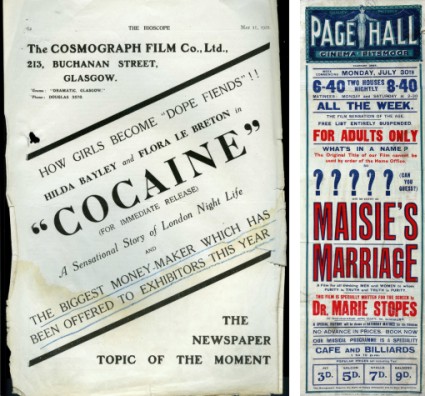
All of which is preamble to the news that TNA has produced a podcast entitled The National Archives Goes to the Movies, and it’s rather good. Written and presented by Joseph Pugh, the podcast is a knowledgeable guide to the history of British cinema through the records of The National Archives. Recorded before an audience, around half of the hour-long talk is about the silent period. Among the subjects he covers are Will Barker’s 1911 film of Shakespeare’s Henry VIII, all copies of which were burned in a publicity stunt; the efforts of the Colonial Office to ban The Birth of a Nation; concern within the Home Office at how Cecil B. De Mille’s The Cheat could offend the Japanese; the production of Maurice Elvey’s ill-fated epic The Life Story of David Lloyd George (1918); the British government-sponsored dramas Hearts of the World (1918) and The Invasion of Britain (1918); Home Office efforts to ban Graham Cutts’ sensationalist Cocaine (1922); and Marie Stopes’ correspondence with the Home Office over her birth control film Married Love (aka Maisie’s Marriage) (1923).

The point of the talk is not only to entertain but to encourage research. Consequently most of the films that Pugh refers to are also listed on Your Archives, TNA’s wiki where researchers can post information on files that they have found. I’m not sure how much the wiki gets used, because researchers tend to be a little wary of giving away all their sources, but the principle is noble.

A trade paper advertisement for Cocaine and a poster for Maisie’s Marriage, taken from The National Archives’ Flickr site, original file references HO 45/11599 and HO 45/11382

The sort of records one find in The National Archives are those which document the day-to-day processes of government departments. There are memos, memos responding to memos, and memos responding to memos responding to memos. There are letters, minutes, briefing papers, personal papers, official papers, diaries, reports, lists, registers, passenger lists, medal rolls, photographs, maps and posters. The contents are generally arranged chronologically, identified by government department and then gathered together by theme into individual numbered folders.

The National Archives can be a daunting place for any newbie researcher. There is no single index, and although they produce an amazing rich online catalogue (helpfully named the Catalogue) they also have to produce a multitude of specialist guides that explain how to pursue particular topics. One of these research guides covers The Arts, Broadcasting and Film, and it’s a very good starting point. As said, The National Archives arranges its records by department, so it is important to know that responsibility for film was held by the Board of Trade’s Industries and Manufactures Department (formed 1918), but information on film is spread widely across particularly all departments. To produce a complete guide to TNA records to silent film would require a blog (or a wiki) all of its own, but here’s an outline guide to some of the key departments to explore. Please note that catalogue references will simply take you to the barest of descriptions online, and to view the documents themselves you will have to visit Kew.

  • AIR (Air Ministry, Royal Air Force etc)
    Records of aerial photography and cinematography during World War One are held in AIR 2 (search under ‘cinematography’).
  • BT (Board of Trade)
    Records of registered companies (since dissolved), including hundreds of film businesses (producers, distributors, cinemas etc), with information on capital and shareholders, are in BT 31; records of liquidated companies 1890-1932 are in BT 34; trade marks (BT 42-53) includes film company trademarks, though there is no overall index so you need to search on-site by date (see the TNA guide on registered designs and trade marks); BT 226 has bankruptcy records for companies and individuals. BT 26 and BT 27 contains lists of ship passengers who arrived in (1878-1960) or left (1890-1960) the UK. The incoming lists themselves can be viewed online (payment required) at Ancestry, and the outgoing list (again payment required) at Ancestors on Board.
  • CAB (Cabinet)
    Papers from the very heart of government. Nicholas Reeves’ Official British Film Propaganda During the First World War has a handy guide to PRO/TNA papers relating to official film, including Cabinet papers in CAB 21, 23-25, 27, 37 and 41.
  • CO (Colonial Office etc)
    Many records relating to the production, distribution and exhibition of films in British colonies and countries of the empire, including records of the Empire Marketing Board (for which John Grierson worked) in CO 758 (correspondence), CO 759 (index cards), CO 760 (minutes, papers) and CO 956 (posters).
  • COPY (Copyright Office, Stationers’ Company)
    Before the 1911 Copyright Act if a UK film producer wanted to copyright a film (usually they did so only if there had been a case of their work being copied) then they had to do so as it if was a photograph; consequently there are numerous records of films 1897-1912 registered under COPY 1. The registration forms were accompanied by single frames, bromide prints, or in a few cases a few frames of film (the originals are now held by the BFI). For a guide to this collection, which comprises a few hundred titles among the many thousands of photographs, see Richard Brown’s essay in Simon Popple and Colin Harding’s In the Kingdom of Shadows. There are also registers and indexes under COPY 3. Some film posters and other promotional material can also be found in the COPY records.
  • ED (Department of Education and Science)
    Disparate documents on film and education, a theme of growing interest throughout the 1920s, including assorted commissions of enquiry.
  • FO (Foreign Office)
    The Foreign Office was concerned with promoting British foreign policy. There are extensive records relating to British propaganda films being shown overseas during World War One, in particular FO 115 on propaganda in the USA and Canada, FO 371 covering general correspondence, and FO 395 which covers war films and American propaganda 1916-17. There is a card index to the FO papers in TNA’s search rooms, making this a particularly fruitful area to explore.
  • HO (Home Office)
    The Home Office oversaw domestic policy. There are extensive records on actual legislation (starting with the 1909 Cinematograph Act) and proposed regulation affecting the British film business, including such issues as censorship, local authority control, unlicensed film exhibitions and the filming of contentious events (political marches etc) are in HO 45. See also HO 158 for relevant general papers and correspondence.
  • INF (Ministry of Information etc)
    A particularly valuable source, with records of the War Propaganda Bureau, the War Office Cinematograph Committee, the Department of Information and the Ministry of Information, all of which were concerned with film production during the First World War (further official papers on war film production are held by the Imperial War Museum). The main section to follow is INF 4. Of particular interest is one chapter from the unpublished memoir by J. Brooke Wilkinson, leading film industry representative and first head of the British Board of Film Censors, at INF 4/2
  • J (Supreme Court of Judicature)
    Covers records of court cases (Chancery), often a rich source of information on how a film company operated. See in particular the winding up orders under J 13.
  • LAB (departments responsible for labour and employment matters and related bodies)
    Includes documents on film industry employees and industrial relations (though relatively little here for the silent era).
  • MEPO (Metropolitan Police)
    The Metropolitan Police conducted surveys of early London cinemas around 1908-09 after they were causing some social concern. The result is a rich record of the early cinema business and audiences, to be found in MEPO 2. They are described in detail in Jon Burrows’ two essays ‘Penny Pleasures: Film exhibition in London during the Nickelodeon era, 1906-1914,’ Film History vol. 16 no. 1 (2004) and ‘Penny Pleasures II: Indecency, anarchy and junk film in London’s “Nickelodeons”, 1906-1914,’ Film History vol. 16 no. 2 (2004), while the London Project database lists the venues covered by files MEPO 2/9172 file 590446/7 and MEPO 2/9172, file 590446 (see also HO 45/10376/16142). There are later surveys of cinemas and screenings of indecent films in the 1920s.
  • RG (General Register Office)
    Has census returns from 1861 onwards (1841-1851 are under HO 107). These can all be found online through various commercial services (see details here), but all are available for free at Kew – see the helpful TNA guide to researching census records.
  • WO (War Office)
    There is relatively little that specifically relates to film here, as most papers relating to the War Office Cinematographic Committee will be found at the Imperial War Museum and the House of Lords Record Office (Beaverbrook Papers). But surviving records of film personnel who served during the War (including Official cameramen) can be found at WO 338 (officers’ service records), WO 363 (service records), WO 364 (pension records) and WO 372 (medal cards). Digitised copies of the actual documents in all four categories can be found online through TNA’s Documents Online or Ancestry (in both cases payment is required for downloads).
  • Other records where information on silent era films can be found include ADM (Admiralty), CUST (Customs and Excise), IR (Inland Revenue), and T (Treasury).

This is a very simplistic overview, and it must be stressed that information on films will be found all over the place. For example, type in the term ‘cinematograph’ in the catalogue and you will get 1,108 records from forty-four separate departments (448 records from twenty-five departments if you narrow the date search to 1896-1930). It is a good idea to look at the bibliographies of books and the end notes of journal articles which have benefited from research at TNA (or PRO before it) to pick up specific references and useful indications of where it would be profitable to search.

The National Archives has produced some substantial publications which explore a subject in depth with copious file references. However, there is no such guide for film (one has been talked about for years but has never been forthcoming). However, there is a classic article by Nicholas Pronay, ‘The “Moving Picture” and Historical Research’, Journal of Contemporary History vol. 18 (1983) (available to higher education users on JSTOR) which describes in details the several kinds of government records which can be used for the study of film, describing why they were created, and giving specific file names. Note also that the above file information relates only to silent films – there is a huge amount of information at The National Archives relating to film (and television) from later periods, particularly govering the GPO Film Unit, film during World War II, the COI Film Unit, the Colonial Film Unit, broadcasting policy, British Council records, and much more besides.

The National Archives is still an underused resource for film history, though we have got beyond the days when Rachael Low could write a multi-volume history of British film apparently without any reference to the Public Record Office. If you’ve not been, and you can get there, then you really should – it’s the most engrossing and rewarding research experience imaginable. Go explore.

By the way, films can be public records too, but the productions of the Ministry of Information, the COI Film Unit and others are preserved on TNA’s behalf by the BFI National Archive and the Imperial War Museum.

My thanks to Brad Scott for alerting me to the podcast.

The world remembers more

St Kilda, Britain’s Loneliest Isle (1928)

A little while ago we told you about UNESCO’s Memory of the World programme, which highlights archival objects which best represent the world’s documentary heritage. The intention of Memory of the World is to “to guard against collective amnesia calling upon the preservation of the valuable archive holdings and library collections all over the world ensuring their wide dissemination.” Among the objects on the register so far as a number of films, most of them from the silent era. They are Metropolis (1927), Lumière films, Roald Amundsen’s South Pole Expedition (1910-1912), The Battle of the Somme (1916), The Story of the Kelly Gang (1906), and the non-silent Luis Buñuel’s Los Olvidados (1950), Norman McClaren’s animation film Neighbours (1952), The Wizard of Oz (1939), the Ingmar Bergman Archives, and the John Marshall Ju/’hoan Bushman Film and Video Collection.

Now their number has grown, because today it was announced that St Kilda, Britain’s Loneliest Isle (1928), nominated by the Scottish Screen Archive at the National Library of Scotland, and The Life Story of David Lloyd George (1918), nominated by the National Screen and Sound Archive of Wales, are to be added to the list (to be accurate, the UK Memory of the World Register).

The Life Story of David Lloyd George (1918)

The Lfe Story of David Lloyd George (1918) will be well-known to regular readers, as it was covered in detail by a Bioscope post last year – indeed, I believe that some of the words from the Bioscope account may have helped secure the nomination, in which case we are immensely proud. The film is a biopic of the British prime minister David Lloyd George, whose production and post-production history are fascinating, because the film was suppressed (for reasons that remain mysterious to this day) and never seen by the public until its happy rediscovery in 1994. It is cultural artefact of the highest order, and an excellent film on top of that. If you’ve not had the chance to see it yet, it is available on DVD from the NSSAW, and comes highly recommended. You can view a short clip here.

St Kilda, Britain’s Loneliest Isle has also been mentioned by the Bioscope, when we reported on the Scottish Screen Archive’s outstanding video streaming site. There you can see this exceptional documentary work, which records the last days of human habitation on the remote Scottish island, as the Gaelic speaking community prepares to leave the place where humans had previously existed for 2,000 years. It is a haunting document, forming a bridge between time immemorial and the modern area that the cinematograph itself represents (the film includes a sequence where St Kildans are taken to see their first film show). It runs for 17 minutes – do watch it if you can.

Warm congratulations to both the National Screen and Sound Archive of Wales and the Scottish Screen Archive.