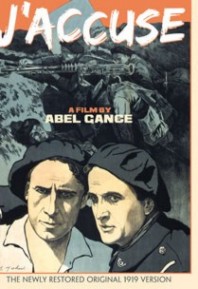
J’Accuse

Hot on the heels of Flicker Alley’s release Abel Gance’s La Roue earlier this year comes another Gance masterpiece, J’Accuse. Described by Flicker Alley (erroneously, I feel) as “the first major pacifist film” (what price Civilization, War Brides, or the Danish films Lay Down Your Arms and Pax Aeterna?), Gance’s World War I film is released as a 2-DVD set on 16 September. The DVD presents the 1919 original version (a re-edited and shortened release was produced in 1922), 166mins in length, restored by Lobster Films, working with the Netherlands Filmmuseum, using materials from Lobster, the Filmmuseum, the Czech film archive, and the Cinematheque Francaise. The film comes with a symphonic score composed and conducted by Robert Israel. The extras include Paris Pendant La Guerre (Paris During the War), a 1915 comic view of life in Paris in wartime; Donald Thompson’s war reportage from the Battle of Verdun, Fighting the War (1916); and a booklet that includes an extensive essay by Abel Gance’s most dedicated champion, Kevin Brownlow.

This is the Turner Classic Movies description of the film and its restoration:

France’s pioneering filmmaker Abel Gance said that his definitive anti-war work J’Accuse (1919) “was intended to show that if war did not serve some purpose, then it was a terrible waste. If it had to be waged, then a man’s death must achieve something.” After seeing the film, a Czech journalist declared that if it could have been seen around the world in 1913 the First World War might not have happened.

J’Accuse was the only “peace film” to be made in Europe during World War I. Gance, who had served briefly in that conflict, returned to active service in 1918 to film harrowing battle scenes of soldiers actually under fire. Parts of the film were shot during the battle of St. Mihiel, one of the most significant of the war. Also, for the famous “March of the Dead” sequence at film’s end, Gance used real soldiers home on leave from the front – most of whom were killed within the following weeks. Some titles are taken from real letters written by soldiers to their families.

Gance had secured enthusiastic support from the wartime French government, which saw the project as a call to patriotism. When it finally occurred to a government official to question the title and ask exactly who or what was being accused, Gance replied: “The war and its stupidity.”

The film stars Maryse Dauvray as Edith, a young Frenchwoman who is in love with a poet (Romuald Joubé) but is forced by her father (Maxime Desjardins) into a marriage with a much older man (Séverin-Mars). Edith is captured by the Germans and endures multiple rapes that result in her becoming pregnant. Edith’s husband initially thinks that the poet is the father of her child, and the story ends in tragedy with both men seeing action in the trenches.

Historian Kevin Brownlow, who dedicated his book The Parade’s Gone By to Gance, described J’Accuse as “a miracle film.” It introduced techniques developed by Gance including rapid-cut editing and expressionistic camerawork and lighting. The film, a huge success in Europe, originally ran 14 reels (three hours) but was truncated to ten reels for its American release, damaging its continuity and preventing it from becoming a success in the U.S. The re-editing blunted the anti-war slant and gave it a happier ending.

The reconstruction, a Flicker Alley Digital Edition from the Lobster Film Collection, began when Gance’s friend and heir Nelly Kaplan provided a 35mm master print of a restoration by the Cinematheque Francaise, taken from a shortened reissue in 1922. Incomplete original prints were sourced from the Lobster Collection and the Czech archive in Prague. Happily, an almost complete copy of the original edit (although in poor condition) was found in the Netherlands Filmmuseum. All these elements were transferred to high-definition video and conflated by the Netherlands Filmmuseum to make the best and most complete edition possible.

Lego goes silent

As we continue our trawls through YouTube looking for imaginative and legitimate (or at least arguably so) creations relating to silent cinema, our eyes settle on Lego…

Lego films (or brick films) have become an honourable strand of the animation film, though one whose apparent ease of production has attracted far too many amateurish efforts. Parodies of films and film genres are rife, inevitably, and so it is that there are numerous silent Lego films to be found, or Lego films imitating silents. For the most part they are as bad as one might fear, showing only the most hackneyed ideas about silents, and minimal artistry. But, as ever, among the dross we find a few gems a-glistening. Here’s a selection to amuse and maybe instruct a little.

So let’s start with The Birth of a Nation. One may tremble with trepidation at what such an offering might mean, but what we get is a parody of one of those TV Hollywood history programmes, presented as though a previously lost fragment of interview material, with talking heads reminiscing over the experience making the films. Enjoy the insights offered by editor Rose Smith, director, producer and editor D.W. Griffith (“I wanted to push the length of feature film productions, baby”), cameraman Billy Bitzer, actor Ralph Lewis, and music editor Joe Carl Briel, all boastfully talking up the film’s length, technical innovations and undying contribution to film history. Created by Geoff Reimer and C.J. Reisenbigler.

Most Lego film parodies tackle the obvious. Here holstenwall has shown a little more imagination and given us a Lego interpretation of the Berg or mountain films of Arnold Fanck, in which Leni Riefenstahl first made her mark as an actress. Here we see Berg von Alptraumen, or Mountain of Nightmares (part 1), complete with German intertitles (with English subtitles), as our hero scales the snowy heights amid settings of suitably midget epic grandeur. Sadly, the world still awaits part 2…

There are various Lego versions of scenes from Metropolis to choose from. This is the one to see. Considerably classier in look than the average, it also shows greater imagination than simply mimicking parts of the film. Entitled 45 Seconds of Metropolis, it takes the film’s famous tag line – ‘Der Mittler zwischen Hirn und Händen muss das Herz sein’ – ‘The mediator between head and hands must be the heart’ – and illustrates this through three sections (two really), dedicated to the hands, the head and the heart. A subtle miniaturist’s idea, and a fine title sequence too. It was created by Gordon Bühler, a.k.a TrashGordon (great name).

That’s probably more than enough, but how could I resist any Lego film which chooses to demonstrate to us that Thomas Edison invented the Kinetoscope…

(I’m just keeping things ticking over while I work on grander stuff to present to you when it’s ready. Bear with me.)

Lost sites

Here at The Bioscope we do our best to alert you to interesting new web resources on the subject of silent cinema, or indeed sites that have been around for a while but aren’t necessarily well known. But what about sites that are no more? We’ve all experienced the frustration of the dead link, discovering that some site or page has been taken down because the domain registration wasn’t kept up, the page was taken down because the owner thought it no longer of interest, or the web links on a site have all been changed. Whatever the reason, the Net is an impermanent place, and many worthwhile sites in our field are around no more.

Happily we have the Internet Archive and its ‘Wayback Machine‘, which has archived a great deal of the Internet (85 billion web pages from 1996 to 2008), taking ‘snapshot’ records of sites periodically (usually every few months). Images are not always retained, and you can’t find movie files, databases or other such complexities in the archive, but you will find the plain HTML. But how do you know what to look for? There is no subject guide or keyword searching (yet). You have to know the web address, and even then that only find you what you knew was there to find. What about those lost sites that you never knew were lost?

Despair not. The Bioscope presents this initial guide to some of the silent cinema sites and web pages which can no longer be found on the Web as such, but do lurk within the Internet Archive. There will be many more than those listed below, of course, but it’s a start (do let me know if you know of any). All links will take you to the Internet Archive record.

The Silents Majority
Old hands will have recognise the gentleman at the top of this post as ‘Merton of the Movies’, the silent town crier who featured on Diane MacIntyre and Spike Lewis’ The Silents Majority, the essential silents information site before it disappeared in 2003 and Silent Era took its place. Here you can still find biographies, reproductions of articles, featured books and videos, photo gallery, guest articles and Cooking with the Stars. Not everything remains (some images and the QuickTime movies won’t be found there), but it’s still a treasure trove. Check also for the final year of its existence when it changed its URL and became www.silentsmajority.com.

A Trip to the Moon
A simple but engaging site dedicated to Georges Méliès’ Voyage Dans La Lune, with an essay on the film, Méliés’ own outline and commentary for the film, film stills (not of terribly high quality, unfortunately), and extracts from the associated imaginative literature of Wells, Verne, Poe and others.

Questions Regarding the Genesis of Nonfiction Film
A stimulating essay on early non-fiction filmmaking, its essence, problems of definition, and neglect by film scholars, by renowned Japanese scholar Komatsu Hiroshi. It does exist elsewhere in print in the journal Documentary Box, but a key text like this ought not to be lost to the online research community.

The Human Motor
This stems from a scientific project to map the human body by the University of Colorado, and was part of a larger site, Building Better Humans. It has sound information on the chronophotography of Etienne-Jules Marey and Eadweard Muybridge, complete with a fine selection of images.

Les Frères Lumière et le Japon 1895-1995
This site accompanied a touring exhibition of films shot in Japan in the 1890s by the Lumière cameramen François-Constant Girel and Gabriel Veyre. It comprises an excellent essay (in French) on the first films and filmmaking in Japan by Hiroshi Komatsu.

Eadweard Muybridge: Father of Motion Pictures
An imaginative, beautifully-designed site on the master photographer who captured motion. Some of the photographs no longer appear, but there some animated gifs of Muybridge sequences, and the whole thing is just done with such style.

Dive cinema muto
Italian site (in Italian) devoted to silent film actresses, especially the Italian ‘divas’ such as Lyda Borelli and Francesca Bertini, plus other femme fatales such as Asta Nielsen and Theda Bara. With biographies, essays and illustrations.

Archiving the Internet is becoming a subject of increasing concern. The Internet Archive leads the field, of course, but the UK Web Archiving Consortium is building up to the day when every UK website will be archived as a matter of legal deposit. For those intrigued by dead sites in general, take a look at Ghost Sites of the Web (these are sites that still exist on the Web, but which have been abandoned).

Please let me know of any lost sites (as opposed to dead ones that just aren’t updated any more) on silent cinema, and I’ll update this list. Note also that not every lost site may necessarily be found on the Internet Archive – the website whose passing I most regret, Charl Lucassen’s beautiful Anima site on chronophotography and other optical delights, once one of the genuine treasures of the Web, is nowhere to be found at all. Such a loss.

150,000

Thank you to whoever you were who just clicked on The Bioscope and chalked up the 150,000th visit!

All bloggers are obsessed with their statistics, and I can tell you that as of this minute the Bioscope has had 150,000 visits, published 644 posts, has an average of 410 visits per day (up on 149 for 2007), and thanks to Akismet has fought off 23,049 spam comments. Most successful month ever was last month (13,912 visits). Top post remains Searching for Albert Kahn, with 8,450 visits (still rising). Most referrals have come from cablecarguy.blogspot.com (thanks Joe), and the most used search terms are ‘albert kahn’, ‘bioscope’, ‘louise brooks’, ‘kinetoscope’ and ‘european film treasures’. And, just in case I get too excited, The Bioscope currently lurks at position 148,422 in the Technorati scores for blog popularity. So, still some work to do.

Onwards and upwards.

Mashing it up once again

Third in what looks increasingly like a series of posts on the creative coming together of silent films and music tracks on YouTube takes us to the wilder edge of things. We’re still following the placing of sequences or montages of silent films with pre-existing music, but playing around with the concept rather more.

To start with, here we have Radiohead meets Buster Keaton, courtesy of YouTuber hoverground. It’s a collection clips (mostly very familiar) put to music, but now we have extracts from several songs, interspersed with pauses for a train passing, wind blowing, bridge collapsing etc. It gives us multiple interpretations of Keaton’s art, while the great stoneface shows himself yet again to be an Everyman figure whose eternal crises can be replayed to ideal effect in almost any form. Not so sure about the use of stills at the end, but a memorable tribute for all that.

Now for something rich and strange – strange at any rate. Here we have a clip from Dimitri Buchowetzki’s 1922 Othello, with Emil Jannings as the Moor and Ica von Lenkeffy as Desdemona. Accompanying it we have loops of music from an unnamed ‘garage band’, plus sounds from The Texas Chainsaw Massacre – whether the original or the remake it does not say, and I am not expert enough to judge. The result is peculiar, to say the least, particularly when the chickens start clucking. Its creator, Joe Boyce Burgess, called the video Me vs You, and he has created a number of bizarre juxtapositions of film and alien sound.

Experimental films of the silent era are a favourite subject for adding music tracks. Here Walter Ruttman’s Opus I, II, III and IV are set to music by electronica outfit Digitonal, courtesy of totaldistortion. The marriage (inevitably?) works perfectly, and you can find Ruttman’s works similarly set to the experimental music (of one kind or another) of John Zorn and The Chemical Brothers.

This, however, starts to take us into the field of applying original soundtracks to silents on YouTube, and that will be the subject of another post or two, as inevitably it’s a rich seam to be mined (albeit with a large amount of dross along the way). As before, I’m keen to learn of other examples you may have come across. In particular, I’ve yet to find an example where two different silent films have been mashed up (Eric Campbell ends up chasing Buster Keaton, the Ku Klux Klan from Birth of a Nation end up galloping along the Circus Maximus in Ben Hur, that sort of thing). Anyone come across such a creation?

Flicking through the magazines

A new publication, Emily Crosby and Linda Kaye’s Projecting Britain: The Guide to British Cinemagzines, opens up a hidden corner of film history, a corner in which the silent cinema played its part. The book’s subject is the cinemagazines, or screen magazines, or just plain magazine films, those unconsidered programme fillers that were a mainstay of cinema shows for decades and out of which sprang the television magazine format. Overlooked by practically all film histories, the cinemagazine has a rich tale to tell, not simply for its form and content, but for the diverse audiences that it reached and the various bodies – entertainment, governmental, industrial – that used the magazine film format to hook audiences to their purposes.

The richest history of the cinemagazine, as indicated by that title Projecting Britain, comes from the sound era, when the British government in particular latched onto the form in the post-World War II era as means to further its strategic aim of ‘national projection’ (i.e. we may have lost an empire and it may be a post-war world, but we still have our part to play in it). But the cinemagazine was an invention of the silent cinema, and it was not the sole preserve of Britain.

The first person to come up with a magazine film series (as opposed to the newsreel – a related form, but tied much more to topicality) was Charles Urban (have I mentioned him before?). Late in 1913 Urban devised the Kinemacolor Fashion Gazette, directed by Abby Meehan, a magazine series highlighting women’s fashions, filmed naturally in colour using the Kinemacolor process. It probably did not extend far beyond Kinemacolor’s London theatre, the Scala, and only lasted a couple of months, but a new film form was born. The next pioneer was the naturalist and filmmaker Cherry Kearton, who devised The Whirlpool of War, a behind-the-scenes war magazine presenting footage from Belgium and France in the first few months of the First World War.

Title design from Around the Town no. 105, 1921 (BUFVC)

But the cinemagazine as a regular entertainment in the cinemas really began in 1918 with Pathe Pictorial. This offshoot of the Pathe newseel in Britain amazingly ran uninterruptedly until 1969, bringing together light stories of fashion, personalities, travel, customs, sport, hobbies, innovations, animals, quirky events – anything that didn’t quite define itself as news. The idea swiftly caught on. In Britain, though the 1920s, there was Around the Town (1919-1923), created by Aron Hambuger, distributed by Gaumont, concentrating on London goings-on, especially theatrical; Eve’s Film Review (1921-1933), Pathe’s iconic magazine series for women; Vanity Fair (1922), produced by Walturdaw; Gaumont Mirror (1927-1932), sister series to the newsreel Gaumont Graphic; and British Screen Tatler (1928-1931), sister series to the newsreel British Screen News. Ideal Cinemagazine (1926-1932), produced for Ideal by Andrew Buchanan, gave the form its name, and introduced a (limited) educational element that was to characterise later developments of the cinemagazine.

Also throughout the 1920s the cinemagazine was becoming a staple of American screens, with Charles Urban once again the pioneer. When Urban established an American film business after government service during the First World War, he based much of his hopes on two cinemagazine series, Movie Chats (1919-1923) and Kineto Review (1921-1923). A typical Movie Chats issue (no. 4) contained the stories ‘View of the River Thames at Henley on Regatta Day’, ‘Experiments in Static Electricity’, ‘Visting the Sacred Monkey Temple at Benares India’, ‘Camel Fight in Desert of Turkey’, and ‘Three Views of the River Seine with Cloud Effects’. Ever the one to make good use of library material, much of Urban’s cinemagazine content came from films his companies shot in Britain before the First World War (and in turn Movie Chats footage was sold to Britain and used by Andrew Buchanan in his Ideal Cinemagazine).

Other American cinemagazines of the 1920s were Screen Snapshots (1920-1958), which focussed on Hollywood stars; Grantland Rice’s Sportlights (from 1924 at least), a mainstay of American cinemas for decades; and several series from James A. Fitzpatrick, an Urban protégé, whose Fitzpatrick Traveltalks (begin 1931) were an equally enduring feature of American screens (with the legendary closing lines “… and so we say farewell to …”). Undoubtedly the form spread to other countries, though information on these seemingly inconsequential components of the cinema programme is particularly difficult to find.

Light the cinemagazine may have been, but inconsequential it was not. An enduringly popular form, it spoke to audiences in an engaging, comforting manner, sometimes quaintly, sometimes with a degree of sly subversiveness. The use of the cinemagazine form in the 1920s to attract women audiences, through a mixture of knowingness and unknowingness, is covered by Emily Crosby in Projecting Britain and by Jenny Hammerton in one of the few other publication to consider the genre, For Ladies Only? Eve’s Film Review: Pathe Cinemagazine 1921-33. There’s also a German thesis available commercially, Nicola Gölzhäuser-Newman’s Eve’s Film Review: Genre und Gender im britischen screen magazine der 1920er Jahre. Some information on the American cinemagazine at this time (though the term is not used) can be found in Leonard Maltin’s The Great Movie Shorts. The use of the cinemagazine in the 1920s to tackle educational subjects remains under-researched, and I know of no publication that I can point you to (though I have some unpublished writing myself…).

You can find plenty of examples of Pathe Pictorial and Eve’s Film Review on the British Pathe site (same content also available through ITN Source). Examples from issues of Around the Town are available on the British Universities Film & Video Council’s Video Showcase (look out in particular for H. Grindell Matthews demonstrating his sound-on-film invention in 1921). It was the BUFVC which hosted the ‘Cinemagazines and the Projection of Britain‘ project which resulted in this book, a project in which I played a small part (mostly obstructive). The BUFVC’s newsreel database now included records of some 19,000 British cinemagazines.

There’s still so much to be discovered in film history, particularly early film history, if we will only start looking in the right places. Projecting Britain (a collection of essays, original documents and reference guide) opens another door.

Filmarchiv Leuzinger

Ben Hur exhibited at Meisterschwanden, Switzerland, May 1930, from http://www.filmarchiv-leuzinger.ch

I was introduced to this website a while ago (by its author), and thought you ought to know about it. The subject of Filmarchiv Leuzinger is a small town family cinema business from Rapperswil, Switzerland. It was founded by restaurant owner Willy Leuzinger, who began organising film screenings in his restaurant in 1909, going on to open two cinemas in the Lake Zurich district. In 1919 he began a touring cinema business, the Wanderkino Leuzinger, which dominated film exhibition in north-eastern Switzerland from the mid-1920s to 1943. Leuzinger was also a filmmaker, shooting many local topicals (local newsfilms) throughout the 1920s, around eighty of which survive. After Willy Leuzinger’s death in 1935, his eldest daughter took over, and today his granddaughter Marianne Hegi still runs three cinemas, in Rapperswil and Altdorf.

The Wanderkino Leuzinger in 1923

All of this is a charming story, but in the hands of Mariann Lewinsky Sträuli it has been turned into an eye-catching and evocative website. Filmarchiv Leuzinger (click on the Übersicht link to find the main ‘archive’ page) arranges an archive of family memorabilia – biographies, photographs, documents, music, background information and film clips in thematic columns to create an innovative and enticingly explorable site that opens up the Leuzinger’s world. The film clips (in QuickTime format, with MPEG-4, DVD-quality downloadable versions also available) show local festivals, parades, fairs, gynmatic events, and so on, each meticulously described. Every clip, image, audio file or other link leads to a page of information (with larger versions of the images), progressively building up a resonant picture of time, place and occupation.

It is a delightful site, quite an inspiration in conception and design. Unfortunately for the linguistically-challenged English speaker, it is in German. But don’t let that deter – it’s clear enough just from looking that it is a fine piece of social and cinema history (the numerous photographs of cinemas in the 1920s and 30s will delight many), put together with a loving archivst’s care. Mariann Lewinsky Sträuli prrogrammes section of Il Cinema Ritrovato in Bologna, teaches film history at the University of Zurich and directs restoration projects at Memoriav, the Swiss audiovisual heritage organisation.

Go explore.

Silent Films Days in Tromsø 2008

The Phantom Carriage (Körkarlen), from http://www.tiff.no

An offshoot of the Tromsø International Film Festival (which takes place in January), Silent Film Days in Tromsø (now in its third year) takes place 3-7 September at the Norwegian town. This year there’s a programme of international classics with musical accompaniment from Neil Brand, Ben Model, the Matti Bye ensemble, and HYSJ: Ola Rokkones and Herborg Rundberg ensemble. Here’s the programme (in Norwegian, but you’ll work it out):

Onsdag 3. september

15.00
THE SILENT PIANIST SPEAKS
Store og små øyeblikk fra stumfilmhistorien presentert ved musiker Neil Brand.

Torsdag 4. september

19.00 Åpningsforestilling
THE BIG PARADE
Den nest største kassasuksessen i stumfilmens historie.

Fredag 5. september

17.00
THE LODGER: A STORY OF THE LONDON FOG
Hitchcocks første thriller gjorde han til stjerneregissør.

20.00
THE PHANTOM CARRIAGE
Banebrytende svensk spøkelseshistorie

Lørdag 6. september

12.00
SILENT CLOWNS: KORT OG KOMISK
Klassiske stumfilmkomedier til glede for store og små.

15.00
FROSTY CELLULOID
“De første opptakene fra områder som tidligere hadde vært hvite flekker på kartet”

21.30
PAN
Første filmatisering av Hamsuns hyllest til naturen.

Søndag 7. september

15.00
SEVEN CHANCES
Fluktscenene filmverden aldri vil glemme.’
Forfilm: A Reckless Romeo

19.00
SOMETHING NEW
Både kjeltringer og kaktuser møter sin overkvinne i den nådeløse mexicanske ørkenen.
Forfilm: Sheriff Nell’s Tussle

More details from the festival website (which has text in English).

Mashing up some more

Well, it was fun picking out those YouTube clips where silents had been creatively mashed up with modern music tracks, so here are three more examples. These aren’t the same as silents to which modern composers (or would-be composers) have added new tracks – that’s an interesting subject for another time. Instead these are examples of re-edits or montages to modern music tracks which illuminate or heighten the films in interesting ways. To impose some sort of thematic reasoning to all this, the three videos below all derive from classic German 1920s silents.

Louise Brooks is one of the most popular search terms used on this blog, but such researchers have been going away disappointed. Well, no more, because here’s a dynamic and assured mix of scenes from Pandora’s Box (1929), skilfully edited by Adam Armand to the tune of The Killers’ ‘Mr Brightside’. It doesn’t tell us anything more about the film or the image of Brooks than we already know, but what else might the film have to say? The video expresses the quintessence of the iconography of Pabst’s film with a song that resonates with sexual torment and urgency. It may vulgarise Pabst’s artistry by reducing it to MTV-style editing, but it also expresses Brooks’ modernity and lasting appeal.

Paul Wegener’s Der Golem (1920), the classic proto-horror film telling of the creation of a clay creature, the Golem, brought to life to protect the Jews of 16th-century Prague, is accompanied by the death metal music of Fantomas, a band who sound like they know a silent film or two. In this case the band wrote a song inspired either by the legend or the film itself, and a fan (‘Monster Island Media‘) decided to do the decent think and match song to clips – which is why lyrics and imagery go together so well. Not exactly most people’s musical cup of tea, but it undoubtedly places the film within a modern, if crude, sensibility. What pop video director could ever have conjured up so convincing a vision of medieval magic?

Others have had the same idea: see here for a more frantically-edited homage.

After all that sex and musical violence, here’s some a little more surprising, and graceful. Scenes from The Cabinet of Dr Caligari (1920) are accompanied by Françoise Hardy singing ‘La Terre’, seemingly for no other reason than the chanson is a pretty one and it brings out the mystery of Robert Weine’s film. Note how well it fits in with Conrad Veidt’s Cesare slowly opening his eyes, and how delicately it accompanies the way the characters move.

The clip’s creator, Clay, has treated other silents to new scores, including Christus (1914), The Abyss (1910), Alice in Wonderland (1915) and Evgenii Bauer’s After Death (1915).

More examples to follow, as the mood takes me.