Colourful stories no. 2 – The Kromskop

The road to colour cinematography began with the efforts of those pioneering colour photography itself. For the second part in our series, we look at the work of Frederic Eugene Ives, whose remarkable device the Kromskop was to play a key part in the history.

Frederic Ives (1856-1937) was an American inventor. Best-known for having developed the halftone printing process, he also experimented extensively with colour and stereoscopic (3-D) photography. From 1877 onwards Ives worked on ways of taking and viewing three-colour images with a camera known variously as a Heliochromoscope or Photochromoscope. The result of this experimentation resulted in the Kromskop, first marketed in 1895, a stereoscopic viewer which combined the Photochromoscope images from six monochrome transparencies through colour filters to created a stereoscopic colour image called a Kromogram.
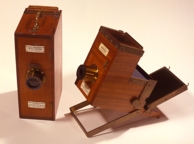
Kromskop camera and viewer

Kromskop camera and viewer, from http://www.spira.com
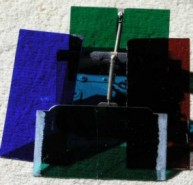
Kromskop colour filters

Kromskop colour filters, from http://www.earlytech.com

The camera, by a combination of mirrors, prisms and colour filters, took three pairs of images of a given object (an exposure time of a minute was required, which made it impractical for portrait work), respectively red, blue and green on a single plate that measured 2½ x 8 inches. The eventual positive was cut into three and mounted in a folded cardboard frame to form the Kromogram. The three pairs of transparencies were, of course, monochrome, but preserved a record of the alterations in the colour of the object as taken through the three separate filters. The Kromskop itself, by an arrangement of mirrors, coloured glass screens, red, green and blue filters, and a light source, produced a full colour and stereoscopic image.
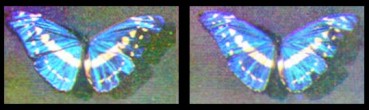
Kromagram images

Kromagram images, from http://homepage.ntlworld.com/forgottenfutures

Ives believed that his invention formed part of a remarkable triumvirate – the Phonograph, which captured sound; the Kinetoscope, which captured motion pictures; and now the Kromskop, which captured colour:

The Kromskop is an optical instrument which accomplishes for light and color what the Phonograph accomplishes for sound and the Kinetoscope for motion … The Kromskop photograph is … although not a color photograph, a color record, just as the cylinder of the phonograph, although not a cylinder of sound, contains a record of sounds, and the kinetoscope ribbon, although not an animated photograph, contains a record of motion. The phonograph cylinder must be placed in the phonograph before it can be made to reproduce the sounds recorded; the kinetoscope ribbon must pass through the kinetoscope in order to visually reproduce the moving scene; and the Kromogram must be placed in the Kromskop in order to visually reproduce the object photographed.

Frederic Ives, Kromskop Color Photography (1898)

However, the Kromskop and its Kromogram put too much technology between the viewer and the object. Ives elsewhere admitted: ‘this is not the kind of color photography that the world has been looking for … because it does not produce fixed color images which can be framed and hung upon the wall’. It was possible to produce fixed colour prints from Kromskop negatives, but ‘only by so greatly complicating the process as to make it comparatively impracticable’. It was the additive synthesis (as demonstrated by James Clerk Maxwell) that was fundamentally impractical, and was soon to be abandoned as a means of securing photographic still images. However, the Kromskop enjoyed a brief period of popularity, marketed as being ‘invaluable for Evening Parties, At Homes, Conversaziones, Garden Parties &c, &c’. Showmen exhibited it alongside magic lanterns and other such visual marvels, and it caught the eye of some motion picture inventors, among them showman/inventor G.A. Smith, who owned a Kromskop, and would go on to invent Kinemacolor.

Ives established a British company in 1898, the Photochromoscope Syndicate. He took on as an assistant that year one Edward Raymond Turner. The following year Turner left Ives’ employment. Excited by the additive principle expressed through the Kromskop, Turner wanted to see if it could be utilised for cinematography. Turner built and patented his three-colour motion picture system in 1899, the story of which we will tell soon, but this in fact was not the first patent for a motion picture colour system. But you’ll have to wait until part three to learn about that.

Recommended reading:
William Ward, ‘The Newest Marvel of Science’, Pearson’s Magazine, December 1897

A bulbous nose, an overbite and a definite squint

Theda Bara

Theda Bara, from http://film.guardian.co.uk

This excellent piece by Kira Cochrane in The Guardian has been doing the rounds, but no reason why it shouldn’t turn up here as well. Its subject is the mysterious allure of some silent screen stars, and why you really have to see them on a screen for their undying magic to work…

If looks could kill

It’s mean to say it, but here goes: one of the things that has always fascinated me about the actors of the silent era, especially the sex symbols, is just how plain, ordinary, even ugly, many of them are. Francis X Bushman, for instance, star of the original 1925 Ben-Hur, may have gloried in publicity pegging him as “The Handsomest Man in the World”, but photographs suggest he was in fact a baggy-eyed bloke with bushy eyebrows and an improbably long nose. Rudolph Valentino, the man whose untimely death from peritonitis in 1926 caused mass hysteria and fainting among his female fans, wasn’t actually all that much of a looker. I’m not saying he was ugly. But gorgeous enough to cause two women to commit suicide on news of his death, as was alleged? It’s debatable.

The silent star who fascinates me the most in this respect, though, is Theda Bara. In a short career, largely played out between 1914-19, Bara became a massive star, her popularity at one stage second only to Mary Pickford and Charlie Chaplin. But unlike Pickford (America’s fresh-faced sweetheart), Bara’s success was based on her reputation as a “vamp”, a woman so cruelly attractive that she could ensnare any man, exploit him, trample him, and walk away with an enormous grin on her face. Bara became so synonymous with the term that she is now referred to as the original on-screen vamp, the woman who made performances such as that of Louise Brooks in Pandora’s Box, Barbara Stanwyck in Double Indemnity and Linda Fiorentino in The Last Seduction possible.

I have read biographies of Bara and pored over her still photographs, and found it hard to fathom her appeal. Her figure isn’t bad, though it could most accurately be described as “matronly”. She has a bulbous nose, an overbite and a definite squint (she was extremely short-sighted). Just what was it that so enraptured audiences?

I found out this week, while watching one of Bara’s only surviving films, A Fool There Was. Released in the US in 1915, this was the first major screen outing for the woman who, until then, had been a minor stage actor. A Fool There Was is based on a variety of sources, including an 1897 painting by Philip Burne-Jones, which shows a woman looming over a man who is either dead, passed out or really very sleepy; and a hokey poem of the same title that Burne-Jones’s cousin, Rudyard Kipling, wrote for the exhibition catalogue. The film tells the story of a wealthy, married diplomat who sinks in horrific decline after submitting to the attentions of “The Vampire”, played by Bara.

The minute Bara arrives on screen, it becomes obvious why she was so popular – why she went on to have songs written about her, children named after her, a perfume and even a sandwich (minced ham, mayonnaise, sliced pimento and sweet pickles on toast – served warm) created in her honour. The first scene shows the diplomat smelling a couple of roses and smiling wistfully. The second scene is Bara, glancing around shiftily, picking up those same roses, smelling them, smirking, ripping off the petals, crushing them in her hands, and laughing. On screen, that face comes into its own – so much so that when you learn that her character’s malevolence has led one man to jail, another to beggary, and her most recent victim to a very public suicide, you believe it. Rudolph, eat your heart out.

Another major factor in the film’s huge success was the groundbreaking publicity machine that whirred around it. A Fool There Was was made by William Fox’s fledgling studio, which employed two wily PR men – Al Selig and John Goldfrap – both determined to ensure this latest film was a hit. In Vamp, Eve Golden’s punchy biography of Bara, there is a description of the outlandish press conference set up by the men to showcase Fox’s newest star. The fact that Bara (real name Theodosia Goodman) was the daughter of immigrants from Cincinnati, was irrelevant. Instead, they claimed she was the child of a French actress and an Italian sculptor, raised in the shadow of the Pyramids, who had gone on to become a huge stage success in Paris, before escaping to America on the brink of war. The story was ridiculous, and the journalists who gathered in the Egyptian-themed room where Bara was presented to them, amid choking clouds of scent, knew it. But it worked. While the end of 1914 had seen Fox Studios in debt, in 1915 Bara’s huge popularity helped them rake in $3m.

Thus, Bara was put to work, cranking out 40 films for Fox over the next four years. Like many ambitious actors, she was anxious not to be typecast, always pushing for a range of roles and occasionally rewarded. In her 30s, she was cast, for instance, as the young, virginal female lead in Romeo and Juliet, a well-received production now most notable for its key innovation: Juliet briefly rising from the dead to share the final scene with Romeo. Bara also played Cleopatra in a series of raunchy costumes, including a bra fashioned out of a coiled snake, ruby-red eyes placed suggestively in the centre of each breast. But most of the time she played a vamp, in films such as The Devil’s Daughter, the publicity material for which described Bara as “The Wickedest Woman in the World”.

But by 1919, Bara’s career was on the rocks. This wasn’t due to the advent of the talkies: there is no suggestion that her voice was especially reedy or ridiculous or wretched. Fox had another star on its books, however – cowboy hero Tom Mix – and a new kind of skinny, youthful sex symbol was growing popular in the shape of the flapper. Then there was the scandal prompted by one of Bara’s late films, Kathleen Mavourneen, in which she played a poor Irish girl. As Golden describes it: “The Friends of Irish Freedom and the Central Council of Irish Associations violently objected to the depiction of poverty in Ireland (although castles and middle-class towns were also shown). Other groups … objected to a ‘Jewess’ portraying a beloved Irish heroine. Stink bombs were rolled down the aisles.”

Abruptly, Bara’s career was all but over. Over the next decade, she appeared in a few films, but never regained her star status. She must have taken some comfort from the fact that she had fallen for the writer/director of Kathleen Mavourneen, Charles Brabin, who often styled himself as a knight and a lord but who was actually a Liverpudlian butcher’s son. The pair married, and Bara saw out her days as a popular Hollywood matron.

Watching A Fool There Was – seeing just how magnetic Bara was in motion – makes you realise how ill-served those early silent stars have been. Around 80%, or even 90%, of silent films have now been lost, partly through neglect, partly due to the recycling of nitrate film, and partly because nitrate is more flammable than a matchstick. Only four of Bara’s films survive, after a Fox storage facility exploded in 1937. Martin Scorsese has been banging on for years now about the need to preserve silent films, to ensure we have something to go on in the future other than still photos. And he’s right. After all, as Bara has made me realise, when it comes to understanding the allure of silent film stars, photos only count for so much. It’s all about the movies, stupid.

A Fool There Was is screening at the Barbican in London this Sunday, live piano accompaniment by Neil Brand.

Welcome to NitrateVille

Nitrateville

NitrateVille, http://nitrateville.com

It is with a degree of trepidation that I pass on the news of the creation of a new online forum for silent films. After all, I hope that The Bioscope serves as a handy source of information on some, if not all aspects of silent film today and yesterday. But NitrateVille looks like it is going to be an important source of information and discussion. It was set up last month in response to the decline of the once excellent alt.movies.silent, which has become awash with spam and tired tirades. NitrateVille has strands on Silent News, Talking About Silents, Talkie News, Talking About Talkies, Collecting and Preservation, and Music for Silents. Many names familiar from alt.movies.silent have moved over to the new forum, and the knowledge on display is impressive. The use of illustrations in some posts is welcome. And of course it’s moderated, and has established some sensible rules of engagement. Go explore – but keep reading the Bioscope too.

Papers Past

Papers Past

Papers Past, http://paperspast.natlib.govt.nz

Yet another digitised newspaper collection, but this is one of the best I’ve yet come across. It is Papers Past, the National Library of New Zealand’s website which boasts one million pages of digitised New Zealand newspapers and periodicals, covering the years 1840 to 1915, all of it freely available.

The site is a model of clarity and usefulness. It features forty-four newspapers (twenty-three of them word-searchable so far) from all regions of New Zealand, from The Daily Southern Cross to the Wanganui Herald. There is a simple search option and and advanced option, which allows filtering by date, paper and content type (articles, advertisement or illustration captions). And there are plenty of relevant results for the early film researcher. The word ‘kinetoscope’ gets 312 hits; ‘kinemacolor’ gets 168; ‘bioscope’ scores 1,133. Nor is all the content restricted to New Zealand news, as many of the results are news reports from around the world (particularly UK and USA).

There are many useful but unobstrusive extra features, such as the option to have preview images; to sort results by best match, date, title (article or newspaper) or content type; a search history facility; and a welcome use of ‘breadcrumbs’ (a line of links below the top menu to show you where you are on the website). Just about the only thing to criticise is some amusing slips with the OCR (optical character recognition), so that Eadweard Muybridge’s The Horse in Motion gets translated as The House in Motion. And, yes, it lets you see the underlying OCRed text as well as the image of the scanned document.

Plus the whole site is available in English or Māori.

A first-rate resource.

Cinefest 2008

Cinefest, the annual festival of silent and early sound films with a speciality in showing titles from private collectors, now in its twenty-eighth year, is to be held, as always, at Syracuse, NY, over 13-16 March.

The titles to be shown are still described as ‘tentative’, but they include so far:

Shooting Stars (1927) Dir. Anthony Asquith with Brian Aherne
You’re a Sweetheart (1937) with Alice Faye, George Murphy
Bought (1931) with Constance Bennett, Ben Lyon, Richard Bennett
The New Klondike (1926) Dir. Lewis Milestone with Thomas Meighan
Vanity (1927) Dir. Donald Crisp with Leatrice Joy, Charles Ray, Alan Hale
One Romantic Night (1930) with Lilian Gish, Marie Dressler
Too Many Blondes (1941) with Rudy Vallee, Lon Chaney Jr., Shemp Howard
The Lucky Lady (1926) Dir. Raoul Walsh with Gretta Nissen, Lionel Barrymore
Smouldering Fires (1925) Dir. Clarence Brown with Pauline Frederick, Laura La Plante
Wayward (1932) with Nancy Carroll, Richard Arlen, Pauline Frederick, John Litel
The Bohemian Girl (1922) with Gladys Cooper, Ivor Novello, C. Aubery Smith
Showgirl in Hollywood (1930) Dir. Marvyn LeRoy with Alice White, Jack Mulhall, Blanche Sweet. Guest Stars Al Jolson, Ruby Keeler, Loretta Young, Noah Berry Sr. & Jr.

There will also be 35mm presentations at the Palace Theatre:

Queen High (1930) with Ginger Rogers, Frank Morgan, Charlie Ruggles
The Lady (1925) Dir. Frank Borzage with Norma Talmadge, Brandon Hurst
Plus silent rarities from George Eastman House

Musical accompaniment will be served up by by Jon Mirsalis, Philip Carli, and Gabriel Thibadeau, and an auction will be held on the Sunday morning, hosted by film historian Leonard Maltin, Lafe McKee Jr. and Gerry Orlando. Other expected attendees are, from the Library of Congress: Mike Mashon, James Cozart; from George Eastman House: Pat Loughney, Caroline Yeager, Ed Stratmann; film score ‘restorationist’ Ray Faiola; and film historian and author Scott MacGillivray.

Details of bookings, hotel reservations, times of screenings etc. are all on the festival web page. It’s well worth checking the menu on the top left of the page which leads you to details of all Cinefests going back to 1998, revealing some of the extraordinary rarities that the festival has unearthed over the years.

Blackpool and the North West on film

Notice of a couple of shows of rare actuality film of Blackpool and the North West of England taking place this weekend in Blackpool. Organised by the British Film Institute, the North West Film Archive and the National Fairground Archive as part of the latter’s ‘Admission all Classes’ project, the programme is as follows:

Saturday 12th January

Pavilion Theatre, Winter Gardens, Blackpool

11.30am – BFI presentation of historic Blackpool

Blackpool High Tide (1913)
The Open Road (c.1925) Blackpool extract
Blackpool: A Nation’s Playground (c.1935)
Mining Review 2nd Year No 12 (1949)
Holiday (1957)

Grand Edwardian Magic Lantern Show

Professor Heard and company take us on a musical, magical excursion from the age of Victorian magic lantern show to the birth of the cinema picture palace.

2.30pm – North West Film Archive presentation of historic Blackpool

Blackpool Seafront (1899)
Royal visit to Lancashire (1913)
Prince of Wales visit to Blackpool (1927)
Blackpool Kaleidoscope (1963)

Grand Edwardian Magic Lantern Show

7.00pm – Electric Edwardians: the Films of Mitchell & Kenyon
With piano accompaniment
commentary by Professor Vanessa Toulmin

Sunday 13th January

The Grand Theatre, Blackpool

1.30pm – Mitchell & Kenyon: North Lancashire and Cumbria
Including:
Employees Leaving Williamson’s Factory, Lancaster (1901)
The Return of the Lancaster Volunteers (1901)
His Worship the Mayor Leaving Lancaster Town Hall (1902)
Opening of the Blea Tarn Reservoir (1902)
Panoramic View of the Morecambe Sea Front (1901)
Parade on West End Pier Morecambe (1901)
Parade on Morecambe Central Pier (1902)
Douglas Harbour Paddle Steamer (1902)
The King’s Ride in the Isle of Man (1902)
Employees Leaving Furness Railway Works, Barrow (1901)
Employees Leaving Messrs Vickers and Maxim’s in Barrow (1901)
Royal Visit to Barrow & Launch of H.M.S. Dominion (1903)
Workers at Carr’s Biscuit Works, Carlisle (1901)
Scenes of Carlisle (1901)

7.30pm – Mitchell & Kenyon: Central Lancashire
including:
Workforce at Horrocks Miller & Co, Preston (c. 1901)
Preston North End v Wolverhampton Wanderers (1904)
Preston North End v Aston Villa (1905)
Turn out of the Preston Fire Brigade (c. 1901)
Return of the East Lancashire Regiment (1902)
Preston Street Scenes (1904)
Whitsuntide Fair at Preston (1906)
Leyland May Festival (1905)
Les Montagnes Russes, Blackpool’s Latest Attraction (1902)
Blackpool North Pier (1903)
Steamboats at Blackpool North Pier (1903)
Blackpool Victoria Pier (1904)
Blackpool Promenade Extension (1905)
Lytham Club Day Carnival (1902)
Lytham Trams and Views along the Route (1903)
Panaromic view of Southport Promenade (c. 1902)
Southport Carnival and Trades Procession (1902)
The ‘hands’ leaving work at North-street Mills, Chorley (1900)
Chorley Coronation Processions (1911)

For booking on Saturday, visit the Blackpool Live site. For booking on Sunday, visit the Blackpool Grand site.

And while we’re considering things Lancastrian, do take note of the North West Film Archive‘s excellent new DVD release, Liverpool on Film 1897-1967, which includes Lumière films of Liverpool taken in 1897, as well as other silent actuality material, handsomely presented. What better way to celebrate Liverpool as the 2008 City of Culture?

Colourful stories no. 1 – Red, green and blue

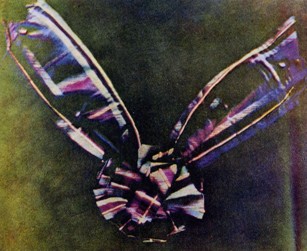
Maxwell’s three-colour photographic image

The world’s first colour photograph

This is how it all began. In 1855 the renowned Scottish physicist James Clerk Maxwell gave a lecture to the Royal Society, where he argued how the three-colour principle of colour vision might be applied to create colour photography. Maxwell said:

Let it be required to ascertain the colours of a landscape by means of impressions taken on a preparation equally sensitive to rays of every colour. Let a plate of red glass be placed before the camera and an impression taken. The positive of this will be transparent whenever the red light has been abundant in the landscape and opaque where it has been wanting. Let it now be put in a magic lantern along with the red glass and a red picture will be thrown on the screen. Let this operation be repeated with a green and a violet glass, and by means of three magic lanterns let the three images be superimposed on the screen. The colour of any point on the screen will then depend on that of the corresponding point of the landscape, and by properly adjusting the intensities of the lights, etc., a complete copy of the landscape, as far as visible landscape is concerned, will be thrown on the screen.

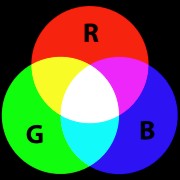
Maxwell here laid down the principles for three-colour additive photography. Using filters for the primary colours of red, green and blue in combination with monochrome photography to create three separate records would result in a full colour reproduction when those three versions of the same image were brought together.

The additive colour principle

The additive colour principle

In 1861 at the Royal Institution Maxwell demonstrated the practical results of his theory, photographing a tartan ribbon through red, green and blue filters (using a very long exposure), then placing the three positive transparencies in three magic lanterns and projecting the images in synchronisation through the same colour filters (the actual photographs were taken for him by Thomas Sutton, editor of Photographic News). Maxwell’s image is therefore the world’s first colour photograph. This was of course before sensitising emulsions had been discovered, and Maxwell was using photographic plates that were insensitive to red light. However, a much later recreation of the experiment (1960) showed that both red filter and ribbon emitted ultraviolet rays, which made an impression on the photographic plate, resulting in an approximately true colour photograph.

It is from Maxwell’s theorising and practical example that we can trace the history of colour cinematography, and it is the starting point for the Bioscope’s year-long series on colour in the silent era. It had of course been the dream of those involved in the early years of photography to come up with a means of capturing colour, and assorted methods of adding artifical colours to photographs were employed throughout the nineteenth century. However, true colour was the goal, and various efforts were made to record colour directly in the same way that monochrome photography operated.

It was Maxwell’s experiment that demonstrated an indirect, practical solution – taking the three primary records, red, green and blue, and adding them together (hence the term ‘additive’), working on principles of colour vision developed early in the nineteenth century by Thomas Young. Other scientists then followed, refining Maxwel’s ideas, including Louis Ducos Du Hauron, Charles Cros and H.W. Vogel (who in the 1870s and 1880s discovering methods of greatly sensitising photographic plates to different colours). But most significant in the stages of experimentation that would eventually lead not only to a practical system of colour photography but for colour cinematography as well was Frederic Ives, who will be the subject of part two of this series.

Recommended reading:

Brian Coe, Colour Photography: The First Hundred Years 1840-1940
Jack H. Coote, The Illustrated History of Colour Photography

Countdown to the festival

Bioscope Festival of Lost Films

Just eight days remain until we start The Bioscope Festival of Lost Films – a world first, I believe. The festival runs 14-18 January, and all of the films to be shown (one feature and one short per day) will be guaranteed not to exist. Once they did, and one reason why the titles are not being announced in advance, is that exhaustive researches are being undertaken in archives around the world to ensure that the selected films do not still exist somewhere.

However, we can give you some incidental details. The festival will of course be taking place in lost venues. Those selected – a different one each night, all in London – are:

The West End Cinema Theatre, Coventry Street
The Court Electric Theatre, Tottenham Court Road
The Casino de Paris, Oxford Street
The Cambridge Circus Cinematograph Theatre, Charing Cross Road
The Circle in the Square, Leicester Square

All are no longer cinemas. The West End Cinema Theatre, which opened in 1913, later became the Rialto and closed in 1982. It is a Grade II listed building but remains disused. The Court Electric Theatre, which closed in 1928, does not exist as a building, but the space it occupied is now the foyer of the Dominion Theatre. The Casino de Paris (opened 1909) is now a McDonald’s. The Cambridge Circus Cinematograph Theatre (opened 1911) is now the Montagu Pyke bar. And the Circle in the Square (originally called the Bioscopic Tea Rooms, opened 1909) is now an Angus Steak House. But we can dream.

And we have musicians. We have gone for the best, and can promise three names once renowned for their accompaniment of silents at the National Film Theatre: Arthur Dulay, Ena Baga and her sister Florence de Jong playing the organ. You will be transported. Book now!

The Bioscope Festival of Lost Films is dedicated to the anonymous person who visited this blog using the search term “lost films download”. We must all continue to live with such hope.

Projection Box essay competition

Just a reminder for anyone with an unpublished essay on early cinema tucked in the desk or on the hard drive somewhere that the deadline for the Projection Box essay award is January 18th. The aims of the award are to encourage new research and new thinking into any historical, artistic or technical aspect of projected and moving images up to 1915; and to promote engaging, accessible, and imaginative work. The first prize of £250 is for an essay of between 5000 and 8000 words (including notes).See the earlier post on the award (which is being awarded for the first time) for details of how to enter, or visit the Award site.

Bach releases DeMille

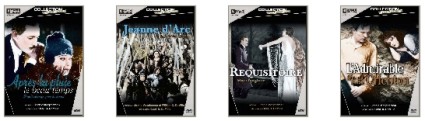
Bach Films

Cecil B. DeMille DVDs, from http://www.bachfilms.com

My thanks to Herr Graf Ferdinand Von Galitzien for the information that the French company Bach Films have released ten Cecil B. DeMille silents on DVD. The titles are:

The Cheat (1915) – with Sessue Hayakawa, Fannie Ward
Carmen (1915) – with Geraldine Farrar, Wallace Reid
Joan the Woman (1917) – Geraldine Farrar and Raymond Hatton
The Whispering Chorus (1918) – with Raymond Hatton and Kathlyn Williams
Old Wives for New (1918) – with Elliott Dexter and Florence Vidor
Don’t Change Your Husband (1919) – with Elliott Dexter and Gloria Swanson
Male and Female (1919) – with Thomas Meighan and Gloria Swanson
Why Change Your Wife (1920) – with Thomas Meighan and Gloria Swanson
The Affairs of Anatol (1921) – Gloria Swanson and Wallace Reid
Manslaughter (1922) – with Leatrice Joy and Thomas Meighan

All are retailing at 7.00€. All are Region 2, and appear to have French titles only. I can’t find any information about the music. At any rate, it’s a remarkable selection, with perhaps Joan the Woman, starring the opera singer Geraldine Farrar (who enjoyed a surprisingly successful career in silent films, given that her chief asset – her voice – was absent), the outstanding classic if you had to go for just one.

I’d not heard of Bach Films before now. Other silent DVDs on their list are D.W. Griffith’s Way Down East (1920), Orphans of the Storm (1922), Broken Blossoms (1919), Intolerance (1916) and Sally of the Sawdust (1925), all of them accompanied by assorted Griffith Biograph shorts; Douglas Fairbanks in The Three Musketeers (1921), Robin Hood (1922), Don Q, Son of Zorro (1925), The Black Pirate (1926) and The Iron Mask (1929); and Tod Browning’s Shadows (1922).

I don’t attempt to keep up with all silent film DVD releases here on The Bioscope, because there are other well-established sources that provide such a service very well. Check out the Silent Films on DVD section on Silent Era, or the impressively-extensive Silent Films on DVD site.