Visual empires

The fourth Visual Delights conference, Visual Empires, will take place at the University of Sheffield between 3-5 July 2009, and a call for papers has been issued.

Popular visual cultures have been central to the construction and propagation of imperial and colonial narratives and have helped define the nature of Empire. They have been intrinsically linked to discourses about the rise and fall of Imperial fortunes in the 19th and early 20th centuries and have been studied as both evidence of imperial attitudes to race and colonial subjects and as propaganda texts which helped spread and cement imperial and colonial ideologies. This conference seeks to explore this rich visual archive and to examine the roles played by popular visual culture in the construction of narratives concerning issues of race, identity, colonial and imperial ideologies, nationalism, patriotism and the ‘Visual Empire.’

We would like to receive suggestions for papers with deal with these issues in popular cultural forms such as photography, advertising, cinema, theatre, the magic lantern, ethnographic display and world’s fairs before 1930. Suggested themes could include:

  • Photography and constructions of ‘otherness’
  • Ethnographic display and racial identities
  • Advertising and imagined colonies
  • Cinema and the mapping of Empire
  • The magic lantern and the topography of Empire
  • Music hall and the patriotic show

Abstracts of no more than 500 words should be sent to Simon Popple (s.e.popple [at] leeds.ac.uk) or The Louis Le Prince Centre, The Institute of Communications Studies, The Houldsworth Building, The University of Leeds, Leeds LS2 9JT, UK. The deadline for submissions is 1 November 2008.

The conference will be jointly hosted by the Louis Le Prince Centre, University of Leeds and the National Fairground Archive, University of Sheffield. It is held in conjunction with the journal Early Popular Visual Culture.

Colourful stories no. 9 – They do it with stencils

Pathécolor machine printing room, from F.A. Talbot, Moving Pictures: How They are Made and Worked (1912)

As films grew longer, and their production increased, through the 1900s, so the idea of adding colours by hand became uneconomic. A mechanised system was required, and at around the same time that experiments were taking place in Britain to develop natural colour motion pictures, in France first Pathé and then Gaumont started developing processes for the mass production of multi-colour-tinted film prints through the use of stencils. This was a labour-intensive process (employing mostly female operatives – see pictures above and below) which could only be carried out by well-capitalised businesses with international distribution, and in the mid-1900s France dominated the world’s motion picture business. Hence France became the home of artificial motion picture colour.

Women workers preparing Pathécolor films, from Moving Pictures: How They Are Made and Worked

Pathé introduced its stencil colour process in 1905, but the system in principle was not new, having been adopted from methods used for colouring postcards and wallpaper. A number of prints of any one film title would be made, each representing the different colours to be employed in the eventual film (i.e. a film featuring red, green, blue and yellow would require four original prints). The areas in each of the original prints to be coloured would be marked out and cut with scalpels. Each cut-out print would be laid over the final projection print and each colour would be applied in turn. 600 women were employed at the Pathé factory by 1906 to produce colour prints in this way.

However, great mechanisation was soon brought in, led by Henri Fourel, who ran the Pathé colour studio in Vincennes. In 1908 Pathé introduced a pantograph mechanism to improve production. A master print would be rear-projected onto a ground glass screen, one frame at a time, which enabled the operator to have a far clearer view of the image. She would then move a pointer over the screen, marking out the area to be treated with one colour. The pantograph allowed for greater precision of line, and a needle at the other traced marked out the corresponding area on a second print. This would be repeated for each colour required. It was painstaking work, and still very labour-intensive, with an estimated 300 women operators employed. About one metre of film per colour was produced in an hour. When all the stencils had been cut, the gelatin emulsion was removed from each and they were then run in turn through a staining machine in precise registration with the master print. The cumulative result was a finished print stained in multiple colours – or rather multiple prints, since at least 200 colour copies had to be produced to make the system economic.

This demonstration of the stencil colour process is taken from Brian Coe’s The History of Movie Photography. The original film is on the left; then follows (L-R) the stencils cut for each colour (top row) and the application of that colour (bottom row) for red, blue, brown, green and yellow respectively.

The Pathé system produced images of frequently exquisite quality, with a notable precision of colour. Colours were not applied to every kind of film, but generally to those kinds of films which it was felt would be best enhanced by colour: exotic travelogues, costume dramas, magical films etc. Such films would be billed as the highlight in cinema programmes, and were more expensive for exhibitors than common film titles. As indicated, the industrial, labour-intensive process could only be supported by major producers with extensive distribution, and Pathé’s only rival in stencil colour was to be Gaumont, which came up with a similar process around 1908.

An unidentified fragment of a Pathé stencil colour film, date uncertain (c.1910?)

Another stencil colour example, from the same collector, again undated (early 1910s probably) and location unknown. Anybody recognise the building and gardens?

Pathé and Gaumont would continue with stencil colour into the 1920s, and the finest examples of their art are among the treasured items of the world’s film archives (there is a particularly strong collection at the Nederlands Filmmuseum). Stencil colour films have also inspired a growing body of academic work looking at the aesthetics and meanings of early colour. Strongly recommended is Tom Gunning’s essay ‘Colorful metaphors: the attraction of color in early silent cinema‘, originally published in the Italian journal Fotogenia (there is a version online in English), which looks at the special nature of early colour, seen in the context of the use of colour in other media (posters, books, advertisements etc.). For Gunning, it was not that the stencil colour films were more true to nature, but that they were an attraction in themselves, offering a ‘sensual intensity’, acting as a ‘signifier of fantasy or as a metaphor’.

However, just as Pathé introduced its improved colour system to the world in 1908, a rival system from Britain was announced, which did not use artificial colour but instead boasted that only its photographic colour was true to nature. The commercial and ideological (i.e. in debates over reality) between the systems that would later be known as Kinemacolor and Pathécolor will be covered in a later post.

Further reading:
Bregtje Lameris, Pathécolor: “Perfect in their renditions of the colours of nature”, in Living Pictures vol. 2 no. 2 (2003)
Brian Coe, The History of Movie Photography (1981)

Classic silent films … and a kickin’ rock concert

While planning an overview of silent film and modern music accompaniment for you, I came across Vox Lumiere, a concept so bizarre that it more than merited a post of its own.

Vox Lumiere is a music theatre company which specialises in presenting a combination of silent film and rock opera. While a silent classic plays in the background – so far their repertoire features Metropolis, The Hunchback of Notre Dame, Peter Pan, The Phantom of the Opera and a ‘greatest hits’ package’ – singers and dancers enact the drama and a five-piece rock band does what five-piece rock bands tend to do. Musically, going by their promo video above, it’s not quite my taste, but clearly some people like the concept, to judge from their press reviews, and they’ve come up with something novel which in its way articulates the modern appeal that the iconography and emotion of silents can engender.

Vox Lumiere Metropolis

Vox Lumiere’s interpretation of Metropolis, from http://www.voxlumiere.com

The Vox Lumiere website provides you with video clips, sound clips, photographs, information about the company, a calendar of events (catch them next in Shreveport, Louisiana in November), and the chance to buy T-shirts and baseball caps. So that’s everything covered really.

As said, it’s not going to be everyone’s taste, and the juxtaposition of the kind of low rent rock music you only get in rock operas with silent movies (which don’t necessarily need this sort of help to gets their effects across) is peculiar, if not alarming. But it wins points for originality, enthusiasm, and for demonstrating that silents remain an inspiration – and an inherently theatrical medium.

(The title of the post is taken from a line in their promo video, by the way)

The Open Video Project

Edison titles

2 A.M. in the Subway (1905), Japanese Acrobats (1904) and The Boys Think They Have One on Foxy Grandpa, But He Fools Them (1902), from http://www.open-video.org

There are a number of online video collections out there designed for university use which feature lectures, demonstrations, educational documentaries etc. One that has been around for some time is the Open Video Project, which is hosted by Internet2 in America, and aims “to collect and make available a repository of digitized video content for the digital video, multimedia retrieval, digital library, and other research communities.” It comprises a number of collections from around the world such the University of Maryland HCIL Open House Video Reports, Digital Himalaya, NASA K-16 Science Education Programs and the HHMI Holiday Lectures on Science, but for our purposes what is interesting about the site is the Edison Video section.

This features 187 Edison production from the Library of Congress, dating from the 1890s and 1900s. Many early Edison titles are, of course, available from the LoC’s own excellent American Memory site, but the majority of the titles here are not on the better-known site. Among the varied titles only available here are A Ballroom Tragedy (1905), A Nymph of the Waves (1903), A Wake in “Hell’s Kitchen” (1903), Dog Factory (1904), Fights of Nations (1907), Gordon Sisters Boxing (1901), International contest for the heavyweight championship–Squires vs. Burns, Ocean View, Cal., July 4th, 1907 (1907), Princeton and Yale Football Game (1903), a series of films on the United States Post Office, films of the Westinghouse electrical works in 1904, and films from the St. Louis Exposition of 1904. And many more.

Basic cataloguing information is provided, though there are some peculiar errors with dates from time to time, and the presentation is rudimentary apart from some helpful synopses. There is little information available on the collection overall, so nothing to explain the significance of Edison films or why these titles – predominantly actuality – have been chosen. All are available as freely downloadable MPEG-1s, with the same frustratingly small image size as one finds on the American Memory site. But let us not be churlish – here is a wonderful selection of titles, many of them unfamiliar and indicative of the range of Edison production, including comedies, dramas, variety acts, sports films, travel films, and sponsored industrial work. Well worth exploring.

The Haunted Gallery

The Haunted Gallery

http://www.amazon.co.uk

What fabulous book cover this is. I’d buy the book purely on the strength of the picture – in fact I just have. The image is a 1901 poster for the British Mutoscope and Biograph Company, taken from the copyright collection of The National Archives. Biograph’s 70mm films were a special feature of the Palace Theatre in London (still active today, currently showing Spamalot), and Biograph programmes generally featured news items – hence the full slogan on the screen (which is obscured on the book cover), ‘The Biograph Reproduces the Latest Events from All Parts of the World’.

But the book within is no less of a treasure. The subject of The Haunted Gallery: Painting, Photography, Film c.1900 is how the moving picture changed visual culture at the end of nineteenth century. Lynda Nead is an art and cultural historian, whose first foray into film history this is. Although the subtitle implies equal coverage of painting and photography, the motion picture takes centre stage, but is set into new and exciting contexts by demonstrating its effects alongside the whole range of contemporary visual media, including painting, photography, stage magic, the magic lantern, posters and even astronomy.

The result is a giddyingly rich brew of evidence and analysis, all expounding a shift in visual culture from stasis to motion, which in turn altered modes of perception and ushered in our modern world. The book’s title comes from a characteristic Nead use of the visual as metaphor: an illustration of the Haunted Gallery at Hampton Gallery, which she describes thus:

A space for pictures and for ghosts, the gallery is also for endless pacing watched by portraits of generations of the dead. It is a place of presences but not life, of likenesses which seem real but which are merely representations or figments of the imagination. The picture gallery is also a place of alternating light and darkness; it is a narrow apartment illuminated by shifts of light cast by unseen objects obliterating the light … How apt that the shadows cast on the ceiling by the windows and tapestried walls look like a strip of film, with intermittent, spaced-out picture frames, separated by short intervals of blank darkness. Set this sequence in motion and the enchantment begins; the pictures come to life and the ghosts haunt the gallery.

Nead finds in the haunted gallery a powerful metaphor for the ‘uncanny magic’ of early film. Typically she finds multiple analogues for this concept, from Edison and Biograph advertising films of ancestors climbing down from portraits on the wall to drink Dewar’s Whisky, to similar Scottish ancestors doing much the same in Gilbert and Sullivan’s comic opera Ruddigore, to Georges Méliès’ films The Living Playing Cards and The Mysterious Portrait, to tableaux vivant, to the myth of Pygmalion and Galatea (the statue that came to life). It all interconnects.

It certainly helps if you can see the pictures, and the book is richly illustrated throughout, sometimes enthralling so. Themes covered include the wheel and movement, representation of the everyday and the detective camera, the vision of mobility generated by the new-fangled motor car, the strip (the film strip, the cartoon strip and the striptease), and the astronomical imagination. This latter section looks at visions of the heavens (by way of serpentine dances, G.F. Watts, electricity and the Paris 1900 Exhibition), including some startling examples of astronomical photography spilling over into the imaginative world, represented in particular by Camille Flammarion, the French astronomer, author and astronomical filmmaker, whose 1872 novel Lumen describes all-seeing beings who view the passing of a time as a ray of light, in a constant relay of images. Metaphors, metaphors everywhere.

The best image comes last – a map of the procession through London taken to mark Queen Victoria’s Diamond Jubilee on 22 June 1897 (filmed by many cameramen), marked with bright yellow explosion symbols to mark where Martian explosions occur as recorded in H.G. Wells’ The War of the Worlds, published in the same year. However, it’s not all image and metaphor, and there’s a good deal of practical understanding of the production of images (still and moving) underpinning the theoretical stuff. The moving images make sense on a practical level as well as an imaginative one.

As with Jonathan Auerbach’s Body Shots, covered in a recent post, here is someone from outside the usual early film studies coterie, looking on the subject with fresh eyes and leading it into a broader cultural world, demonstrating bold analogies and connections, inviting in those from other disciplines to see how film was integral to a change in consciousness in the late-Victorian/early-Edwardian era. Both publications have enriched our field. I feel that the Bioscope may have to expand, to become just that little bit more metaphorical, if it is properly to represent its subject in its contexts. We’ll see.

Silent cinema in Tamil

I’ve just seen notice of this publication, a history of world silent cinema written in Tamil, reported on by The Hindu newspaper. It seems worth noting, for the record. Here’s the review:

ULAGA CINEMA VARALAARU — Mouna Yugam (Silent Period): Ajayan Bala; KK Books Pvt. Ltd.,

19, Srinivas Reddy Street, T. Nagar, Chennai-600017. Rs. 150.

A WELCOME publication in Tamil, most likely the first of its kind, narrating the interesting history of world cinema during the period December 1895 to October 1927 being the silent age when many purists and diehard conservatives sincerely felt that the medium would not last long. Ajayan Bala who is involved in many a capacity in cinema has narrated interestingly the fascinating true story of the founding, growth and development of silent film around the world, including India. Today there is great awareness about film history in this part of the country and this book will go a long way in filling the virtual vacuum that exists.

The book is well illustrated with thumbnail photographs, which adds to its attraction and utility.

The author is currently working on more volumes to continue his in-depth study and writing of the later exciting periods of world cinema. Economically priced, this book is a must read for Tamil readers who wish to know the fascinating tale of international cinema. The publishers also deserve to be congratulated besides the author for planning and publishing such a book.

There will be silents

The Story of Petroleum

The Story of Petroleum, from http://www.dvdtalk.com

An intriguing small news piece for you. The forthcoming DVD release (Collector’s Edition) of the Paul Thomas Anderson film There Will Be Blood, on the birth of the American oil industry, will include The Story of Petroleum among its extras.

This 25mins documentary dates from c.1923 and was produced at the behest of the US Bureau of Mines and the Sinclair Oil Company (nothing to do with Upton Sinclair, whose novel Oil! forms the basis on Anderson’s film). It shows operations of the American oil industry at the time (There Will Be Blood is set in the 1890s), and comes with a score from Radiohead’s Jonny Greenwood, who also scored the main feature film. The film was presumably remade or updated from time to time, as the BFI National Archive has copies dating from 1920 and 1928. It is a typical example of the semi-instructional semi-propagandist films produced by industrial concerns for the burgeoning non-theatrical market from the 1920s onwards.

The DVD (Collector’s Edition) of There Will Be Blood is released in the UK on 8 April.

Motion pictures

Execution of Czolgosz

Execution of Czolgosz with Panorama of Auburn Prison (1901)

This gentle, business-like image comes from one of the most discussed and notorious of early films, Edison’s Execution of Czolgosz with Panorama of Auburn Prison (1901). Leon F. Czolgosz was the assassin of President William McKinley, and Edwin S. Porter and James White journeyed to Auburn Prison in upstate New York, reportedly with the hope of filming Czolgosz’s actual execution in the electric chair. Happily they were rebuffed, but they filmed the outside of the prison on the day of the execution, then back at the studio the Edison team dramatised the scene that had taken place inside, and cut the films together.

Should you wish to, you can see the film on the Library of Congress’ American Memory site, which supplies this original catalogue description:

A detailed reproduction of the execution of the assassin of President McKinley faithfully carried out from the description of an eye witness. The picture is in three scenes. First: Panoramic view of Auburn Prison taken the morning of the electrocution. The picture then dissolves into the corridor of murderer’s row. The keepers are seen taking Czolgosz from his cell to the death chamber, and shows State Electrician, Wardens and Doctors making final test of the chair. Czolgosz is then brought in by the guard and is quickly strapped into the chair. The current is turned on at a signal from the Warden, and the assassin heaves heavily as though the straps would break. He drops prone after the current is turned off. The doctors examine the body and report to the Warden that he is dead, and he in turn officially announces the death to the witness. Class B 200 ft. $24.00

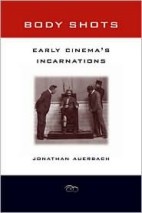
So much that is complex, problematic, mysterious, engrossing and unique about the motion picture is bound up in this short film; in its production, reception and subsequent critical understanding. What exactly does it signify? What is the relationship between the actuality footage and the dramatised? How ‘real’ is it? How do we understand the figure of Czolgosz from what is presented to us? Why did audiences want to see the film, and what exactly did they see in it? It is these mysteries, and in particular the presence of the human body in motion, trailing all kinds of ‘anxieties and preoccupations’ with it, that forms the subject of a new book on early cinema, Jonathan Auerbach’s Body Shots: Early Cinema’s Incarnations, which places the Czolgosz film on its front cover.

Body Shots

It’s an inelegant title, but a compelling work – quite the best book on early film that I’ve read in ages. Its argument is not one you can summarise easily. Auerbach’s interest is in the earliest years of film before narrative took hold, when the signification of these figures in motion is not straightforward. He does not put forward an all-encompassing theory, but rather raises questions and demonstrates the complexity of an audience’s understanding of the figure in motion. In doing so, he rather lays into the dominant theory in this field, the ‘cinema of attractions’, promoted by Tom Gunning and André Gaudreault in the mid-1980s, and cited religiously by countless students and scholars of early cinema ever since. The theory (to use Auerbach’s words) “posits early films and filmmaking as a mode of showing that privileged immediate shock and sensation over narrative continuity and integration”. So, variety acts, exotic scenes, hand-painted colour, magic tricks – spectacle over story.

I doubt that Gunning himself would say that his should be a theory to explain all film before 1906, but it has become an orthodoxy, as Auerbach states, and he’ll have none of it. For him it is too cosy a solution, too tidy an explanation of what should be perplexing, uncertain territory. He finds the evidence provided by specific films, in their specific contexts, and it is close readings of just a handful of actuality (or pseudo-actuality) films that makes the book such an engrossing read.

Perhaps the book’s tour de force is the chapter on McKinley at Home – Canton, O (1896). This brief film shows the Republican candidate for the presidency, William McKinley, walking across his garden and receiving a telegram, before walking with a companion of out frame. Auerbach tell us the history of McKinley’s campaign (he made a virtue of staying at home), the film’s production (McKinley’s brother was on the board of the American Mutoscope and Biograph Company which made the film), its promotion, interpretations of the film at the time (the message he was receiving could be interpreted how you wished), the participatory nature of its reception (audiences reacting vocally to what they saw on the screen), and the film’s enthusiastic reception by a press largely dedicated to the Republican cause. Four years later, he would be assassinated, and the chapter concludes with a more speculative reading of Execution of Czolgosz.

Auerbach demonstrates the range of strategies and meanings that can underlie such a simple seeming actuality as McKinley at Home. Of course, not all films of the 1890s may yield such a rich contextual history, but it is the potential for such contexts that matters – that, and the relationship between film and audience, each operating in their own particular sphere. None of the profusion of ideas that Auerbach brings to his interpretation of McKinley at Home, Execution of Czolgosz, early Edison and Lumière actualities, The May Irwin Kiss, The Big Swallow, Personal or The Life of an American Fireman seems forced or inappropriate. The themes he takes on include the visualisation of sound, the emergence of the chase movie as proto-narrative, and finally a Barthesian meditation on death and early film, when such bodies cease to move.

The great appeal of early cinema is its receptivity to ideas, its status as a period when no one can be certain of what is going on, just as Auerbach says about the early actualities themselves:

… volition and animation are often at odds rather than coterminous, a fact that gives these early moving images a peculiar kind of affect, suggesting neither filmmakers nor viewers nor bodies on-screen quite knew what to make of or do with themselves. Hence their interest for me.

It seems a new generation of theorists is coming to the field (Auerbach’s background is in literary studies) and dragging early cinema forward or back into the many worlds to which it belongs. Body Shots is not an easy read, but then neither is it a difficult one. It makes films that you may not have seen nevertheless visible, and makes you want to look again with sharper eyes at those you do know. I may not have explained it terribly well, but I do recommend it.

Early anime discovered

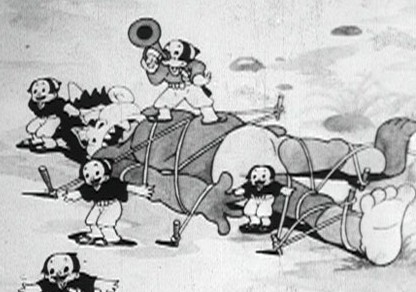
Chibisuke Monogatari

Issun-boshi: Chibisuke Monogatari (Tiny Chibisuke’s Big Adventure) (1935) © Digital Meme

The National Film Center, Toyko, has announced the discovery of two anime films from the silent era. Given the fact that less than 4% of Japanese films made before 1945 still exist, any such discovery, as brief as these titles are, is heartening news.

Anime might be thought of as a modern phenomenon, but the history of Japanese film animation stretches back to the early silent era. Soon after American and European animation films were first seen in Japan, around 1914, Japanese filmmakers were imitating them and coming up with their own distinctive native style.

The two films that have been uncovered (they were found in good condition in an Osaka antique store) are Junichi Kouichi’s Nakamura Katana (1917), a two-minute tale of a samurai tricked into buying a dull-edged sword; and Seitaro Kitayama’s Urashima Taro (1918), based on a folk tale in which a fisherman is transported to a fantastic underwater world on the back of a turtle.

There’s a little more information in a Reuter’s report, but no images or clips just yet.

If you are keen to see what silent anime looks like, the enterprising Japanese publisher Digital Meme sells a four-DVD box set, Japanese Anime Classic Collection, which features examples from 1928 onwards, some with benshi narration (the Japanese actor/presenters who explained the stories of films to audiences and who enjoyed stardom in their own right). Digital Meme retails a number of Japanese silents on DVD with benshi accompaniment as a special feature, and I’ll put together a post some time soon about these and the world of the benshi.

World’s first sound recording

Phonautogram

Phonoautogram, from http://www.nytimes.com

Well, this item fails our criteria on two counts – it’s not about cinema, and it’s not silent. But it’s relevant, so here goes.

It was announced today that researchers have uncovered the world’s first sound recording, dating from 9 April 1860, an astonishing seventeen years before Thomas Edison received the patent for his Phonograph. The recording was created by something called a Phonoautograph, and the recording itself is a Phonoautogram. The Phonoautograph was designed to create a visual record of sounds. Invented by the Frenchman Édouard-Léon Scott de Martinville, the device comprised a barrel-shaped horn connected to a stylus, which etched impressions of sound waves onto sheets of paper which has been blackened with soot. There was no means of playing back the recording. It was a visual record of sound designed for analysis.

The recording is a ten-second burst of the song Au Clair de la Lune, sung by an unidentified female. You can hear it (all ten seconds of it), and discover the background to its discovery and the ingenious use of optical imaging technology by the Lawrence Berkeley National Laboratory in Berkeley, California that reconstituted the sound in a New York Times article.

Or just click here for the MP3 file.

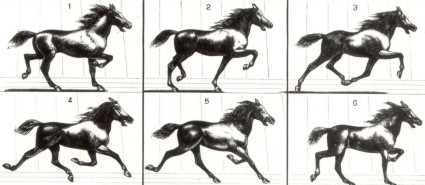
So it’s the world’s earliest known sound recording, but is it a true sound recording if it could not be played at the time? Surely the invention is only complete with the full realisation of the technology; that is, when Edison combined both sound recoding and playback, the earliest playable example of which (part of a Handel oratario) dates from 1878. And this is where the relevance bit comes in, because we face exactly the same dilemma with motion pictures. Eadweard Muybridge first photographed motion in sequence in 1878, and we can reconstitute such images to display motion. They look like movies, but at the time they never moved. Etienne-Jules Marey photographed humans and animals in sequence from 1882 onwards, soon to be followed by other chronophotographers, but his purpose was the same as Édouard-Léon Scott de Martinville – analysis. Yet we can convert these film strips (Marey used celluloid) into fleeting semblances of motion. Louis Aimé Augustin Le Prince took perfectly serviceable motion pictures (on paper) in 1888, but much as he wanted to he was not able to project them.

So we award the laurels to Edison and to Lumière for having brought together the full package. Or so I’ve always argued. Now I don’t know. It seems to me that Édouard-Léon Scott de Martinville (great name) achieved the essential business first – to capture sound. Being able to play it back was secondary – desirable, of course, but ultimately an inevitable follow-up that would just take a little bit longer to achieve (in his case, 148 years). So, on that basis, Edison and Lumière came last. They realised, but it was others who pioneered. Stand up Eadweard, the laurels are yours.

Debate, anyone?

Muybridge 1878

Muybridge’s photographs of a horse in motion, from Scientific American 19 October 1878