Timon’s Friendship Adventure

Timon’s Friendship Adventure

As regular readers will know, here at The Bioscope we try to keep up with current trends in silent filmmaking, while those who know me may know that I have an interest in that engagingly oddest of genres, the silent Shakespeare film. But who would have suspected that the two interests might come together, and that Timon of Athens would be its subject?

And so I offer you Timon’s Friendship Adventure, which is a modern silent (in modern dress) based on William Shakespeare’s Timon of Athens. It’s few people’s favourite Shakespeare play, and one of his least filmed (let alone performed), but writer Michael Weinreich, producer Lisa Shapiro and director Max Littman have created this oddity, shot in black-and-white, silent, with intertitles, and a familiar-style piano accompaniment (until, unfortunately, electric guitar and drums kick in halfway through). Jason Davids Scott plays Timon.

There’s website dedicated to the film, which was made in 2007, and has been doing the round of festivals. Timon is one of Shakespeare’s more misanthropic characters, but though in the play he holds a feast for friends who turn out to be false friends when he is in need, he doesn’t slaughter everyone, as happens here. The inspiration seems more Titus Andronicus than Timon of Athens. Anyway, it deserves notice for being different, and for showing that the honourable art of compressing Shakespeare into five minutes (and squeezing out his words while you’re at it) is not lost.

In the dock

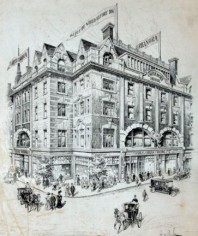
Cinematograph theatre in Lordship Lane, London, in 1913, from http://commons.wikimedia.org

Let us celebrate the Bioscope’s imminent passing of the significant milestone of its 100,000th visitor (hurrah) by looking at a major new research resource for British historical studies in general which offers some minor but intriguing opportunities for the early film historian.

The Proceedings of the Old Bailey Online is just that – a fully searchable edition of digitised texts from London’s central criminal court, with details of 197,745 criminal trials. These are trial reports originally published for general consumption. Previously this remarkable resource (a collaboration between the Open University, and the Universities of Hertfordshire and Sheffield, funded by the Arts and Humanities Research Council and the Big Lottery Fund) covered the years 1674-1834. Now the collection has been augmented by texts of trials going up to April 1913 (when the printed Proceedings ceased publication). This makes it an obvious boon for historians of the nineteenth and early twentieth centuries, with a wealth of social detail alongside the intrinsic interest of the trials themselves. It is also a source of huge interest to family historians, who are exploring with nervous/eager anticipation to see if any of their forbears ended up in the dock (I’ve found one such forbear, but happily he was merely a witness to a crime). It is easy and helpful to use, and utterly engrossing to read.

So, given that the records go up to 1913, what is there for the film historian? Well, not a huge amount, but enough to merit further exploration by somebody. There are both cases which involve motion pictures, and cases where the accused or witnesses attended film shows which are recorded as part of the evidence.

For example, consider the case of Manuel Goldberg, alleged user of counterfeit coinage, from 8 January 1907. We get this evidence from one of the witnesses:

LOUISE VALLERS, wife of Henry Vallers, 129, Whitechapel Road, E. We keep a Bioscope Exhibition. I was there on the evening of December 22 last, between five and six, when prisoner came in on see the exhibition. The charge for admission was one penny. He tendered a half-crown. The people pay at the door as they enter. This is the coin marked by myself. I took it and gave him two separate shillings and fivepence change. He said to me, “Are there no tickets?” I said, “No,” and he went to the door again and beckoned to another man to come in. The other man came up, and he also gave me a half-crown for his admission, for which I gave him two and fivepence change. This is the one. I looked at them, being two half-crowns looked suspicious. I tested both of them with acid, and found they were bad. The second-man kept by the doorway, but the prisoner walked right to the end of the shop and sat down and waited for the exhibition. When the second man noticed that I saw the coins were no good, he took to his heels and ran away. I then closed my shop door and sent for a constable. I went up to prisoner, and said, “This half-crown ie no good to me,” and detained him till the other people in the shop had left. I gave him the coin back again. He simply said, “Not” and gave me a two shilling piece and ten halfpennies for his half-crown. A constable came in and I gave him in charge.

This is incidental evidence of a very early cinema in London, from which we learn its location, ownership, the price of admission, the ticketing policy, and the fact that, interestingly, the owner refers to the business as a shop (many early cinemas in London were simple shop conversions). He was found not guilty, by the way.

Next, this simple case report from 20 April 1909:

THOMPSON, William (31, operator), pleaded guilty of stealing two spools and four cinematograph films, the goods of Herbert Crow; also to stealing two spools and six cinematograph films, the goods of Horace Liver and another; also to stealing three cinematograph films, the goods of Frederick Weisker and another.

He confessed to a conviction for felony in 1906 in the name of Albert Storer. Several other convictions were proved, dating back to 1891. It being stated that another charge against him was pending, he also pleaded guilty to that in order that the Court might deal with all matters against him up to date.

Sentence, Two years’ hard labour on each indictment, to run concurrently.

And so on. It is necessary to use a variety of search terms to find relevant material. I’ve found evidence (as it were) using Bioscope, Cinematograph, Cinema, Biograph, Film (though look out for errors in the optical character recognition – a lot of ‘films’ should actually be ‘firms’) and Picture Palace. With the latter you get many glimpses of the regular habit of cinema-going at this time. Use the term Living Pictures, and you find the trial of the renowned anachist group behind the ‘Houndsditch Murders’ and the Siege of Sidney Street, as in this testimony from Luba Millstein :

When I got back to No. 59 Dubof was there; I cannot remember what time he left. Later that night Trassjonsky and I went to see some living pictures. On returning she and I were staying in the back room; Fritz and Trassjonsky lived there together. About midnight I heard two people coming upstairs. On my going to the front room door and knocking Fritz told me I must not come in. A little later the men left and I went with Trassjonsky into the front room and there saw the body of Gardstein lying on the bed. I heard a conversation between Fritz and Trossjonsky. Fritz told her that Morountzeff was wounded…

The only name from the British film industry that I’ve come across is J. Brooke Wilkinson, the future head of the British Board of Film Censors, who in December 1911 was a witness in a case of forgery.

As someone who is researching cinema-going in London at this period, the Proceedings of the Old Bailey Online is an absolute treasure trove to me. But there are other aspects there well worth pursuing, particularly relating to bankruptcy and fraud. Or maybe you’ll just what to find out if those rumours about great-grandfather’s criminal past are really true or not…

Putting up statues to Charlie

This intriguing news report just turned up on a Kazakhstan news site:

A monument to Charlie Chaplin has appeared in Kostanai last week. As reported, it is the 12th in the world. The very fact of a sculpture to the cinematographe idol being installed in our city is quite weird for the town’s standards, especially taking into account that the only movie theatre in Kostanai was recently demolished. In any case, now we have Charlie and a bench near charlie. And as Farid writes in the local newspaper, “the bench is good enough to sleep on it — that’s practical, because we have as much vagabonds in town as in NYC in early 1900s”.

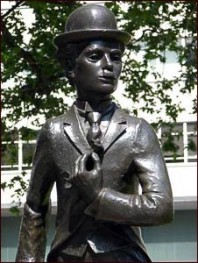
What intrigues me is where the other eleven statues are. I wasn’t able to find a helpful source for this, and so I set out to track them down for myself – though it all depends on how you define ‘statue’. Anyway, I thought I’d share this information with you; certainly it’s pleasing to see how admiration for silent cinema’s most celebrated practitioner is marked worldwide in bronze. So to start with (left) we have the twelfth and most recent statue, that which has gone up in Kostanai.

Next, there’s the renowned statue of Chaplin in London’s Leicester Square. He is located in the heart of London’s movieland, with cinemas all about him, while his fellow statues in the Square are Isaac Newton, William Shakespeare, Sir Joshua Reynolds, John Hunter (a pioneer of surgery), and William Hogarth. The Chaplin statue is by John Doubleday, and was created in 1981.

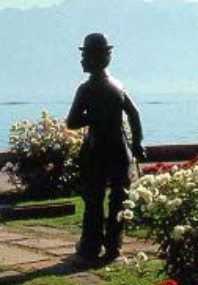
On to Chaplin’s final home, Vevey in Switzerland. In the Square Chaplin, Quai Perdonnet is you’ll find the double of John Doubleday’s statue, showing the little tramp looking out over his favourite view of Lake Geneva and the Alps. It is said to be the subject of pilgrimage, and certainly there are plenty of blogs out there showing people photographed next to Chaplin, leaving flowers there, or even kissing the statue. It was erected in 1982, and is a copy of the Leicester Square statue.

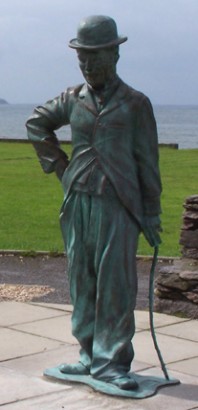
Our next statue is in the seaside town of Waterville, Co. Kerry, Ireland. Waterville was a favourite holiday destination of the Chaplin family. The legend on a stone nearby reads, “For the man who made the movies speak in the hearts of millions. Charlie spent many years in our midst as a welcome and humble guest and friend to many. This image was created by sculptor Alan Ryan Hall. It was funded by the generosity of Josephine Chaplin and by the EU Leader Programme”. It was unveiled in 1998.
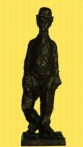
And on to Norway. In Oslo, near the Frognerpark, in front of the Coliseum cinema there is a bronze statue of Charlie Chaplin by the renowned Norwegian sculptor (well, renowned to Norwegians, anyway) Nils Aas, dated 1976. Frustratingly, I haven’t been able to track down an image of this in situ [see comments], but here at least is a studio copy. There doesn’t seem to have been any special association of Chaplin with Norway, unlike most of the other statues on view here.
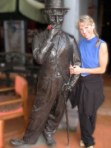
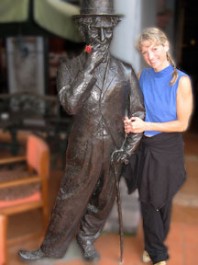
Now let’s away to China, no less. This statue is located outside the ‘Old Film Cafe’. Duolan Road, Hongkou District, Shanghai. The personal connection is that Chaplin secretly honeymooned in Shanghai with Paulette Goddard in 1936. No information as to sculptor or date, but much like most of the statues on display here, you have to say it looks nothing like him. It’s so easy to capture the outline figure, so difficult to capture the man.
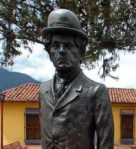
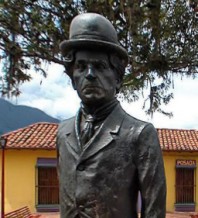
I’m not quite sure why there should be a statue on Charlie Chaplin in Venezuela, but there is. It is located in the city of Mérida, where it is to be found in the Plazoleta Charles Chaplin. No information that I can find as to artist or reason. So on to Disneyland Paris, where a statue of Charlie Chaplin welcomes visitors to the Production Courtyard, but I’ve not yet found a picture of this one.
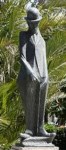
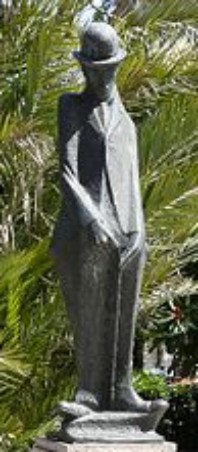
And now we travel to Alassio in Italy. This sheltered spot on the Ligurian coast (the Italian Riviera) is another place where Chaplin often stayed on holiday. The legend on the base of the elongated and not terribly Chaplin-like statue simply reads ‘Charlot’. No information as yet on sculptor or date.
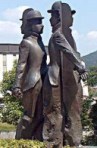
The statue on the left is located in Gabrovo, a small mountain town in Bulgaria. Gabrovo and Gabrovians are apparently the butt of Bulgarian national jokes, but they have responded ingeniously by creating a museum of humour and satire. So it is an appropriate location for a statue of Chaplin. The statue was created by Georgi Chapkanov, and is situated next to Don Quixote and Sancho Panza. It also wins some marks for being a little different.

This sitting statue of Chaplin is to be found in the foyer to the Roosevelt Hotel, along Hollywood Boulevard, Los Angeles. It common with most of the statues, there is particular reason for its location. It was at the Roosevelt Hotel where Chaplin received his Academy Award for The Circus in 1929. Another favourite subject for a host of tourist photos.

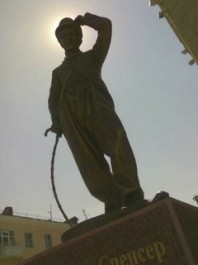
Well, that makes eleven. Where’s the twelfth? I don’t think the twelve-foot statue of Kermit the Frog as Chaplin outside the Jim Henson Studios (the former Chaplin Studios) really counts. Nor do assorted figures of Chaplin outside restaurants. I think I’ll go with the statue of him outside the Hollywood Entertainment Museum in Los Angeles, which is pleasingly dynamic (pictured left). If anyone knows of any others, or has more information about those described, do say.

Update (16 March 2009): For the news story about the attempt to build a giant statue of Chaplin in India, which have aroused religious protests, see The 13th Statue.

It’s an ill wind…

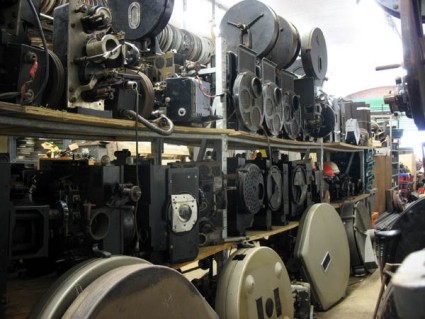
Projectors, sound systems and projection miscellanea, from http://www.cinemamuseum.org.uk

Good news re the Cinema Museum in London, which had been facing a bleak future when it was asked to move out of its current location at a former Lambeth workhouse, as it had not been able to find any suitable new home. Owing to the downturn in the UK property market, the NHS Trust which owns the building has decided not to put it on the market until their signs of upturn. So they have put the Museum on a monthly rolling contract for the next six months after which the position will be reviewed. The search is still on for a long term solution, but for the time being the collection is safe. Here’s hoping a new home emerges, just in time for those green shoots of recovery…

Bioscope Newsreel no. 1

British newsreel cameraman Jack Cotter, working for Pathé Gazette in 1922

I need to do a little more to separate news pieces from background, more discursive pieces, and so I’m going to introduce The Bioscope Newsreel. This will be a gathering of news alerts on silent cinema, with links to further information, released at what will no doubt be irregular intervals. Nevertheless, just like the newsreels (which were of course an invention of the silent cinema), each release will be numbered, there will be an average five stories per reel, and each story will have a mildly jokey title. So here goes with issue number 1…

Filming the father of Indian film
A feature film is to be made of the life of Dadasaheb Phalke, who made Raja Harishchandra, the first Indian fiction film, based on Hindu mythology, in 1913. Learn more.

Read all about it
The bi-monthly PDF magazine on silent cinema, The Silent Treatment, is now available online, with back issues for 2007. Learn more.

Hard times
Flicker Alley is to release a DVD of the important American social dramas Traffic in Souls (1913) and The Italian (1915) in July 2008, under the title ‘Hardships of the New Land’. Learn more.

More from the alley
Flicker Alley is busy at the moment, because also promised in September 2008 is its DVD release of Abel Gance’s pacifist classic J’Accuse (1919) and a Douglas Fairbanks boxed set in November 2008. Learn more.

Repatriation
A collection of American newsreels, documentaries, trailers and promotional films, dating 1912-1927, is being repatriated from the National Film and Sound Archive of Australia to American film archives. Learn more.

‘Til next time!

Laws and cases

It’s high time we had a new addition to the Bioscope Library. Fresh in, and just being stamped and having its classification number assigned is The Law of the Motion Picture Industry (1916), by Gustavus A. Rogers. This is the text of a lecture given by a New York lawyer to the College of the City of New York on 28 November 1916. The legal side of early film may not seem to have that much appeal, but it is a crucial subject to grasp. Laws existing and laws which had to be devised for the purpose not only governed but helped define the new medium.

Gustavus A. Rogers proves to be a helpful guide, with a clear-sighted view of his subject and much case law that he is able to cite as milestones in the development of cinema as a social entity. There is a particularly helpful section on patent law (“Ask the average person who is the inventor of motion pictures and the answer will be, Thomas A. Edison. Mr. Edison himself would probably agree that he is the inventor, but the courts have held otherwise”.) and the formation of the Motion Picture Patents Company, which sought to restrict trade to those businesses which recognised Edison’s film patents. Out of this history Rogers draws some fascinating and helpful definitions of what motion pictures actually were (in law), what the technology was there to achieve, and how a motion picture production was to be defined. He cites in the important case of the Kalem Company v Harper Brothers, which determined that the Kalem 1907 film Ben Hur infringed the copyright of the Lew Wallace book on which it was based. Rogers’ interest is in what the ruling meant for the definition of a motion picture in other legal proceedings. He says that the the case had not “definitely determined as to whether a photo-play is really ‘a commodity’ or whether as such it comes under the jurisdiction of the Federal Anti-Monopoly Law”. Rogers’ inference from this is interesting:

I am, however, of the opinion that whenever it will become important to effectually dispose of the question, that it will be found that there is no difference between the photo-play and the celluloid record which is used upon the phonograph, or the picture postal-card. For, after all, what is sent in commerce is a strip, or strips, of film, contained in rolls of approximately a thousand feet each. On these are still photographs that are commercially useful when put into a projecting machine and ground out to portray the story on the screen, in the same manner as the phonograph record is put upon the machine for the purpose of reproducing the musical sounds or matter contained on the record.

This short document (sixty pages) is therefore useful not just as a survey of the law’s engagement with motion pictures to 1916, but as a thoughtful disquistion on what a motion picture actually is. There is useful discussion of trade marks, copyright law, censorship (with comparisons of the state of things in America, Britain and France), Sunday legislation, and an overview of the laws regarding motion pictures in various European countries. It’s available from the Internet Archive in DjVu (1.6MB), PDF (5MB), b/w PDF (1.5MB) and TXT (122KB) formats.

Neversink Valley Area Museum

The Neversink Valley Area Museum is in Cuddebackville, NY, an area know to film historians as a popular location for New York film companies in the pre-Hollywood era. In particular it was a favoured location of D.W. Griffith and the Biograph company, which filmed in Cuddebackville six times over the period 1909-1911. The local museum (which takes its name from the optimistically-named Neversink river) has a section on filmmaking in the area (Thanhouser and the Victor Film Company were other visitors). But more than that, it has established competitions for silent filmmaking today and writing scores or silent films. The rules for the silent film competition are as follows:

We will accept any film up to 18 minutes in length, it may be from any country and does not have to premiere at our festival. Films currently in distribution are not eligible.
Film makers to submit entries on DVD (all region compatible, as one judge is UK-based).
Length not to exceed 18 minutes.
No synchronized sound.
Music, if used, must be original or provide proof of licensing.
Intertitles acceptable.
DVD should be marked with Title Only.
Enclose sheet with all credits in submission packet.

And here are the rules for the original film score competition:

Entrant to compose an original score for one of these three films: King Lear, The Vagabonds and The Marvelous Marathoner, all made by Thanhouser Motion Picture Company.
Thanhouser will provide a copy of the film to interested entrants.
The winning entry (i.e. film + winner’s music) will be posted on the Thanhouser web site for viewing the winner can use the film with their music royalty free.

Prizes are to be announced later. All screenings to take place 23 August. Further details and application form on the museum’s website.

Pen and pictures no. 2 – The most popular authors

I’ve started up this new series on literary authors and their engagement with motion pictures of the silent era, but which authors were the most popular subjects for adaptation? It’s a difficult subject to research, because of the variable quality of the reference sources to hand. One could go to the IMDB, but it still misses out so much, and there would be no easy way that I know of to isolate all literary source credits and then match these to silent films.

A better route I’ve found is to use Denis Gifford’s Books and Plays in Films 1896-1915. This is a typically thorough and rigorous reference work from the late Mr Gifford. His filmography is arranged by original author, and then gives release date, title, title of original work if different, production company and length. Its measure is films that were released globally, so it omits titles that were probably only shown in Russia or China (to name two obvious gaps), but in most respects it is as near a definitive source as you are going to find. He stops at 1915 just before the age of the feature film, but also to demonstrate the astonishingly varied literary adaptations of the first twenty years of cinema. It is apart from anything else, an excellent guide to popular taste and the cultural ambitions of the early cinema business.

So, who comes out on top out of the 861 authors he lists? No, it’s no who you think it is – he comes second – and no it’s not the other guy – he comes fourth. Below I’ve listed every author who has ten or more film adaptations to his or her name 1896-1915, with the number given in brackets after their name), and an intriguing list it is too:

  • James Curwood (81) [sturdy tales of the Canadian north]
  • William Shakespeare (75)
  • George Ade (70) [American humourist best known for his ‘fables in slang’]
  • Charles Dickens (60)
  • Alexandre Dumas père (28) [Three Musketeers etc]
  • Victor Hugo (28)
  • Alfred, Lord Tennyson (27)
  • Arthur Conan Doyle (26)
  • Frederick Burr Opper (26) [creator of Happy Hooligan cartoon strip]
  • Henry Longfellow (24) [Hiawatha etc]
  • Sir Walter Scott (23)
  • Dion Boucicault (22) [Irish playwright]
  • Richard Harding Davis (22) [journalist and novelist]
  • Washington Irving (22) [Rip van Winkle etc]
  • Edward Bulwer-Lytton (21) [Victorian novelist, The Last Days of Pompeii etc]
  • Johann Wolfgang von Goethe (19) [Faust, mostly]
  • Bret Harte (19) [tales of the pioneer life in California e.g. The Luck of Roaring Camp]
  • O. Henry (19) [American short story writer]
  • Charles Perrault (19) [Cinderella, mostly]
  • Cyrus Townsend Brady (18) [journalist and adventure writer]
  • Bud Fisher (18) [creator of Mutt and Jeff]
  • Robert Louis Stevenson (17)
  • Victorien Sardou (16) [La Tosca, etc]
  • George R. Sims (16) [English journalist and writer of sentimental verse]
  • Honoré de Balzac (15)
  • Jack London (15)
  • Roy Norton (15) [writer of Westerns]
  • James Oppenheim (15) [American poet]
  • Frederic Kummer (14) [American novelist and short story writer]
  • Richard Outcault (14) [creator of Buster Brown]
  • Rex Beach (13) [tales of the Klondike]
  • Edgar Allan Poe (13)
  • Charles Reade (13) [Victorian novelist, The Cloister and the Hearth etc]
  • Hal Reid (13) [playwright, father of Wallace Reid]
  • David Belasco (12) [playwright and theatrical impresario]
  • Count Leo Tolstoy (12)
  • George Randolph Chester (11) [short story writer, Get-Rich-Quick-Wallingford etc]
  • Clyde Fitch (11) [American playwright]
  • George Bronson Howard (11) [playwright]
  • ‘Hal Meredith’ (Harold Blyth) (11) [creator of Sexton Blake]
  • Georges Ohnet (11) [French novelist]
  • Mary Imlay Taylor (11) [American novelist]
  • Robert Browning (10)
  • ‘Nick Carter’ (John Russell Coryell) (10) [detective stories]
  • Wilkie Collins (10) [Victorian novelist]
  • Rudolph Dirks (10) [creator of the Katzenjammer Kids]
  • George Du Maurier (10) [Trilby, mostly]
  • Prosper Merimée (10) [Carmen]
  • Sir Gilbert Parker (10) [Canadian novelist and British MP]
  • Arthur Shirley (10) [English actor and playwright]
  • Booth Tarkington (10) [American novelist]
  • Louis Vance (10) [American novelist]
  • Giuseppe Verdi (10)

Quite a few names there that are new to me. An interestingly high number of poets (when was the last time a popular film of today was adapted from the work of a contemporary poet?). Some names like Mark Twain, Frank L. Baum and Oscar Wilde just missed the cut. And only one woman author is listed. Anyway, fascinating stuff, and I’ll do some more analyis of this sort of data later. Which was the most popular single work 1896-1915, for instance? You’ll have to wait and see.

Fight pictures

I wrote a post a while ago on two new books on boxing and modern culture. I’ve just started reading Kasia Boddy’s Boxing: A Cultural History, which is a real treasure trove, so more on that in due course.

I’ve not yet laid eyes on Dan Streible’s Fight Pictures: A History of Boxing and Early Cinema, which is going to be a real treat, but anyone who’s in New York might like to know about an illustrated lecture the author will be giving at Light Industry, a new venue for film and electronic art in Brooklyn. The event takes place on 6 May at 8.00pm, and costs $6.

Here’s the blurb:

Between 1894 and 1915, the first generation of filmmakers produced more than 250 motion pictures with boxing and prizefighting as their subject. Fight pictures were among the most conspicuous, profitable and controversial productions of early cinema. From 1912 until 1940, U.S. law banned the interstate distribution of film recordings of prizefights. Congress enacted the law to suppress the celebrity of the first black heavyweight champion, Jack Johnson, titleholder from 1908 to 1915. Yet, only a few years after the start of the ban, fight pictures flourished again. Throughout the 1920s and 30s these supposedly criminal records were nearly ubiquitous in movie houses and other venues. In conjunction with his newly released book Fight Pictures: A History of Boxing and Early Cinema, Dan Streible presents glimpses of some of these ephemeral films, most of which no longer survive or exist only in fragments. Also on screen will be much of the ephemera – posters, photographs, cartoons, advertisements and the like – that accompanied these “moving fight pictures.”

See the likes of:
Corbett and Courtney Before the Kinetograph (1894)
Corbett-Fitzsimmons Fight (1897)
A Scrap in Black and White (1903)
Squires vs. Burns, Ocean View, Cal., July 4th, 1907 (1907)
Jack Johnson: Der Meister Boxer der Welt (1911)

It’s a compelling history, one well worth telling and telling again. More from the ring in the near future.

Colourful stories no. 10 – Happy centenary!

The projection hall at Urbanora House, where the first Kinemacolor films seen in public were shown

On 1 May 1908 a special demonstration was held for the press at 89-91 Wardour Street, London. The occasion was the opening of Urbanora House, a prestigious new home for the Charles Urban Trading Company, the leading British film company. Previously based at nearby Rupert Street, the CUTC had relocated to much larger premises, and in doing was to have an important effect on the future of the British film industry, as it was the first film company to move to Wardour Street, soon to become the unofficial home of the native film industry (a symbolic role that it arguably retains to this day).

Urbanora House was designed to dazzle. For anyone who believed that the British film business was a minor industry of ramshackle appearance and sometimes seedy reputation, the new building was a bold statement of better intent. The 250 attendees, representatives of daily newspapers, the photographic and cinematograph trade press, and the film industry, were led through stylish, well-appointed room after room. The Kinematograph and Lantern Weekly was particularly struck by its implications for the industry.

Urbanora House makes an impression on the member of the trade first of all because of its spaciousness but even more noticeable is the manner in which that space has been used. The many thousand feet of floor space are divided up among the bewildering number of departments so that hardly an inch is wasted. The building is at once factory and office. On the ground floor are the distributing offices, secretary’s office, advertising and correspondence departments and the projection hall. The latter calls for special notice. It is easily the largest in the English trade, accommodating over one hundred if necessary, and is beautifully fitted up. The size of the hall allows of a picture of a size equal to that of most public exhibitions being shown. The projection hall, like the entrance hall and staircase is beautified by a series of pictures, many reproducing scenes with which Urban films have already familiarised the trade.

The floors above continued the wonders of Urbanora House (left): the drying room with drums capable of drying 12,000 feet of film per hour, the rooms for film processing and equipment manufacture, a studio on the top floor, with Ladies and Gentlemen’s dressing rooms adjacent, and rooms for experimental work and colour cinematography. The latter was the day’s triumphal flourish. All were ushered into the projection hall, where there was to be an exhibition of ‘Animated Photographs in natural colours’. This was the first public exhibition of the two-colour motion picture process which had been patented by G.A. Smith in 1906 and whose development had been funded by Charles Urban, whose mansion Urbanora House was. 1 May 1908 was therefore the first time that the public saw motion pictures in natural colour.

Smith gave an introductory talk, explaining the as yet imperfect system that they were to witness, and having some barbed words for other inventors whose claims to have produced motion picture colour had not been backed up by any presentable results:

Another motive which prompts me publicly to exhibit my early results is the desire to bring to a crisis a sort of intellectual scandal. I have been actively engaged with Mr. Urban in the art of the Bioscope for the past twelve years, and during the greater part of that time have heard of people and have met people who claimed to be able to take pictures in natural colours. The Patent Office is presumably littered with the specifications of inventors who are free with their theories and loud in their claims. But we never see their performances! We frequently meet with gentlemen who tell us of their patented ideas, but never have they yet come to the practical point of showing us the thing on the sheet. So well is this state of things recognised and smiled at that I am beginning to be nervous of being placed in the same class and am therefore willing to take you into my confidence and exhibit my experimental results in the hope that other claimants will be sportsmanlike enough to follow my example if they are able.

Smith then went on to stress the universality of the equipment that he had used, before showing a selection of subjects, apologising for their rough-and-ready state and stating (a little ingenuously) that they were not taken with any thought of presenting them before an audience. Today, alas, only a handful of Kinemacolor (as the system would be named in 1909) films survive, but the two test films below indicate the sort of thing Smith and Urban exhibited before the press that day:

Tartans of Scottish Clans and Woman Draped with Patterned Handkerchiefs, two Kinemacolor test films held by the British Film Institute. The woman in the second film may be G.A. Smith’s daughter Dorothy

We don’t know precisely what films were shown, but we do know that to demonstrate the effectiveness of the colour, the audience was invited to compare them with Autochrome photographs of the same subjects, which included Smith’s wife Laura and daughter Dorothy. Smith described them as “improvised test subjects rigged up on the lawn as close to my Laboratory door as possible” i.e. they were filmed at his house ‘Laboratory Lodge’ in Southwick, just outside Brighton. The audience was duly delighted by the results, though there was at least one note of qualification. As enthralled as it was by the building, the Kinematograph Weekly nevertheless recognised imperfections in the colour films, even if they were acknowleged to be an obvious improvement on artificially-coloured films:

… we must observe that, as present produced, there are fringes of complementary colours, red and green, outlining swiftly moving portions of the composition. Thus, so long as the movement is of a moderate speed or the object is a considerable distance from the camera, this defect is not apparent, but when the object is in rapid motion and is located a very short distance from the lens, two sucessive images are sufficiently dissimilar to make absolute registration of the complementary images impossible, hence the coloured outlines.

That’s a good explanation of the inherent limitation of Kinemacolor, that the successive red and green records inevitably could not capture precisely the same image if the subject was in motion, and one which the system was never to overcome.

And so motion picture colour was launched upon the world. It’s not a centenary that’s likely to be picked up on by the broadsheets, or frankly even the motion picture press, alas. So let’s raise a glass here, and if you’re in London some time, take a look at the bottom of Wardour Street, where Urbanora House still stands, indeed with a grand stone fascia on top still bearing the name ‘Urbanora House’. That’s where it all began.

Happy centenary!