Two new titles from Eureka

Last Laugh and Woman in the Moon

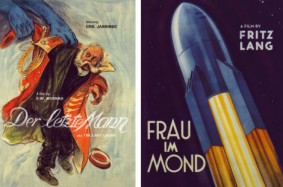
Eureka Entertainment has announced the UK release of two DVDs, F.W. Murnau’s Der letzte Mann (The Last Laugh) and Fritz Lang’s Frau im mond (Woman in the Moon). Both titles will become available on 21 January 2008. Below is some blurb from Eureka for each of the titles:

Der Letzte Mann (1924)

A landmark work in the history of the cinema, Der letzte Mann represents a breakthrough on a number of fronts. Firstly, it introduced a method of purely visual storytelling in which all intertitles and dialogue were jettisoned, setting the stage for a seamless interaction between film-world and viewer. Secondly, it put to use a panoply of technical innovations that continue to point distinct ways forward for cinematic expression nearly a century later. It guides the silent cinema’s melodramatic brio to its lowest abject abyss — before disposing of the tragic arc altogether. The lesson in all this? That a film can be anything it wants to be… but only Der letzte Mann (and a few unforgettable others) were lucky enough to issue forth into the world under the brilliant command of master director F.W. Murnau.

His film depicts the tale of an elderly hotel doorman (played by the inimitable Emil Jannings) whose superiors have come to deem his station as transitory as the revolving doors through which he has ushered guests in and out, day upon day, decade after decade. Reduced to polishing tiles beneath a sink in the gents’ lavatory and towelling the hands of Berlin’s most-vulgar barons, the doorman soon uncovers the ironical underside of old-world hospitality. And then — one day — his fate suddenly changes…

Der letzte Mann (also known as The Last Laugh, although its original title translates to “The Last Man”) inaugurated a new era of mobile camera expression whose handheld aesthetic and sheer plastic fervour predated the various “New Wave” movements of the 1960s and beyond. As the watershed entry in Murnau’s work, its influence can be detected in such later masterpieces as Faust, Sunrise, and Tabu — and in the films of the same Hollywood dream-factory that would offer him a contract shortly after Der letzte Mann‘s release. The Masters of Cinema Series is proud to present the original German domestic version of the work that some consider the greatest silent film ever made.

SPECIAL FEATURES

  • New, progressive encode of the recent, magnificent film restoration
  • Der letzte Mann – The Making Of – documentary by Murnau expert Luciano Berriatúa [41:00]
  • New and improved optional English subtitles (original German intertitles)
  • Lavishly illustrated 36-page booklet with writing by film scholars R. Dixon Smith, Tony Rayns, and Lotte H. Eisner — and more!!!

Frau im mond (1929)

Frau im Mond is: (a) The first feature-length film to portray space-exploration in a serious manner, paying close attention to the science involved in launching a vessel from the surface of the earth to the valleys of the moon. (b) A tri-polar potboiler of a picture that manages to combine espionage tale, serial melodrama, and comic-book sci-fi into a storyline that is by turns delirious, hushed, and deranged. (c) A movie so rife with narrative contradiction and visual ingenuity that it could only be the work of one filmmaker: Fritz Lang.

In this, Lang’s final silent epic, the legendary filmmaker spins a tale involving a wicked cartel of spies who co-opt an experimental mission to the moon in the hope of plundering the satellite’s vast (and highly theoretical) stores of gold. When the crew, helmed by Willy Fritsch and Gerda Maurus (both of whom had previously starred in Lang’s Spione), finally reach their impossible destination, they find themselves stranded in a lunar labyrinth without walls — where emotions run scattershot, and the new goal becomes survival.

A modern Daedalus tale which uncannily foretold Germany’s wartime push into rocket-science, Frau im Mond is as much a warning-sign against human hubris as it is a hopeful depiction of mankind’s potential. The Masters of Cinema Series is proud to present for the first time in the UK the culmination of Fritz Lang’s silent cinema, newly restored to its near-original length.

SPECIAL FEATURES

  • Brand new film restoration by F. W. Murnau-Stiftung
  • Original German intertitles with newly-translated optional English subtitles
  • 36-page booklet which includes a newly revised analysis by Michael E. Grost on the film, and on Fritz Lang’s body of work as a whole — and more!

Moonshine

Moonshine

Moonshine CD cover

Dedicated Bioscope watchers will know that I like a little jazz with my silents, and that earlier this year I reported on seeing American trumpeter Dave Douglas and his Keystone band playing music inspired (obliquely) by the work of Fatty Arbuckle at the Bray Jazz festival in Ireland. Well, blow me down if they haven’t produced a CD of the music, but it’s a live recording from the Bray concert itself, so you can hear me applauding in the background.

The CD is entitled Moonshine, which is of course the title of a 1918 film that Arbuckle made with Buster Keaton, probably best known for its much-imitated gag of having a seemingly endless procession of people pour out of a car. Douglas’ music is not really intended as accompaniment to Arbuckle’s films (it certainly doesn’t work in that way), and is more an expression of ideas inspired by Arbuckle’s work. As Douglas says:

But these pieces weren’t written as soundtracks, more as reflections on great forgotten absurdities like ‘Mabel and Fatty’s Married Life’ and ‘The Rough House.’ The bounce and bubble of those characters begged for a beat – shimmering shadows on the screen hinting at hidden crevices of texture and timbre. The songs reflect the atmosphere of those innocent/zany black and white images, refracted through a 21st century jazz sensibility, interpreted by an eclectic collection of gifted musicians.

Those musicians are Douglas (trumpet), Marcus Strickland (saxophone), Adam Benjamin (keyboards), Brad Jones (double bass), Gene Lake (drums) and DJ Olive (turntables and laptop – yep, its modern jazz, folks).

The CD is released on 27 November, but it seems it is available now as MP3 downloads. There’s more information on the Greenleaf Music site.

Douglas and Keystone have released two other CDs, Keystone and Keystone: Live in Sweden.

I’m seated ten rows back on the right, by the way…

Update: Arbuckle and Keaton’s Moonshine has just been posted on YouTube, with Dave Douglas’ ‘score’. Moonshine only survives in a regrettably fragmentary state, hence the gaps in the narrative and the abruptness of several shots. See what you think…

God kicks our backsides

It’s been a while since we had any poetry on The Bioscope. While browsing through the fine Old Poetry site, I came across by A.S.J. Tessimond (1902-1962), a British Imagist poet whose name, I’m ashamed to say, I’d not come across before now. This poem of his, entitled ‘Chaplin’, dates from 1934. It rather appeals to me:

The sun, a heavy spider, spins in the thirsty sky.
The wind hides under cactus leaves, in doorway corners. Only the wry

Small shadow accompanies Hamlet-Petrouchka’s march – the slight
Wry sniggering shadow in front of the morning, turning at noon, behind towards night.

The plumed cavalcade has passed to tomorrow, is lost again;
But the wisecrack-mask, the quick-flick-fanfare of the cane remain.

Diminuendo of footsteps even is done:
Only remain, Don Quixote, hat, cane, smile and sun.

Goliaths fall to our sling, but craftier fates than these
Lie ambushed – malice of open manholes, strings in the dark and falling trees.

God kicks our backsides, scatters peel on the smoothest stair;
And towering centaurs steal the tulip lips, the aureoled hair,

While we, craned from the gallery, throw our cardboard flowers
And our feet jerk to tunes not played for ours.

Not just Chaplin as beleaguered everyman, but Chaplin as Don Quixote, the person we all might actually be but would never want to be. Now that I like (though it’s a conceit that has occured to others). There are more of Tessimond’s poems on The Filter^ blog.

Pordenone On Screen

This evening BBC World Service radio is broadcasting an item on the Pordenone music masterclasses as part of its On Screen film programme. Every year at the Giornate del Cinema Muto there are masterclasses held on the art of accompanying silent films, in which aspiring silent film musicians work all week with the established musicians who accompany the films during the festival, with audience. It has become one of the most popular features of the festival.

The World Service programme was recorded during the festival, and features Pordenone regulars Donald Sosin, John Sweeney, Gabriel Thibaudeau and Neil Brand. The programme is being broadcast today, Wednesday 14 November at (GMT) 09.30, 19.30 and 23.30 and tomorrow at 02.30. It will then remain available online for a week. The item is 20mins into the 27mins programme.

It’s an encouraging item about the general rise in the popularity of silent cinema of late, and its affirmative tone is in marked contrast to the snide attitude revealed by that recent Today broadcast. I particularly like John Sweeney contrasting silent cinema with sound, arguing that the latter offers no sense of surprise, but the latter’s liveness is like going to the theatre – “if you weren’t there, you missed it”.

Harper’s Magazine

Harper's Magazine

Another day, another digitised historical journal. This time it is the American general interest monthly Harper’s Magazine, which has been going since 1850.

It has puts its archive, 1850-2007 online, arranged in a singularly helpful manner by rows of years, then months within each year. Articles come up with thumbnails images, title, author, hyperlinked keywords (very useful), and some lines of text marked by whatever keyword you may have used. I spotted numerous film references for the pre-1930 period, including eye-catching articles by Arnold Bennett, Homer Croy, George Bernard Shaw and editor William Dean Howells, plus literary references to the medium in short stories by figures such as Rudyard Kipling, Joseph Conrad and Henry James.

It is particularly elegantly expressed, but it does come at a modest price – $16.97, for a year’s subscription of the journal, which also entitles you to a year’s access to the archive site.

The Gold Rush

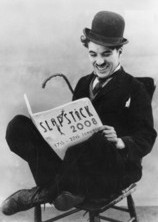
Slapstick 2008

http://www.slapstick.org.uk

We’re still awaiting full programming details for the Slapstick festival in Bristol, though we do at least have the dates – 17-20 January 2008. But meanwhile, tickets have just gone on sale for the festival’s gala event, a screening of Chaplin’s The Gold Rush, hosted by the ubiquitous Paul Merton, and the world premiere of Timothy Brock’s rescoring of Chaplin’s own score, played by the Emerald Ensemble. The evening also features a programme of comedy shorts, including Laurel and Hardy’s Leave ’em Laughing, with musical accompaniment from the no less ubiquitous Neil Brand “and international friends”, plus special guest Paul McGann. All this at Colston Hall, Bristol, on Friday 18 January, tickets £15, £12 conc., £5 for the under-twelves.

Motion Pictures: A Study in Social Legislation

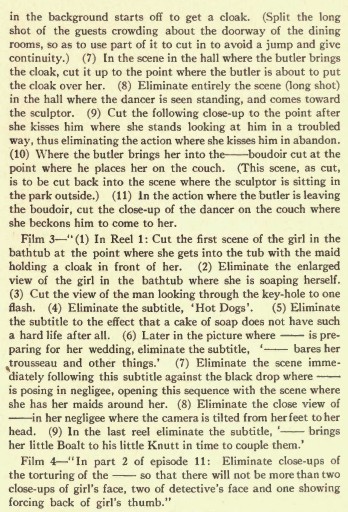
National Board of Review censorship recommendations

The above document contains some of the recommendations from the National Board of Review of Motion Pictures for cuts to be made to some unnamed films. Donald Young, later professor of sociology at the University of Pennsylvania, was no admirer of this private organisation which made censorship recommendations which were not legally binding and could be ignored locally. Young was the author of Motion Pictures: A Study in Social Legislation, now added to the Bioscope Library. Published in 1922, this PhD thesis must be one of the first doctorates to be awarded for the study of motion pictures.

Young’s subject is the influence of motion pictures upon the American people, particularly children. As a piece of supposedly scientific social investigation it is remarkably partisan. It takes as read reports conducted by various groups with an interest in the morals of society which found motion pictures to be generally pernicious in their effects, and comes down on the side of legalised state censorship (by 1922 eight American states had instituted film censorship laws). A National Board of Censorship, later the National Board of Review, had been instituted in 1909, but its recommendations carried no legal weight. This is therefore not the social study that it claims to be, but rather an expression of fear, albeit one that is artfully and authoritatviely expressed. Under the guide of social investigation, it looks for ways to control the medium whose malign tendencies are taken as a given.

The value of the text is firstly the period attitudes that it demonstrates, with the evidence that it calls on to support this. Secondly, it provides a rich picture of the various forms of municipal and state regulation that existed, their operations and aspirations. Thirdly, there are the several appendices with useful information, including the numbers of cinemas across America, state by state; figures for the importing of films from other countries; the rules of the British Board of Film Censors; the Standards of the Pennsylvania Board of Film Censors (the first US state to have censorship laws); and samples of eliminated scenes by the National Board of Review (as illustrated above). It is available from the Internet Archive in DjVu (3.1MB), PDF (9.4MB), b/w PDF (3.4MB) and TXT (232KB) formats.

Comedians on comedians

comedians.jpg

Paul Merton’s Silent Clowns, from http://www.bbc.co.uk/bbcfour

The television series Paul Merton’s Silent Clowns, first shown on BBC4, is being repeated on terrestrially on BBC2, with the first episode on Buster Keaton having aired this evening. Episodes on Chaplin, Laurel and Hardy, and Harold Lloyd are to follow. It was an engaging, unassuming production which simply wanted to put Keaton’s art first and foremost. It mostly took the format of one of Merton’s live shows, with Merton a lot of the time on stage giving short introductions before showing clips, Neil Brand at the piano, and audience laughing, all rounded off with the one complete film – in this case, The Goat (1921). I laughed heartily at gags I’ve seen a hundred times, and though it really only brushed the surface of Keaton’s comic gift, it must have left every viewer impressed with his art and many determined to check out more on DVD.

Merton is not the first television comedian to use his current popularity to pay homage to the silent comedians of the past. Bob Monkhouse in the 1960s presented a series, Mad Movies, which I can dimly remember, which introduced us to a wide range of silent comedians – not just the Keatons, Chaplins and Lloyds, but minor figures like Billy Bevan, Lupino Lane, Charley Chase, Larry Semon, Chester Conklin, Ben Turpin et al. I think the films all came from his personal collection. It gave us all a marvellous grounding in the names, the gags and the styles of the era (like Merton, Monkhouse explained to us how the gags and stunts worked). Then there was Michael Bentine’s Golden Silents, which was a multi-part, light-hearted history of the cinema, presented at the National Film Theatre, demonstrating as Merton does the great value of showing these films before an audience. You have to be laughing with someone really to appreciate the greatness of the silent comedians.

We were really lucky in the late 60s and early 70s – there was the intensive education in the art of silent comedy that we received from Monkhouse and Bentine, and we would be regularly treated to Robert Youngson’s compilations of comedy clips, such as The Golden Age of Comedy (1957), When Comedy was King (1960), Days of Thrills and Laughter (1961) and Laurel and Hardy’s Laughing 20s (1965). I’ve not seen them since that time, and I expected that the narrator’s interjections and the selectivity of the clips might irritate now, but at the time they helped rescue silent films from oblivion, and we watched them avidly. I can remember also that Chaplin shorts were a regular feature on early evening television – we were soon familiar with almost the entire oeuvre, and would lap up a rare new title with a collector’s fervour.

American TV also did its bit to keep the flame going for silent films in general. Jay Ward’s Fractured Flickers was first shown in 1963 and regularly syndicated thereafter. I’ve no memory of seeing it, but the approach seems to have been to take a rather satirical view of the films. Silents Please, first aired 1960, which used films from the Paul Killiam archive, was a more straightforward homage, and stood up very well when it turned up in some form or other in the UK in the 1980s in the early days of Channel 4. At least I assume it was the same series; someone might know.

Will silent comedies continue to amuse future generations? You have think that they have a good chance, indeed that it is verbal comedy that dates so badly, while there will always be something eternal about the silent art. But slapstick, however elevated a form it could be in the hands of the greatest practitioners, is not a form of comedy that is likely ever to return to the mainstream, and the clothes, the manners, the socio-cultural references, the black-and-whiteness and of course the silence will all inevitably confer too much strangeness upon this material for it ever to gain even the revival in popularity that Youngson and Monkhouse managed to conjure up. Or will artistry win out and will these films always retain a fundamental human appeal? Do we want to continue to admire them because they artistic, or because they are funny?

Brian Coe 1930-2007

Brian Coe

Brian Coe

It is sad to have to report the death of Brian Coe on 18 October 2007. To anyone with an interest in the history of the technologies of cinematography or photography his work over four decades has been, and remains, indispensible. He joined Kodak in 1952, where he helped found its education service. He made a particular impact with his writings in the early 1960s which forensically overturned the romantic myths which had seen William Friese-Greene chauvinistically championed as a pioneer of cinematography.

He was Curator of the Kodak Museum from 1969 to 1984, building up the collection to be one of international renown, and curating many pioneering exhibitions. When the collection moved to the National Museum of Photography Film and Television in Bradford, Brian became Curator at the Royal Photographic Society’s collection in Bath. In 1989 he joined the Museum of the Moving Image as special events co-ordinator, organising shows, events and organisations on an extraordinary range of topics, all underpinned by exemplary research and presented with enthusiasm, finding a perfect balance between scholarship and entertainment.

At Kodak he built up not only a great collection but considerable personal expertise, which found lasting expression in his many publications. The remarkable thing about his books is that they have not dated. Twenty or thirty years on they are still relied upon as standard reference works, notable as much for their clarity of exposition as their steadfastly reliable content. They include The Birth of Photography (1976), Colour Photography (1978), Cameras: From daguerrotypes to instant pictures (1978), and the incomparable The History of Movie Photography (1981). This is still the best book on cinema technology that exists, and it is hard to see how it could be bettered. It is particularly strong on early cinema technologies – magic lanterns, the optical toys and chronophotographic experiments of the so-called ‘pre-cinema’ era, the first cameras and projectors, the development of colour cinematography, early widescreen systems, the birth of home movies. Its illustrations have been plundered by countless other sources. Film archivists swear by the book – it used to be (and I hope it still is) standard reading for anyone working at the National Film and Television Archive’s preservation centre. Another gem is Muybridge and the Chronophotographers (1992), a small exhibition book reportedly thrown together in a great hurry, but a handy reference guide that I turn back to again and again.

Sadly Brian suffered a serious stroke in 1995, and took no further active part in the worlds of film and photography to which he had contributed such invaluable knowledge. It was a sad curtailment to a varied and richly productive career, recognised through such honours as his Fellowship of the Royal Society Arts, but leaving him little known to the general film enthusiast. Check out one of his books – they’ll be in the local library or second-hand book store. They look beautiful, and they wisely and reliably inform. Thank you, Brian.

The Twenties in Colour

Twenties in Colour

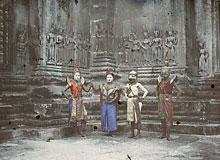
Dancers in ruins of Angkor-Vat, Cambodia, 1922 © Albert-Kahn museum, from http://www.ejumpcut.org

The promised follow-up series on Albert Kahn’s Archives de la Planète project, covering the 1920s, started on BBC4 this evening. The four-part series, The Twenties in Colour, follows on from the earlier series, The Wonderful World of Albert Kahn, in showing how Kahn’s team of still and motion picture photographers continued their task to make a photographic recod of the world. Included in the series is Paris after the Armistice, scenes in the Middle and Far East, and (I hope) some of the scientific-medical cinematography produced by Jean Comandon, who collaborated with Kahn in the late twenties.

Those who want find more about Kahn’s work, and web sources for Autochrome photographs etc, should go to the earlier post, Searching for Albert Kahn, which has the background story and a number of useful links.

Meanwhile, for those of us unable (or in my case, too idle) to get hold of BBC4, the original Wonderful World of Albert Kahn series is to be showing in re-edited, half-hour episodes form on BBC2, starting 16 November, at 19.30pm.