Birt Acres on CD

It is perhaps inevitable, given the different trajectories of the twin pioneers of British film, Birt Acres and Robert Paul, that while the latter gets the deluxe DVD treatment from the BFI (see previous post) with book to follow, his one-time partner and later bitter rival Acres has his biography published on CD from a small publisher for the interest of the select few. While Paul became a rich and successful man, noted in all film histories, Acres’ name remains little known, his work unfamiliar even to specialists in the field. Frontiersman to Film-maker: The Biography of Film Pioneer Birt Acres, FRPS, FRMetS 1854-1918, published by The Projection Box, is worth checking out by anyone interested in the earliest years of filmmaking, and in seeing how family history can be used to humanise people from this remote period of film history. The biography is written by Alan Birt Acres, his grandson, and tells the story of the man who was the first person to take and project a 35mm film in the UK. Not all of it stands up to rigorous historical enquiry, but it conjures up a credible picture of the man, is beautifully illustrated, and offers plenty of leads for those keen to research further the still mysterious roots of filmmaking in the 1890s.

Robert Paul on DVD

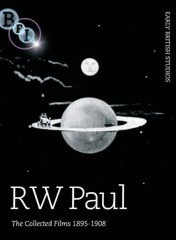
RW Paul

RW Paul DVD cover, from http://www.bfi.org.uk

The British Film Institute has published a DVD of practically all of the surviving films made by Robert William Paul, one of the leading pioneers of British cinema. R. W. Paul: The Collected Films 1895-1908 contains sixty-two films, including comedies, dramas, trick films, actualities from the Anglo-Boer War, Paul’s notorious film of the disastrous launch of HMS Albion in 1898 (notorious because Paul carried on filming after people had been knocked into the water, some fatally, though his boat picked up survivors), travel films from Spain, Portugal, Egypt and Sweden, and news footage of the 1896 Derby and Queen Victoria’s Diamond Jubilee through London on 22 June 1897. The DVD runs for 147 mins, with piano accompaniment by Stephen Horne, and a commentary and booklet by Ian Christie, whose book on Paul comes out later this year.

Podcasting Valentino

The Falcon Lair web site is dedicated to Rudolph Valentino (it gets its name from Valentino’s home). Apart from being a beautifully-designed site rich in information, it is the first and apparently the only site which offers podcasts on silent cinema. Its podcasts have included contributions from Emily Leider (author of Dark Lover: The Life and Death of Rudolph Valentino), Denis Doros and Kevin Brownlow, and they are expanding beyond Valentino to cover other silent cinema subjects. The next podcast will be Allan Ellenberger and Andrea Soares talking about Ramon Novarro, to be posted on 5 March 2007. All can downloaded via iTunes, and there is an RSS feed from which to subscribe to the service.

The Bioscope (continued)

Bioscope is a term for a film projector. Its first use in a moving image context precedes projected film. Hermann Hecht’s monumental Pre-Cinema History: An Encyclopaedia and Annotated Bibliography of the Moving Image Before 1896 records an 1852 reference to the stéréo-fantastique or Bioscope of Jules Dubosq, a combination either of the Phenakistoscope (Plateau’s spinning disk with images on its edge which when its mirror reflection was viewed through slots gave an illusion of motion) with the stereoscope, or the Zoetrope (using the same principle as the phenakistoscope but with the images on the inside of a drum) and the stereoscope. The effect was to produce moving, stereoscopic pictures.

On the cusp of projected film, in 1892 the Frenchman Georges Demenÿ patented a motion picture device he named the Phonoscope, which projected brief images from rotating glass discs. When the Phonoscope was marketed by Gaumont from the end of 1895, it was renamed a Bioscope. Also at the end of 1895 the German Max Skladanowsky named his projector a Bioskop, and gave the the first commercial presentation of projected film in Europe with it at the Berlin Wintergarten theatre on 1 November 1895.

In 1896 the American Charles Urban developed a projector with the engineer Walter Isaacs, which he named a Bioscope. When Urban moved to Britain in 1897 he brought the Bioscope with him. He built a successful business on the back of the Bioscope projector and the use of Bioscope as a brand, to the extent that for a while the word became synonymous with cinema itself. A version of the Bioscope c.1900 is illustrated in this site’s header.

More on the history and etymology of the Bioscope to follow…

Cinema Context 2

Special issue Tijdschrift voor Mediageschiedenis (TMG):

Cinema in Context

Last year, Dutch film historian Karel Dibbets launched the website Cinema Context (see post on February 10th), an on-line database of Dutch cinema culture. Cinema Context aspires to become a new standard among the digital reference sources, comparable to the Internet Movie Database which was put on-line in 1996 by film buff and computer freak Col Needham and which since then has become an indispensable source for millions of film lovers and scholars worldwide. Whereas IMDb mainly offers film production data, Cinema Context is a research tool for the study of film programming and distribution.

Dibbets launched his website during the Cinema in Context conference (Amsterdam, 20-21 April 2006), where several projects of the international research group Homer (History of Moviegoing, Exhibition and Reception) were presented. The conference addressed the urgent question of the future of film studies, in general, and film history, in particular. Anno 2006, film history proved to be in a dynamic but problematic phase. Which direction will we take in the coming years? Can we collaborate more and in which ways? How do we deal with the growing but very diversified digital sources? What will be their role in our future research? Which questions are pertinent and which technologies do we need? Lastly, have we reached the limits of our territory?

This special issue of Tijdschrift voor Mediageschiedenis (2006/2), edited by Ivo Blom and Wanda Strauven, documents the important debate of the Cinema in Context conference. It deals with burning questions such as local vs. national identity, film history vs. cultural geography, ‘factual’ history writing, consumerism, and the state and availability of film historical research. The issue contains the four keynote papers (in English) of the conference, and two Dutch contributions. All articles have English written summaries. The issue also contains a list of relevant websites.

Contents:

‘Cinema in context: het einde van filmstudies?’, by Ivo Blom & Wanda Strauven

‘The place of space in film historiography’, by Robert C. Allen

Cinema Context en onderzoek naar sociale netwerken binnen de filmgeschiedschrijving: een aanzet tot discussie’, by André van der Velden, Thunnis van Oort, Fransje de Jong and Clara Pafort Overduin

‘Het taboe van de Nederlandse filmcultuur. Neutraal in een verzuild land’, by Karel Dibbets

‘Just the Facts, M’am?’ A Short History of Ambivalence Towards Empiricism in Cinema Studies’, by Ian Christie

‘On the Prospect of Writing Cinema History from Below’, by Richard Maltby

‘Local cinema histories in France: An Overview’, by Jean-Jacques Meusy

You can order the Cinema in Context issue (€ 25 excl.) at Boom Publishers.

E-mail: m.siemons@boomonderwijs.nl

Address: Boom Publishers, Martine Siemons, Prinsengracht 747, 1017 JX, Amsterdam, The Netherlands.

Limelight and music hall

Limelight

http://www.amazon.co.uk

Chaplin’s “Limelight” and the Music Hall Tradition is a new publication, edited by Frank Scheide and Hooman Mehran. The collection of essays covers Chaplin’s film Limelight (1952) and the history of the English music hall. The book is the second in the ‘Chaplin Review’ series, the first of which – Chaplin: The Dictator and the Tramp – was published by the BFI in 2004. The second book has been published by McFarland, and a third volume is in preparation.

A synopsis of the life-work of Alfred West

The 1912 catalogue of the films of Alfred J. West, A Synopsis of the Life-Work of Alfred West, has been published online in PDF format by the Wessex Film and Sound Archive. Alfred West (1857-1937) was the man behind ‘Our Navy’ and ‘Our Army’, hugely popular multi-media shows comprising films, photographs, songs and dramas. West was active as a filmmaker from 1897-1912, based at Southsea, Hampshire, UK. His patriotic, militaristic and sentimental shows were popular across Britain and the Empire, and for many who came to see the shows they were their first experience of motion pictures. There is a website dedicated to West which is maintained by his great-grandson, David Clover, who has been instrumental in getting the catalogue published. The original is held in the British Library.

Update (August 2008): The weblink for the document has now changed to http://www3.hants.gov.uk/wfsa/wfsa-collections/navy-marines.htm.

Cinema Context

What is the finest film reference source on the Web, for all film let alone silent film? With all due respect to the Internet Movie Database, I think it is Cinema Context, a Dutch site created by Karel Dibbets and the University of Amsterdam. Describing itself as “an encylopedia of film culture”, the site documents film distribution and exhibition in the Netherlands in 1896. It does so through four data collections, on films, cinemas, people and companies, derived from painstakingly researched data on nearly all films exhibited in Dutch cinemas before 1960. The research team located film programmes from 1896 onwards in each of the major Dutch cities, entering all film titles, names, dates, cinemas etc, and then ingeniously matched this data to the records of these films on the IMDb.

The result is an incomparably rich resource for tracing films, the performers and the producers across time and territories, opening up whole new areas of analysis. Cinema Context also contains comprehensive data from the files of the Netherlands Board of Film Censors 1928-1960. As the site states: “Cinema Context is both an online encyclopaedia and a research tool for the history of Dutch film culture. Not only can you find information here about who, what, where and when: you can also analyse this information and study patterns and networks. Thanks to Cinema Context, we are now able to expose the DNA of Dutch film culture.” Naturally, it is available in both Dutch and English.

This is the new film research. Every nation should have the same.

The Bagman’s Bioscope

The word ‘bioscope’ next appears (see post on February 6th) in the title of William Bayley’s 1825 publication The Bagman’s Bioscope, an enertaining collection of anecdotes, stories, homilies and histories, described in the book’s subtitle as presenting Various Views of Man and Manners, Being the Points in Conversation in Commercial Room; Collected for the Use of Johnny Newcomes on the Road. A bagman was a travelling salesman. It was therefore presented as a handy collection of yarns for someone on the road to use. The use of the word ‘bioscope’ is not elaborated upon, so by this date it was presumably already understood to have a general sense of something that offered a view of life.

Where does the music come from?

Yet more from the indefatigable (if not indispensible) Neil Brand. He can be seen at the Barbican in London on Saturday 17 February, presenting a one-man show on the art of accompanying silent films with music, which is described as being “about music and film but also about storytelling, experience and laughter”. And then he turns up again on the Saturday playing piano to F.W. Murnau’s Sunrise (1927). The weekend is part of the Barbican’s Silent Film and Live Music series, which runs until June this year.